



By the time the 1991 All-Star break rolled around, the Braves' mildly Cinderella-esque run as a surprise contender had pretty much ended.
The young team that had been one of baseball's feel-good stories for much of the first half -- even spending some time in first place in mid-May -- limped into the break mired in an 8-15 skid that had dropped them under .500 for the first time in more than two months. But worse, they had dropped into third place and were 9 1/2 games behind the Dodgers in the NL West. And in the pre-Wild Card era, this signaled that they were well on their way to yet another season as a non-factor in the division.
There were other issues, too. John Smoltz, their hard-throwing righty and a former All-Star, went 2-11 with a 5.16 ERA in the first half and appeared on the verge of a demotion to the bullpen or the Minors. David Justice, the 1990 NL Rookie of the Year and one of Atlanta's most reliable run-producers, was out with a back injury and wasn't expected to return until late August. Sid Bream, a veteran lefty bat acquired in the offseason to help guide a young team, was also out until August after compiling an .833 OPS through June. So, despite Atlanta's first-half high points, there was little reason to see the Braves as a viable contender for the remainder of 1991.
But, of course, that's not the whole story. What happened next would change the direction of their season, their decade and their entire franchise as the Braves embarked on a remarkable second-half surge that that resulted in a historic worst-to-first season and took them all the way to Game 7 of the World Series. And, in a way, that surge has never stopped.
Thirty-five years later, it's easy to see that the modern Atlanta Braves -- the team with three-plus decades of consistent excellence, 21 division titles, six NL pennants, two World Series championships, multiple Cy Young and MVP winners, and seven Hall of Famers (so far) -- were born right after the All-Star break in 1991.
How do we know that? Because they started winning -- and winning a lot, despite improbable odds.
Collecting streaks
Atlanta won its first four games after the break in '91. That accompanied a four-game losing streak by the Dodgers. Suddenly, a 5 1/2-game deficit felt manageable.
The Braves closed July by winning 10 of their last 15 games and started a trend of collecting winning streaks. Four in a row here. Five straight there. Even an eight-game streak. One of their pitchers emerged as the NL Cy Young favorite. Ditto for one of their hitters and the MVP. Yet another player chased the 30-30 club. In other words, some of the best players in baseball were now found in Atlanta, all guided by the steady influence of manager Bobby Cox. Sound familiar?
Another now-familiar Atlanta trait emerged, too: The Braves just seemed to get the best out of everyone in that second half. Young players? Old players? Journeymen? They all contributed. Injuries? Slumps? Even a suspension? None of it mattered. The next man up seemed to always come through, the right buttons pushed with regularity. Winning became the expectation.
Ultimately, Atlanta went 55-28 in the second half of 1991, the best record in baseball, erasing that 9 1/2-game deficit and clinching the NL West title on the penultimate day of the season. It was their first division title since 1982, but it certainly wasn't their last. Season after season for the next 14 years -- highlighted by a World Series championship in 1995 -- the Braves followed a similar model that resulted in a new banner added to their stadiums' rafters and made them the envy of nearly every other MLB team. After that streak ended in 2006, the Braves still posted winning records 13 times over the next 19 seasons, including an additional streak of six straight division titles from 2018-2023 and a World Series title in 2021.
But it's unlikely any of that happens without the turnaround in the second half of 1991. And though the overall scorching nature of that stretch was what defined them, there were a handful of games in particular that proved critical to the outcome, given that the Braves ended up winning the division by a single game over the Dodgers. And though some of them have been largely forgotten in the 35 years since, there are no champagne celebrations without them.
Here's a look back.
July 12: Braves 6, Cardinals 2
Smoltz allows two runs over 6 1/3 innings, earning his first win in seven starts and essentially turning around both his season and his career as he embarks on an 12-2 second half and carries a 2.63 ERA the rest of the way. It can be argued that everything -- his game, his season and his career -- turns on a 3-1 pitch in the first inning. It can also be argued that this is the biggest development of the season, given the role Smoltz will play down the stretch and in October
July 31: Braves 8, Pirates 6
The Braves overcome a 6-1 deficit on the strength of a six-run fifth inning, highlighted by a solo homer from Deion Sanders and capped by Jeff Blauser's go-ahead three-run blast with two outs. Smoltz, who allows all six of the Pirates' runs, pitches five innings and still records the win. Big comebacks will become a theme down the stretch.
Aug. 21: Braves 10, Reds 9 (13)
In an epic back-and-forth affair in Cincinnati, the Braves trail by three runs with two outs and nobody on in the ninth inning against hard-throwing Nasty Boy Rob Dibble. But after a double from Justice and a walk from Brian Hunter, up steps Francisco Cabrera as the tying run. More than a year before Cabrera would have a much bigger moment with two outs in the ninth, he crushes an 0-1 hanger from Dibble for a three-run homer -- his second homer of the night -- to tie the game. Atlanta eventually wins in 13 innings.
Aug. 27: Braves 3, Expos 2
Riding lefty Charlie Leibrandt's 13 strikeouts over eight innings, the Braves pull out a one-run win against Montreal to fully erase their 9 1/2-game deficit and reach first place for the first time since May 17. One night later, a 3-1 win over the Mets puts Atlanta alone in first place, the latest in a season they'd been in first place alone since 1983. But the rollercoaster is just getting started.
Sept. 14: Braves 3, Dodgers 2 (11)
The back-and-forth NL West race has the Dodgers in front by a half-game entering this contest, which takes 11 innings before the Braves complete a comeback and vault back into first place on Ron Gant's walk-off RBI single down the left-field line. A Braves blowout the next day, highlighted by a Bream grand slam, gives them a little padding atop the division. Temporarily.
Oct. 1: Braves 7, Reds 6
Though all wins count the same, this is arguably the Braves' biggest win of the season. Down 6-0 after one inning, Atlanta claws its way back and enters the ninth trailing 6-5. Again facing the flame-throwing Dibble, the Braves have a runner on with one out when Justice launches a fastball into the right-field seats to put them up 7-6 -- a lead they'd hold to capture their fifth-straight win and, more importantly, keep them within a game of the first-place Dodgers.
Oct. 5: Braves 5, Astros 2
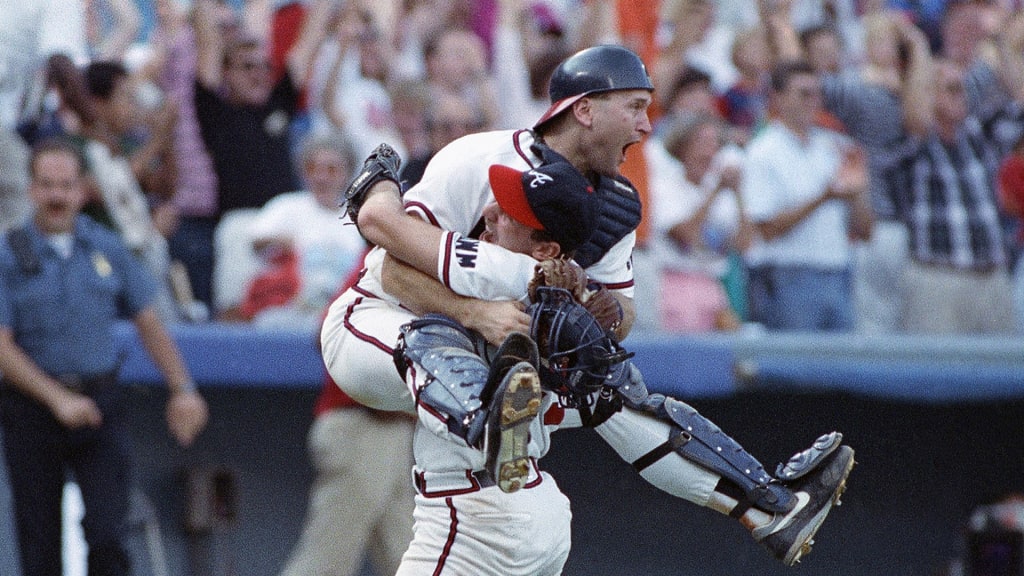
Thanks to their now-seven-game winning streak, the Braves enter the day in first place by one game over the Dodgers with two left to play. Atlanta jumps on the Astros early, Smoltz goes the distance and the Giants beat the Dodgers to clinch Atlanta's first division title since 1982 -- and the first of what would be 14 straight, setting the record for the longest streak of division titles in any professional sport.