



A good Major League starting pitcher has to figure out how to neutralize the platoon advantage. Zack Wheeler is a great starting pitcher. And over the years, he has gotten very, very effective at getting left-handed hitters out.
That is a big part of Wheeler's evolution over the course of his career. In his early years, he struggled against lefties. Now he dominates them.
That's one of the keys to Wheeler's continued success in 2026, even coming back from thoracic outlet syndrome surgery. The veteran leader of the Phillies rotation, who takes the ball Saturday against the Guardians at Citizens Bank Park, is 3-0 with a 1.99 ERA through his first five starts.
This season, Wheeler has faced 72 left-handed hitters and has held them to a .156 batting average and .470 OPS. Last season, he faced 336 lefties and held them to a .193 batting average and .632 OPS. Against Wheeler, stepping into the batter's box as a left-handed hitter is not much of an advantage at all.
"I always struggled against lefties, and I've been throwing against them for so long now, and teams can stack lineups with lefties," Wheeler said. "I had to figure out something."
But this is the beautiful paradox: Wheeler has figured out how to dominate lefties while simultaneously evolving in a way that, in theory, would make it harder for him to get them out.
Over Wheeler's five-plus years in Philadelphia, his arm angle has gotten more and more sidearm.
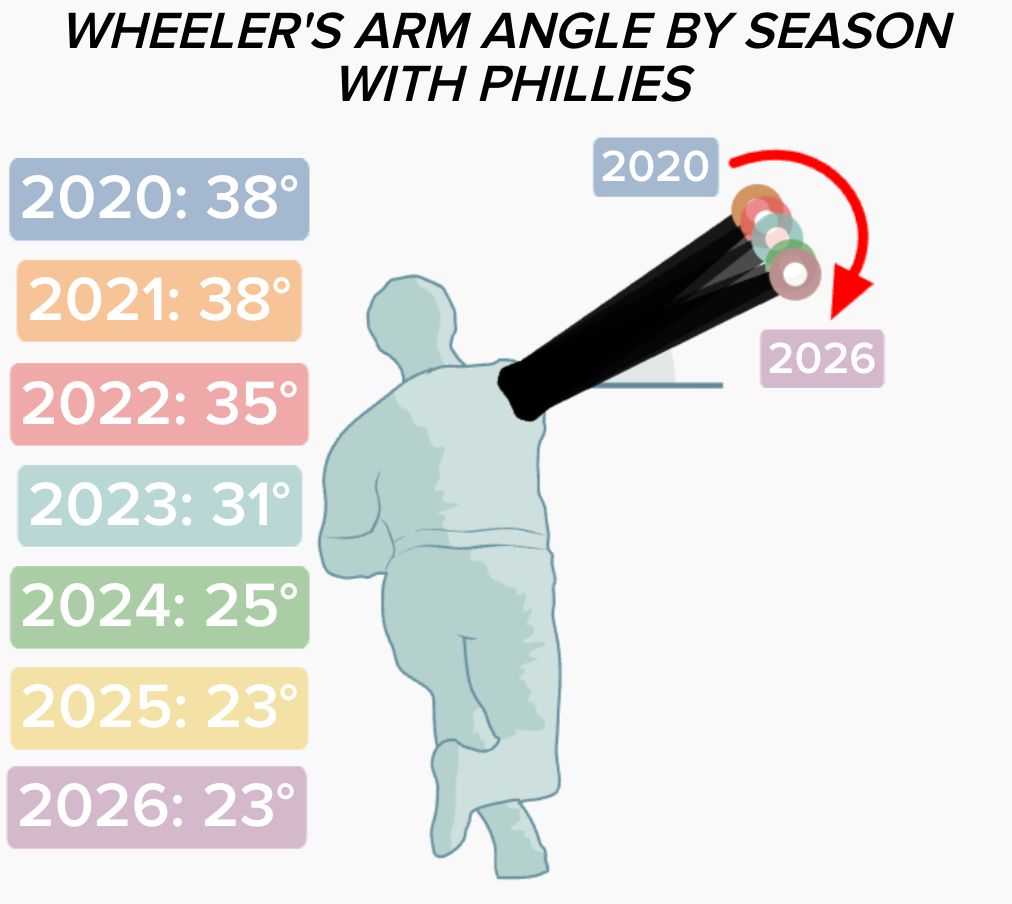
It happened incrementally, but a 15-degree drop in arm angle, even over five years, is a big change. By now, Wheeler has one of the lowest arm angles of any right-handed starting pitcher. Sidearming righties have a big advantage against right-handed hitters -- it's hard to pick up on a pitch that's being released from behind your back -- but they should have a disadvantage against lefties, who have a clear sightline on the ball traveling in toward the barrel of their bat.
RH SP with the lowest arm angles in 2026
- Emerson Hancock: 13 degrees
- Luis Castillo: 17 degrees
- Spencer Arrighetti: 19 degrees
- Aaron Nola: 20 degrees
- Logan Webb: 21 degrees
- Zack Wheeler: 23 degrees
(Zero degrees = perfectly sidearm. 90 degrees = perfectly over-the-top)
Instead, as Wheeler's arm angle has gotten to its lowest point, he's been at his best against lefties. We talked to the Phillies ace to find out how.
Here's a riddle that will help us get to the bottom of this: When is a change in arm slot not really a change in arm slot?
The answer for Wheeler: When it's really a change in body position.
"I didn't necessarily try to change my arm angle," Wheeler said. "I think my mechanics just got better."
Picture Wheeler's pitching arm as a tree branch sticking out of the tree trunk (aka, his body).
When the tree trunk is standing upright, the branch stays at one angle relative to the ground. But if the tree starts to topple to one side, the branch will point higher and higher into the air. The angle compared to the ground changes, even though the branch itself is still sticking out of the trunk the same way.
Wheeler used to pitch like a half-toppled tree trunk. He'd lean over toward the first-base side during his delivery, which in turn raised his arm angle higher. But over the last few years in Philadelphia, he's straightened his trunk. Wheeler's body is more upright in his delivery, which has pushed his arm angle down naturally.
"I think my arm slot's lower over the years just because I'm not throwing like this anymore," Wheeler said, leaning down to his left to mimic his old delivery.
"Now I'm more square to the plate, so my arm slot's down. So I fixed this, and now my arm's here" -- he straightened back up to show his new release point -- "rather than more over the top like that."
Wheeler didn't just wake up one day and say "I want to throw sidearm." What he actually decided was, "I want to drive straight at the batter."
Better mechanics, better results, no matter what type of hitter he's facing.
You can see it if you look at Wheeler's release points over the years. Pay attention to the slope of his shoulders. It used to be a lot steeper, with his left shoulder dipped down. Now those shoulders are much more level.
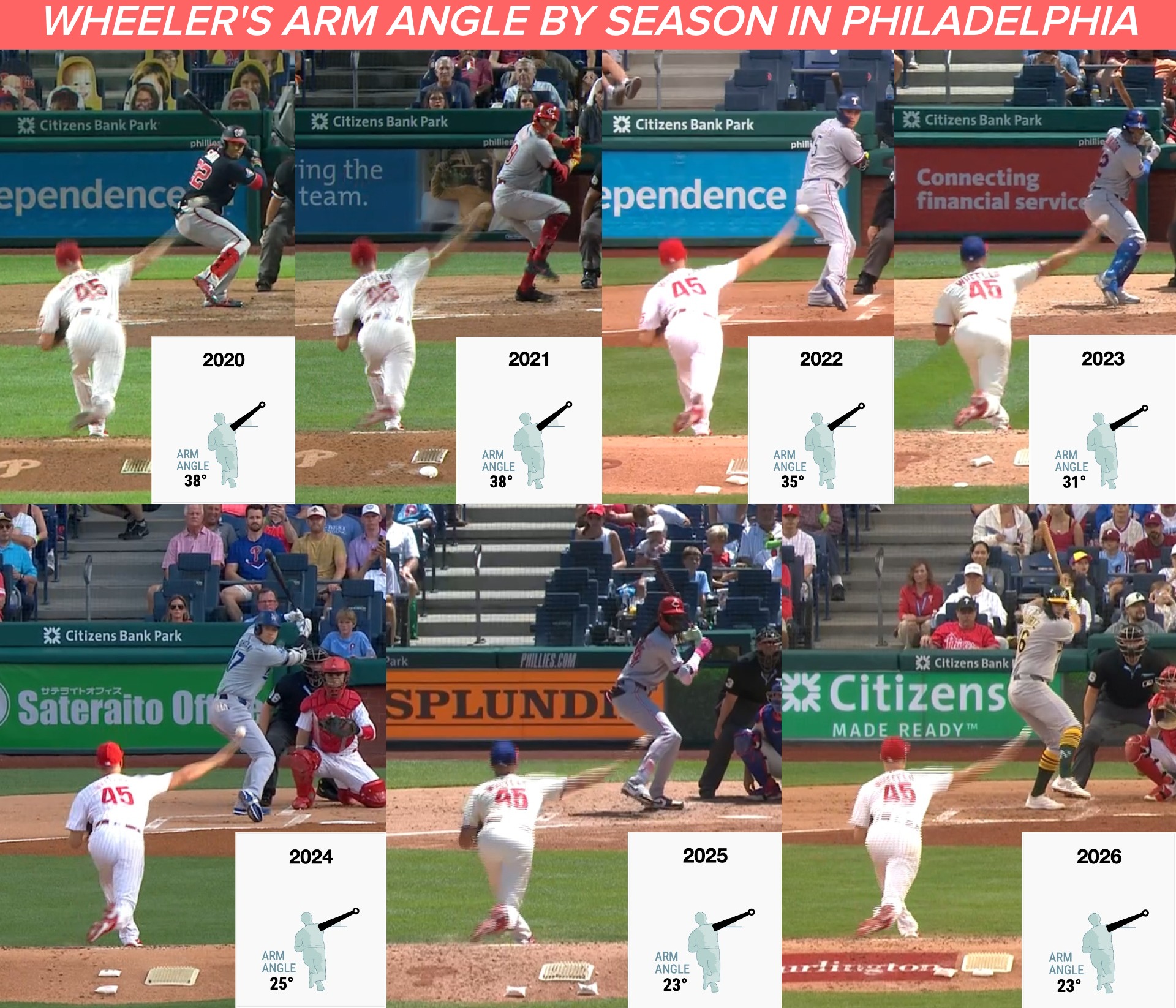
"I wanted truer stuff," Wheeler said. "So we made that adjustment, to come level. Because my shoulders are level, I'm probably behind the ball a little bit more, and the ball's going to stay truer if you're behind it. Rather than up here" -- he reached back up for a higher arm angle, with his shoulders tilted, to make the comparison -- "where it's a little more inconsistent.
"It's harder for you to be on time when you're trying to come this way [downhill toward the batter] and your body's flying this way [toward first base]. So now we're here, and everything's a little bit more in-sync."
So that's the mechanical side of things. But then there's also the plan of attack.
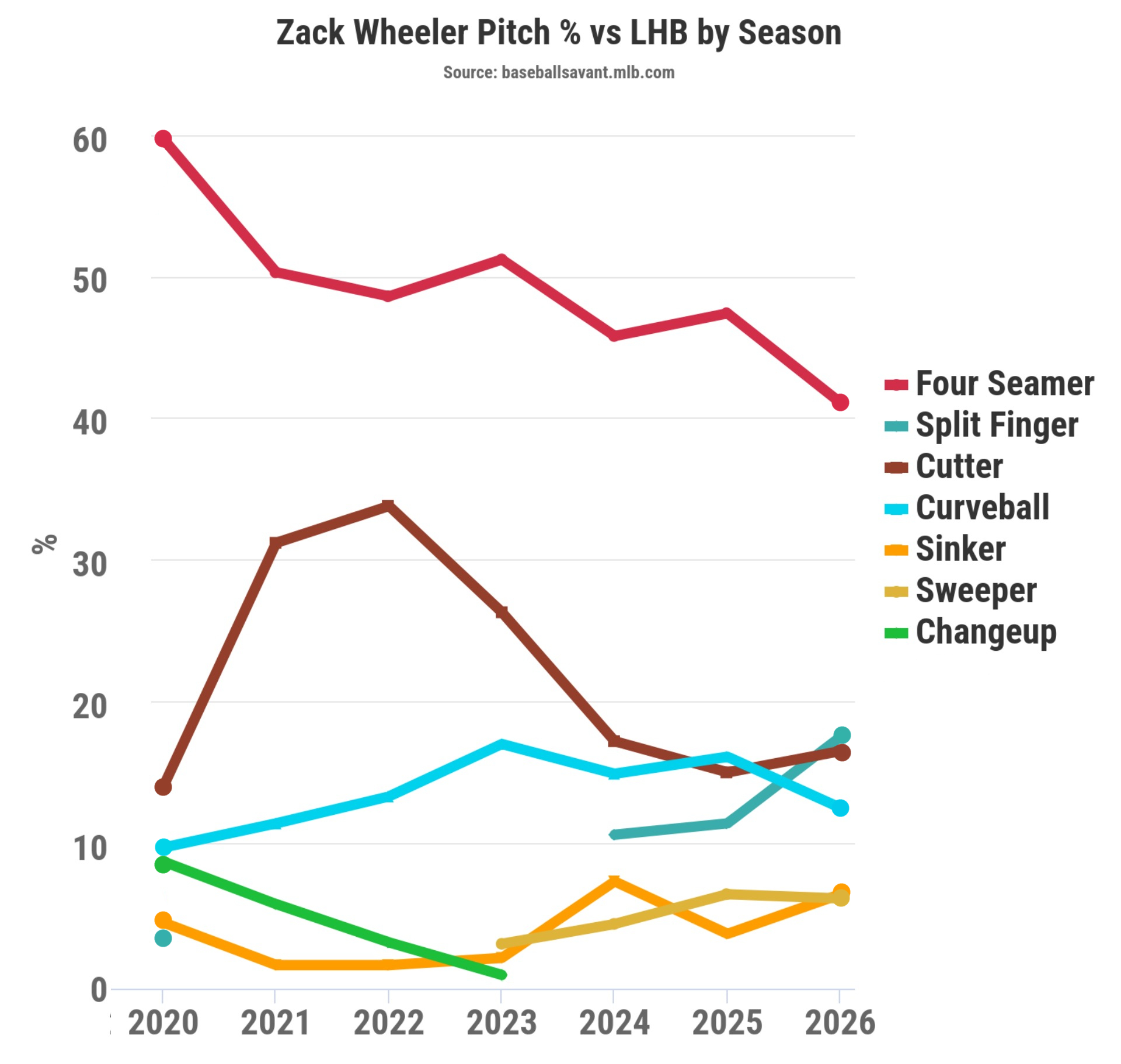
Wheeler's approach vs. lefties early on with the Phillies was fairly simple: Rip fastballs and cutters up-and-in, and then every so often sprinkle in a secondary pitch, usually a curveball.
Up until 2023, Wheeler's four-seamer and cutter would account for at least 75% of his pitches to lefties, sometimes upwards of 80%. Now, it's not like Wheeler was pitching badly at that time -- quite the opposite, he was usually a Cy Young contender. But he wasn't satisfied.
"Going into offseasons -- even in-season, but mostly in the offseason -- I'd hit up Caleb [Cotham], our pitching coach, and I'd say, 'Hey man, what can I do to get myself over that line of just being mediocre against lefties and good against righties?' And we just kind of changed the gameplan a little bit."
Starting in 2024, Wheeler started to diversify his pitch mix against lefties.
"Before, it'd be cutters and fastballs up-and-in, and maybe something down, but hitters would just foul that off and just battle, battle, battle," Wheeler said. "But now, I'm just changing it up just a little bit more. Introducing newer pitches and locations."
The biggest change: Wheeler added a splitter, which he's thrown with more and more confidence as he's tweaked it along the way. Wheeler's splitter usage vs. lefties has increased to 18% in 2026; it started out at 11%.
"I kind of brought it out and then had to tweak it here and there to make it into what I wanted," Wheeler said. "I think that's been a big key for me."
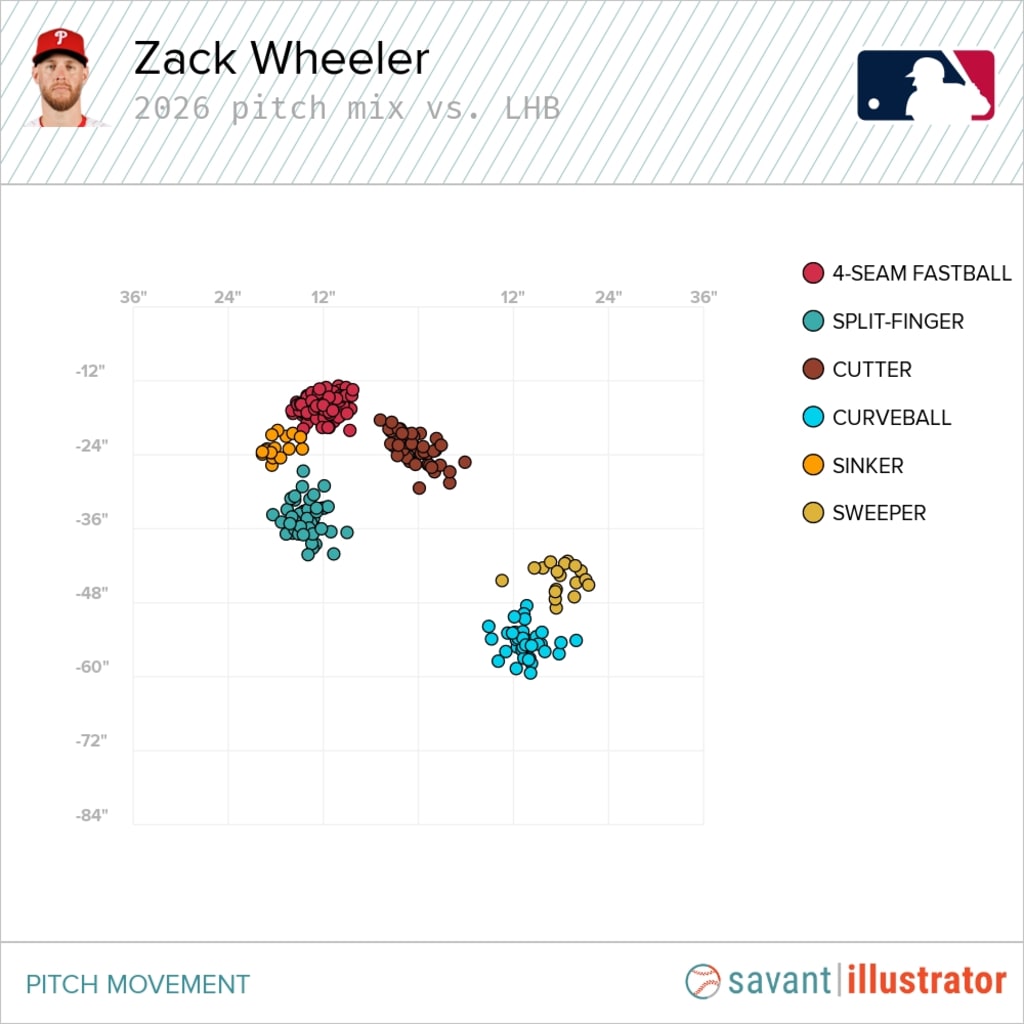
Wheeler's splitter is now his most-used secondary pitch against left-handed hitters, ahead of even the cutter this season. There are even some front-door sinkers, which the splitter has helped unlock (because the two pitches tunnel well together), and sweepers down-and-in, which is a new thing for Wheeler over the last couple of years.
Wheeler has more tools in his toolbox to get left-handed hitters out than he used to. He still throws those heaters and cutters up-and-in, and drops those curveballs down below the zone, he just throws a lot of other stuff, too. And his arm angle allows for a nice variety of movement on those pitches in his arsenal.
Since the start of last season, Wheeler has struck out 130 left-handed hitters. Only five other pitchers have K'd at least that many lefties: Paul Skenes, Dylan Cease, Gavin Williams, Jacob deGrom and Sonny Gray.
And Wheeler strikes out lefties at a higher frequency than all five of those guys. He's struck out 32% of the left-handed hitters he's faced since 2025, the highest K% for any pitcher who's faced as many lefties as he has.
Wheeler has been a beast from Day 1 in Philly. He's still a beast in 2026. He's just a beast that can make adjustments to stay a beast.