



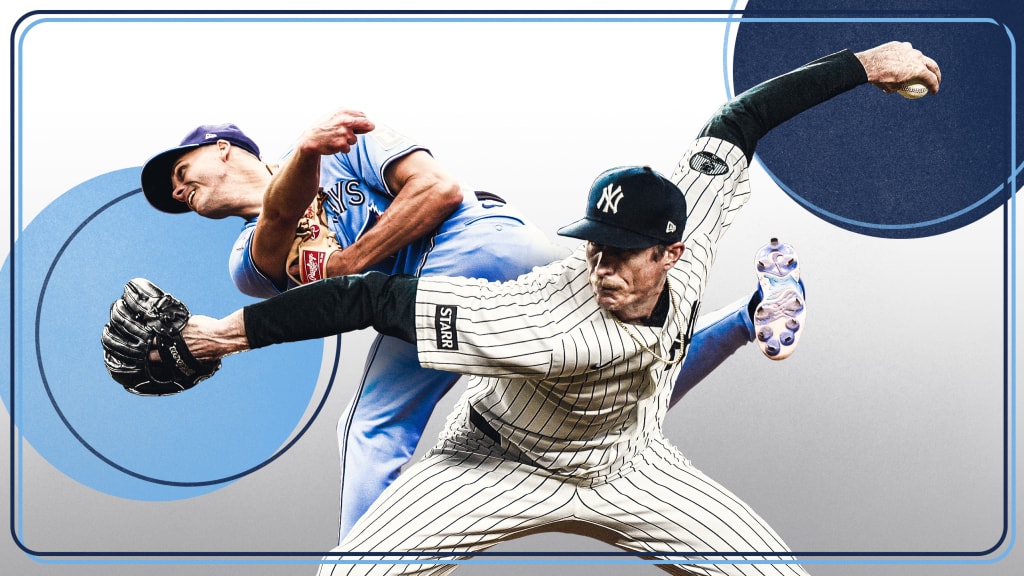
These days, pitching sure feels like it's defined by velocity, which continues to tick up.
But there's a small group of pitchers who don't rely on velo at all. They play baseball like it was first designed to be played.
In 1845, the New York Knickerbocker Base Ball Club spelled out the first surviving rules of baseball. They noted that "the ball must be pitched, not thrown, for the bat."
That's right. Everyone threw underhanded, a mandate that required the pitcher to throw with a stiff wrist and elbow. No one does this anymore, unless, well, you squint a bit. Then, you'll see that some players are still carrying the mantle. While they don't throw underhanded, they most certainly don't deliver the ball over the top, either.
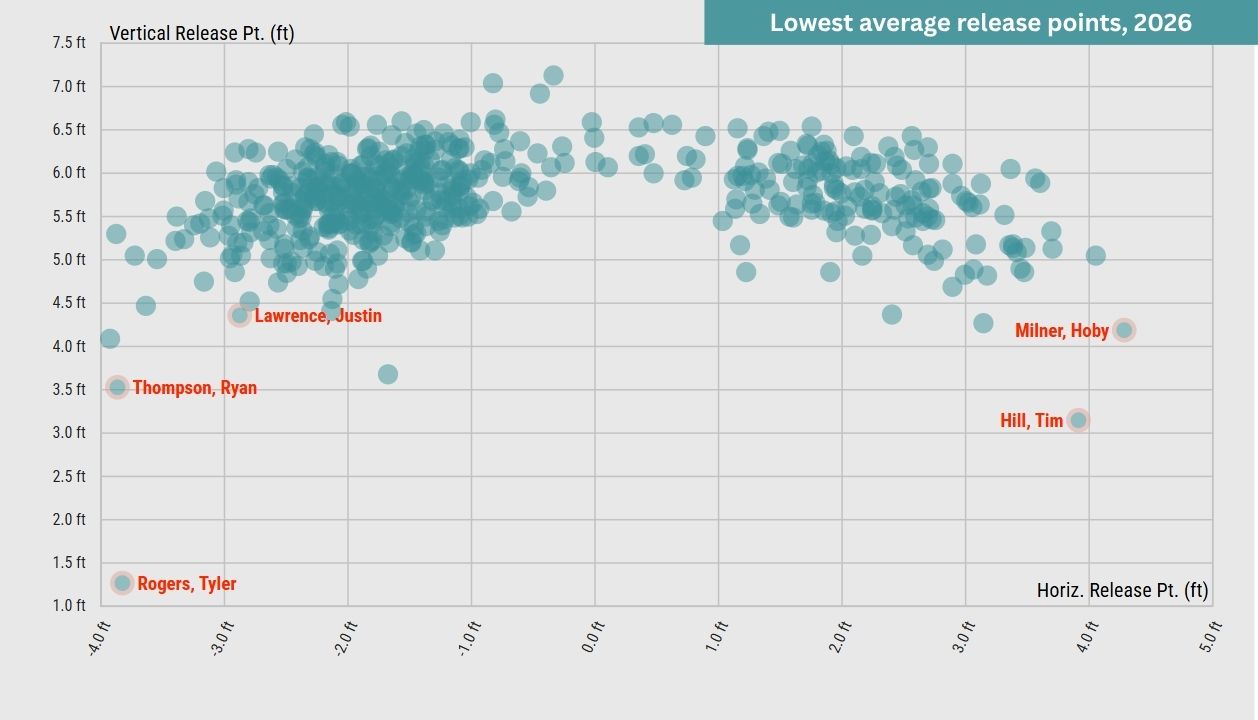
Pitching is fascinating because there are so many different ways to go about getting outs. For these few pitchers, that means throwing submarine-style or side-arm. It is undeniably weird. It also very clearly works for them.
Lowest average arm angle, 2026
Min. 250 pitches thrown
- Tyler Rogers (TOR): -61 degrees
- Tim Hill (NYY): -22 degrees
- Ryan Thompson (AZ): -13 degrees
- Hoby Milner (CHC): -5 degrees
- Kevin Kelly (TB): 1 degree
- Jose Cuas (KC): 2 degrees
- Justin Lawrence (WSH): 3 degrees
These quirky throwing motions can lend themselves to memes: Rogers, for example, is often compared to Marge Simpson. But these are not parlor tricks.
That got us thinking: How in the world does someone decide to throw a baseball like this?
As it turns out, the answer is pretty simple. There is no other way.
"If I threw over the top, I probably wouldn't be playing," said D-backs righty Ryan Thompson, a seven-year big league veteran with a career 3.67 ERA. "In this game, you can be different and it's a good thing. What makes me different is what makes me good."
Added Justin Lawrence, a six-year pro currently in the Nationals organization: "Once it happened, there was no going back."
But how did it happen in the first place? Over the course of the season, we spoke to a number of pitchers eschewing convention with some of the lowest arm angles and vertical release points in the Majors, hoping to get a better idea of what life is like on the other side of the pitching world.
Tyler Rogers (-61 degrees)
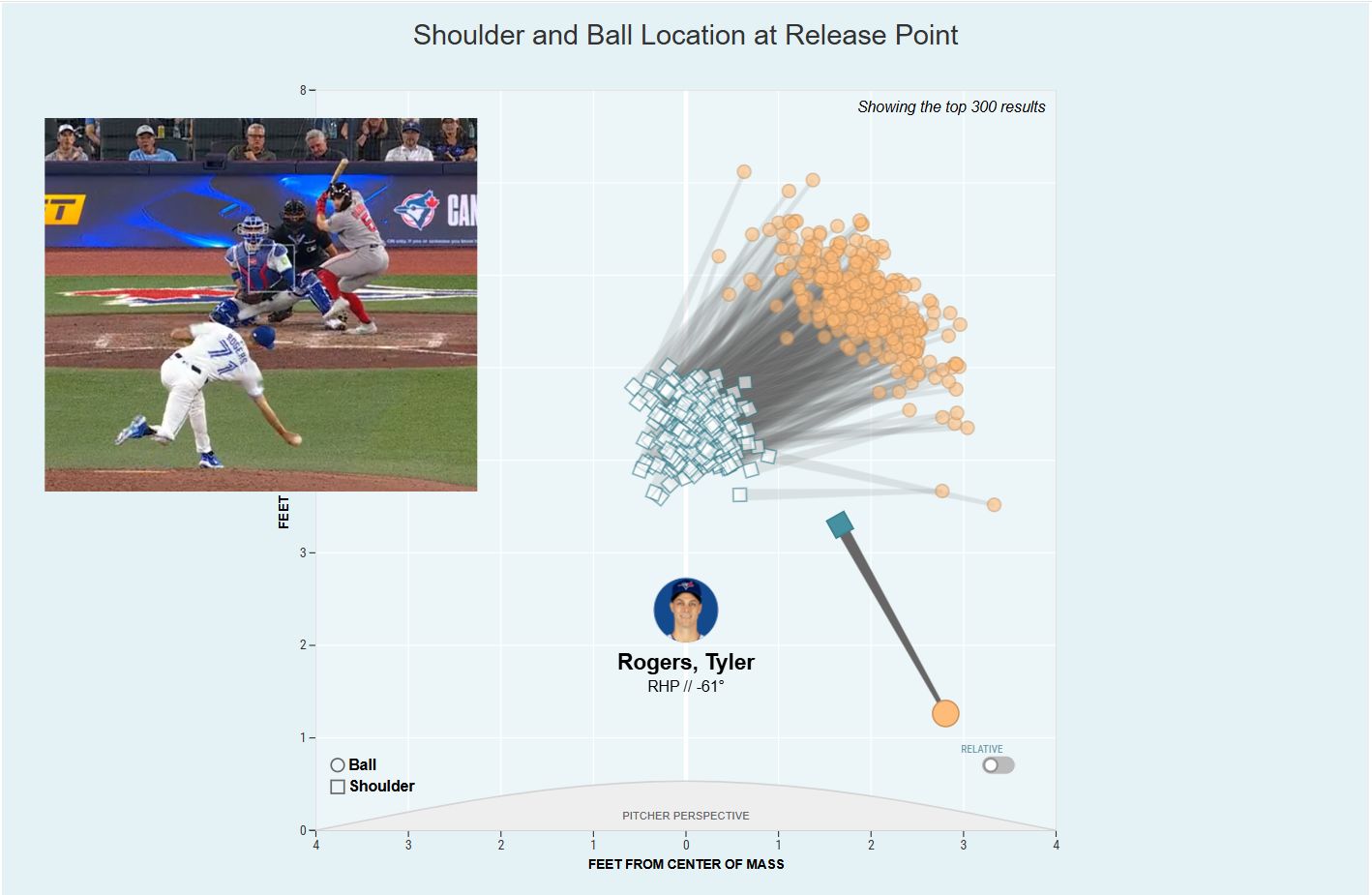
Rogers defies everything that we know about modern pitching. He has the slowest fastball in the game (83.2 mph) and uses a two-pitch mix. And yet, over the last six seasons, he's tied with Josh Hader as the second-most valuable relief pitcher in baseball -- largely because of the way he throws.
Rogers is the true submariner of the Statcast Era, which we've explored in depth before. His pitches have inverted movement, with a slider that rises and a fastball that drops. It's so wonky, and yet it's also not exactly new, because Rogers has been at this for his entire eight-year career. He is asked about it all the time. So, we wondered what people still don't understand about his one weird trick, all these years later.
"Most people probably don't realize that I throw the ball as hard as I can every single time," said Rogers, whose average fastball velocity is over 11 mph slower than that of the average right-handed pitcher (94.5 mph).
Early on in his freshman season at Garden City Community College -- a small JUCO school in Western Kansas -- Rogers struggled to get hitters out. The school's head baseball coach, Chris Finnegan, suggested that he drop down. "Throw like a shortstop," Finnegan told him. Rogers obliged.
"To this day, I don't know why I was so receptive to it," Rogers said. "I do think, though, that if you're going to make the change, you have to fully commit. It's not something that you can just dip your toe in."
Rogers sure hasn't. He has the lowest average release point of any pitcher in the Statcast Era (since 2015) by nearly a full foot. Statcast arm angle data dates back to 2020, and in that span, Rogers' arm angle has not crept above -59 degrees. He is remarkably consistent.
That doesn't mean it's been easy. Rogers developed his slider after randomly catching Darren O'Day on TV at a restaurant. Those are the sort of innocuous moments that submariners rely on, because few others know anything about the trade. Rogers has scratched and clawed to make things work.
Since the start of the 2020 season, he has appeared in 460 games. Only three other pitchers have appeared in more than 400 games in that span.
"At the end of the day, I love to pitch," Rogers said. "I'm going to want to be out there."
Tim Hill (-22 degrees)
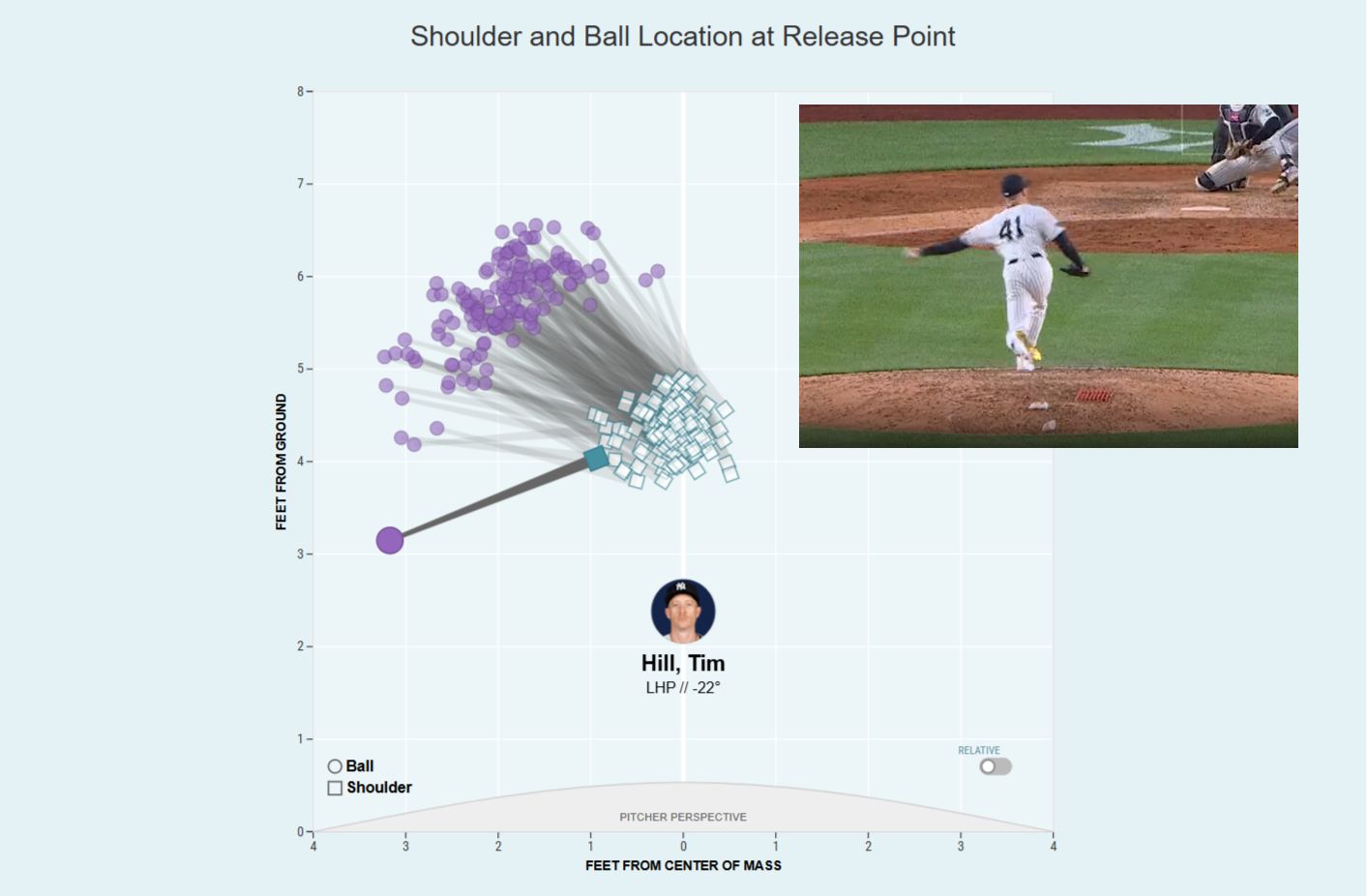
He's no Rogers, but among left-handers, Hill is unique. He has the lowest arm slot of any southpaw, releasing the ball more than a foot closer to the ground than the next closest pitcher.
Hill's backstory is unique, too. Unlike everyone else in this story, Hill did not switch his delivery at the suggestion of a coach or upon reaching a crossroads. It's all he's ever known.
"It's just kind of funny," Hill said. "I literally can't throw a baseball overhand. I've tried a million times."
Hill's unusually low release point maximizes his best pitch -- a sinker -- which he throws 82% of the time. It generates 41.6 inches of vertical drop (think downwards movement), which is third most of any qualified sinker. So, even though he throws it 88.3 mph, it still puzzles hitters, who are batting .228 against it.
The arm angle isn't something that Hill thinks about. Instead, it's more about what his lower half is doing -- and what it isn't.
"I don't feel like my arm slot is that low," Hill said. "It's more my trunk is tilted. So, I can't really keep my trunk stacked while I throw."
Ryan Thompson (-13 degrees)
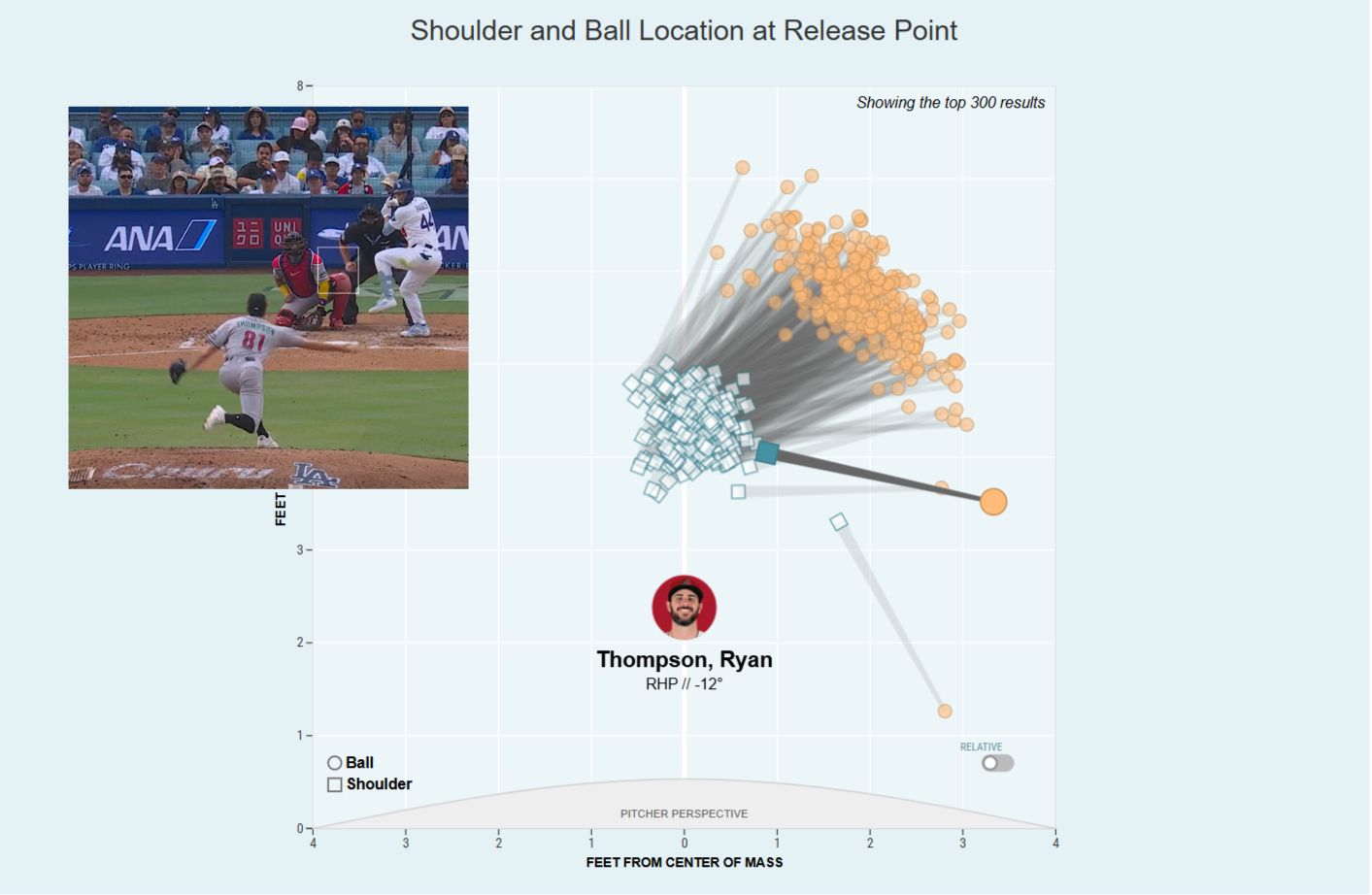
Growing up, Thompson emulated different pitchers who stood out for their unique qualities. He perfected El Duque's iconic leg kick. Byung-Hyun Kim's side-arm motion came next. He wanted to be different. But Thompson didn't see side-arm as a legitimate path until he attended a baseball camp at Western Oregon University while in high school.
"They watched my mechanics and were like, 'Man, it kind of looks like you're more of a naturally side-arm guy,'" Thompson said. "And I was like, 'Dude, I'm good at that. I can do that."
Thompson convinced his dad and later pitched his way into his high school record books. At college, Thompson's coaches hung strings around the plate and forced him to throw underneath them, teaching him how to clip the bottom of the zone. Sure enough, Thompson throws 24% of his pitches in the lower third of the strike zone, the highest rate of any pitcher to throw at least 500 pitches this season.
Thompson will still make tweaks to his mechanics, like any pitcher. "It's what keeps me around," he says. But much of this comes on his own accord. He does not emulate other side-armers, because there's still no perfect copy -- for example, he has more of an extreme elbow bend than most. Typical pitching drills may not apply to him, either. Instead, he pours over data on his pitch shapes and watches footage to assess his command.
He will never change his way. That's a good thing, because he doesn't really have a choice.
"Once, in a bullpen, a coach was like, 'Let's see how hard you can throw, let's see what this looks like over the top,'" Thompson said. "So I'm like, 'Yeah, let's do it.' I'm on video, I throw one over the top as hard as I can and the whole place starts laughing. I'm like, 'What's so funny?' I go over and look at the video and my arm angle was only four inches higher. It would take a lot of practice for me to figure it out, the proprioception of how to get my arm out there."
Hoby Milner (-5 degrees)
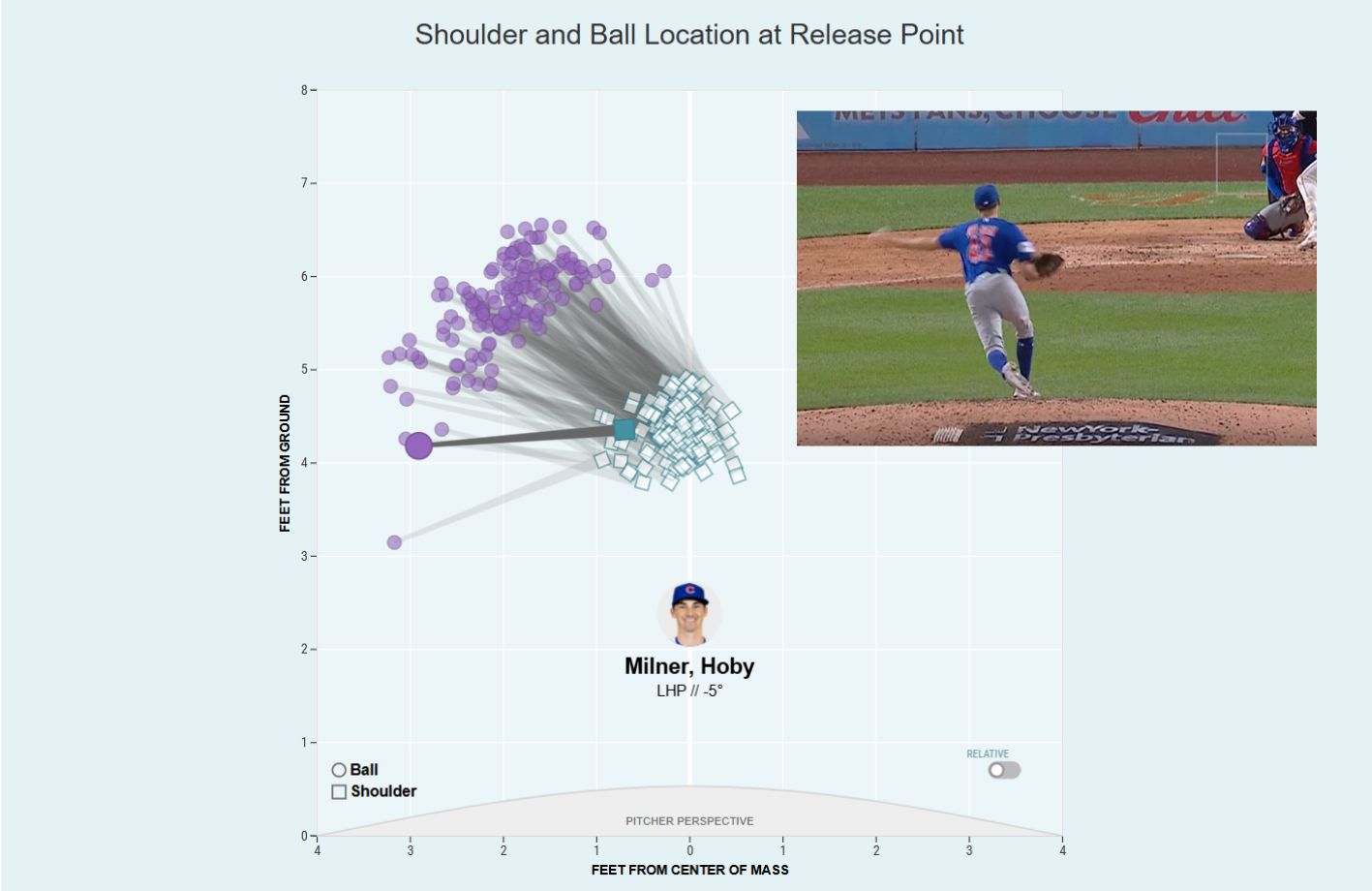
Milner did not switch to a side-arm throwing motion on the mound until 2015, when he stalled out in his second season at Double-A Reading. But Milner always threw sidearm while fielding ground balls. One day, after watching Milner during pitchers fielding practice, a coach asked the club's general manager if he could drop Milner down.
The GM gave the project the green light. Would Milner?
"It was a tough pill to swallow at first," Milner said. "I pitched a certain way my whole life, and that's how I envisioned myself making the big leagues. But the goal was to get to the big leagues, and it didn't matter how I got there."
Milner finished the Minor League season with a month-long stint as a sidearmer, then took his new motion with him to the Puerto Rican Winter League, only to realize everything was still out of whack when he showed up to Spring Training in 2016. So, he broke everything down, revamping his mechanics from square one. Only then did he get to the point where he needed to be.
Today, Milner mostly relies on a sinker/sweeper combo, along with a depth-y changeup. That's mostly typical of a sidearm pitcher. At one point, though the Phillies implored him to try a knuckleball -- a "backup, backup plan" -- because they liked its movement profile.
The experiment only lasted a month. Milner didn't want another label. But as for the other one? That's OK. He's never gone back from throwing sidearm.
"I throw everything from here," Milner said with a smile, showing off his slot inside the visitor's clubhouse at Citi Field.
Justin Lawrence (3 degrees)
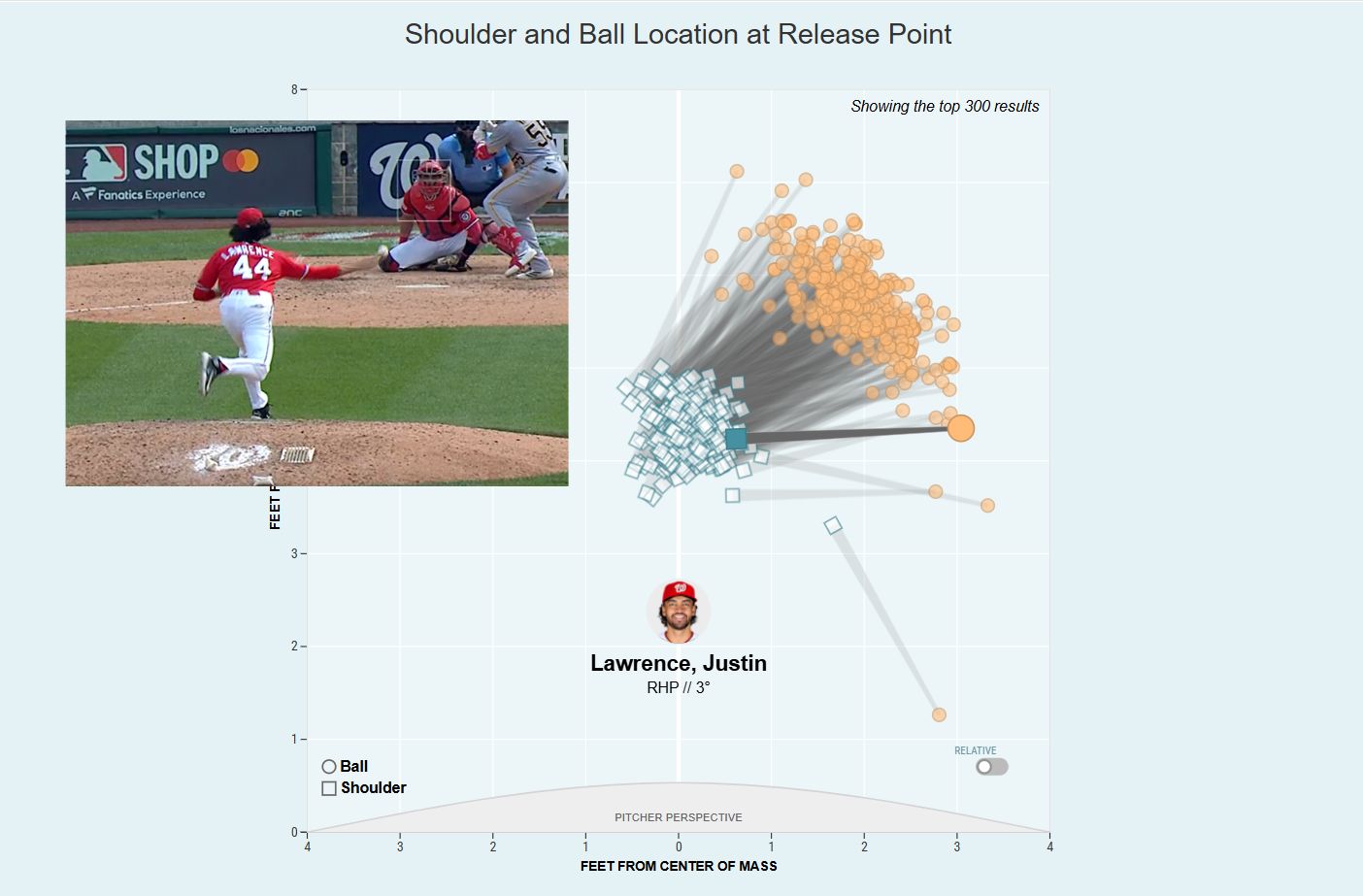
Of this group, Lawrence is more of your traditional side-arm pitcher. His arm angle is slightly above zero degrees, and he whips the ball to home plate.
Lawrence didn't play much as a freshman at Jacksonville University. Baseball, he said, started to feel like a distant dream. He dropped his slot down as a last-ditch effort to turn around his career. It took a while to train his mind.
"I would throw two or three pitches from a low slot, and then I would raise my arm slot if I got to a 2-0 count because I wanted to throw strikes," Lawrence said. "My coach would yell from the dugout, 'Trust it!'"
That trust came eventually, especially after a successful stint in the Florida Collegiate Summer League. Around that time, Steve Cishek was establishing himself as a legitimate leverage option in the Marlins bullpen, buoyed by a low side-arm delivery.
"I watched every video on YouTube about him," said Lawrence, whose pitch mix -- a breaking ball with two fastball shapes -- mirrored Cishek's.
Lawrence has one other feature that eludes most sidearm pitchers: He throws hard. Despite an average release height of just 4.32 feet above the ground, Lawrence throws his sinker 95.5 mph. Seattle's Emerson Hancock is the only other pitcher who throws their fastball 95+ mph from an arm slot of 10 degrees or lower.
Like the other sidearm hurlers, Lawrence recognizes that he is a part of a unique community. He tries his best to help the next generation, too.
“It’s funny because I don’t remember who it was, but I had reached out to a side-armer when I first got to the big leagues, and they never responded to me," Lawrence said. "Now I take it personally when a young guy does message me on Instagram. I’ll take the time to respond to all of those guys about it.”
MLB.com Blue Jays reporter Keegan Matheson contributed to the reporting of this story.