



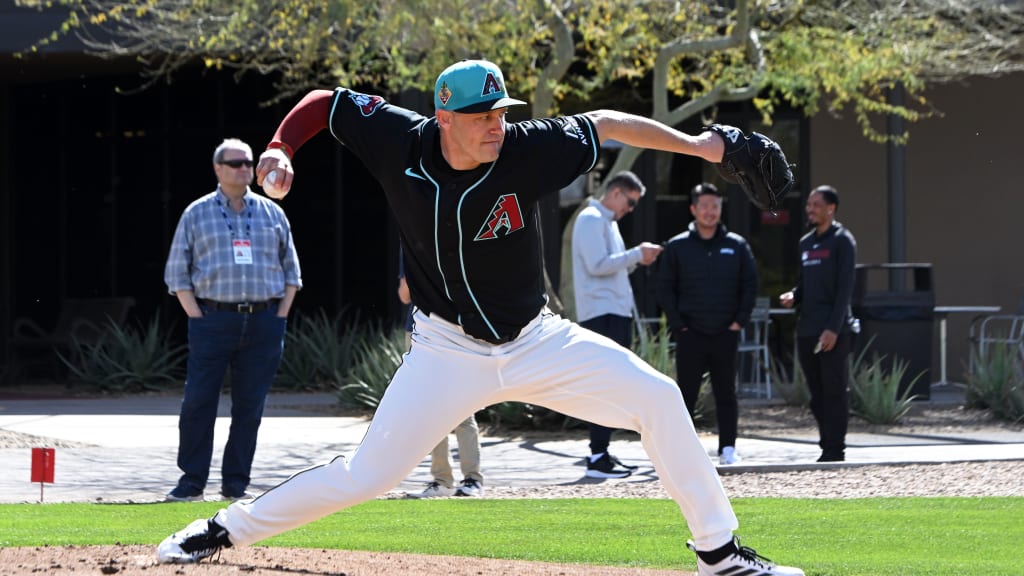
This story was excerpted from Steve Gilbert's D-backs Beat newsletter. To read the full newsletter, click here. And subscribe to get it regularly in your inbox.
There were times during Spring Training with the Guardians last year when Paul Sewald would throw his four-seam fastball as hard as he possibly could and then turn around to look at the velocity posted on the scoreboard and see 90 mph.
"I was just like, 'What?!'" Sewald said.
Sewald didn't think there was an injury involved, though he did have a couple of injury issues as the year went on, so who knows? But he was sure that it would be hard to survive in the big leagues if his fastball was topping out at 90 mph, so he had to do something.
Since he had moved to the Phoenix area and needed a new place to train, Sewald went to Driveline Baseball, which has helped many pitchers find extra velocity on their fastballs.
"They don't know everything about everything, but they've had a lot of success with guys," Sewald said. "And I thought, in general, the most important thing for me is I wanted a coach to watch every rep."
Sewald put in the work day after day during the offseason, and he knew he had made progress, but nothing can match seeing results in an actual game. So when Sewald took the mound for his first spring outing with the D-backs on Feb. 28 against the Angels and touched 92.6 mph with his first fastball, there was a feeling of relief.
"It gives me a ton of confidence," Sewald said. "One, that the work I put in this offseason, you see results. It's really tough to continually put in the work if you're not seeing results. That's the same for people on a diet, people trying to do anything. You want to see the results of the hard work you're doing.
"I'm never going to be a hard thrower, but 92 versus 90 is a gigantic difference. I had been one of the best pitchers in baseball when I averaged 92."
The Diamondbacks remember that version of Sewald well.
Acquired from the Mariners at the Trade Deadline in 2023, Sewald was the closer Arizona lacked, and his presence allowed everyone to stabilize in their setup roles. The back end of the bullpen over the final two months -- consisting of Sewald, Kevin Ginkel, Ryan Thompson and Andrew Saalfrank -- got on a roll and led the Diamondbacks to the World Series, where they fell in five games to the Rangers.
Not coincidentally, Sewald's four-seam fastball averaged 92.2 mph that year as opposed to 90.4 mph last season, per Statcast.
Flash forward to this past offseason, and Diamondbacks general manager Mike Hazen was searching for help at the back end of the bullpen once again.
Knowing that Sewald was throwing at Driveline, Arizona scouts kept their eyes on his progress during the winter.
"We didn't really know where our search was going to go earlier in the offseason," Hazen said. "We were kind of focusing on some other bullpen targets -- some trade, some free agents -- that didn't work out. And then, when we felt like we had a spot open, we made the decision to sign him."
Sewald was signed to a one-year, $1.5 million deal on Feb. 14 just after camp opened.
Manager Torey Lovullo said at the time that Sewald would have to earn a leverage role in the wide-open bullpen competition. The skipper has been very pleased with the uptick in Sewald's stuff so far this spring, and his history of having done it certainly works in his favor.
Lovullo's comfort with Sewald, and Sewald's familiarity with the Diamondbacks, played a role in their decision to sign him and his decision to turn down other offers.
"There were other options," Sewald said. "The most important thing I can possibly do this year is be healthy and pitch -- and what's a better place to do that than here, where I live? I can sleep in my own bed. There's just a lot less stress and moving parts being here."