




Jake Bauers seemingly came out of nowhere in his breakout 2026, but also, at 30 years old and more than a decade into his pro career, it was a long time coming.
Prior to joining the Brewers, Bauers had spent years cycling through the systems of (among others) the Rays, Guardians and Yankees. In other words, a number of the organizations that are perceived to be the smartest in the game kept seeing something they liked in him, even if the production wasn’t quite there.
They weren’t all wrong, as the saying goes. Just early.
Bauers got nearly 1,800 plate appearances in the bigs between 2018 and '24, and his paltry line of .208/.302/.361 in that time – to go with relatively limited value on the bases or in the field – made him one of the least productive players in the game during that span. Usually, that’s enough to end a career. But he kept getting chances, and eventually it paid off for Milwaukee, which rode his success to the franchise's first title. Now the Red Sox are banking on that breakout being real enough now to justify a four-year contract.
What interests us today is all the chances Bauers got before he figured things out. A first baseman/corner outfielder who doesn’t hit or provide value with the glove isn’t a very useful player at all, and most of those types don’t stick around long enough to even get the opportunity to have a late-career breakout. But Bauers did, as teams kept hoping they could transform his underlying skills into performance.
Again, having all of those skills didn’t lead to success then and there; it just kept the promise of them alive. It took Bauers years of failure, a new mindset, a changed training regimen, an entirely different batting stance, and a dalliance with retirement to get to where he did. The skills just earned him the chances.
But if we can try to see what teams liked about him back then, maybe we can try to answer a more interesting question: Who is the next Bauers? We can’t possibly find someone with exactly the same career path, but maybe there are some hitters out there with similar profiles who haven’t quite had it all click yet.
At the most basic level, a Bauers scouting report would read something like this:
- He swings the bat very fast. His 76.5 mph average bat speed last season ranked in the 93rd percentile.
- He has excellent plate discipline. His chase rate (93rd percentile) and walk rate (98th) were elite.
Swing the bat fast, don’t chase bad pitches. It’s not as simple as that, because Bauers has long been good at these things and wasn’t actually good, so there’s more to it than this. But it’s a great place to start, too. It’s what keeps those chances coming, hoping changes lead to production, similar to the mediocre pitcher throwing 99 who keeps finding a spot in a bullpen.
If you put chase rate and bat speed over the last two seasons on a plot, you’ll get a very busy chart, but you’ll also get Bauers down there in that elite corner surrounded by names like James Wood, Kyle Schwarber, Nick Kurtz, Aaron Judge, and Vladimir Guerrero Jr. (the 2025 version, anyway).
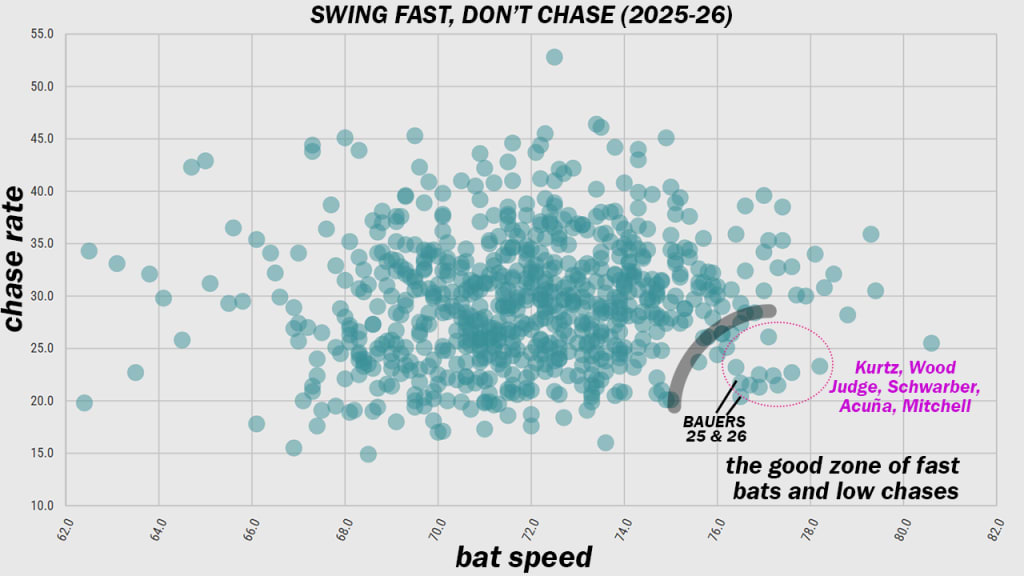
Bat speed and plate discipline are, for the most part, things that can’t really be taught at the Major League level. You can make improvements on each, to be sure, yet it’s incredibly rare to see either one massively change for the better – and it’s that combination that kept teams interested in Bauers.
It’s why Brewers general manager Matt Arnold said of Bauers back in November 2023: “He's a really interesting bat that we're happy to have." (That was after a year in which Bauers posted a well below-average 87 OPS+ for the Yankees.) It's why Yankees manager Aaron Boone said Bauers was “a very interesting player moving forward” that summer. Not wrong, again. Just early.
Bauers turned all this into some very damaging contact. A "barrel" is the perfect combination of exit velocity and launch angle, and last year:
- Bauers' 14% barrel rate was in the 92nd percentile – near where it was in 2025, too.
So: Who might be the next Bauers? That’s the question every team wants to know, because unlike the actual Bauers, that next version may be freely available.
What we're looking for here is hitters who have plus bat speed and strong plate discipline, yet haven’t quite broken through yet. These are the kinds of guys where the baseball card stats might say there’s not much happening here, yet the underlying skills suggest they should get another chance (or two).
It’s not about a player bouncing through a lot of organizations, like Bauers did, because that’s too narrow. It’s about hitters who may yet give you reason to hope. It's the Max Muncy theory, a decade later.
If we look at hitters with a minimum of 200 plate appearances over the last three seasons and find the most similar to the 2023-25 version Bauers in terms of chase rate, barrel rate and bat speed, you’ll find stars such as Judge and Mike Trout, as well as promising youngsters such as Roman Anthony. If not for the fact that he just had a strong season after years of injuries, then Bauers’ now-former teammate Garrett Mitchell might have been the first name we listed, because his hitting profile is similar.
Established players aren’t really what we’re looking for, though. So, let’s restrict this to players between 25-31 (to remove those just getting their feet wet, as well as those who may have missed their window) who have also been below-average hitters (which is simply an OPS+ under 100).
By that method, then, the five most similar players to pre-breakout Bauers are as follows … and if this list doesn’t impress you, that’s the entire point. We’re finding the next Bauers (if one even exists), not the one who just broke out. Imagine what you’d have said if Bauers himself had been on this list a year or two ago.
OF Jack Suwinski (age 28, Rays)
3-year percentile ranks: 96th (chase rate), 79th (bat speed), 73rd (barrel rate)
The closest comparable here, Suwinski had his moments in four seasons with the Pirates, mostly in a solid 2023 campaign in which he hit 26 homers and posted a 113 OPS+. But it was bad in 2024, then worse in 2025, when he combined for -1.8 WAR over those two seasons, leading to him being cut free last spring when the team needed a roster spot for Marcell Ozuna. Even in 2025, though, Suwinski had paired essentially Juan Soto’s chase rate with well above-average bat speed. It’s the Bauers starter kit.
You might be able to see this happening already just by looking at the transaction logs. When the Pirates cut him free, the Dodgers claimed him off waivers, worked on some swing changes, then saw him hit 21 homers with production 36% higher than average in Triple-A. When catching injuries popped up, that waiver claim turned into him being traded to Tampa Bay in a deal that returned catcher Hunter Feduccia. Following the season, the Rays retained him by adding him to the 40-man roster.
Simply being employed by the Dodgers and Rays guarantees you absolutely nothing, and neither gave him a Major League plate appearance in 2026. But it’s at least a badge of respect that two of the best-regarded organizations in the Majors saw something they liked, and even not playing in the bigs this year at 27 has an echo; after all, Bauers spent his entire age-26 season in the Minors.
OF Will Benson (age 28, free agent)
3-year percentile ranks: 83rd (chase rate), 60th (bat speed), 93rd (barrel rate)
Benson, somewhat like Suwinski, had a very good 2023 (128 OPS+) but hasn’t done a whole lot since, posting an 82 OPS+ over the last three seasons while bouncing back and forth between the Majors and Triple-A. He was outrighted over the summer, and declared free agency after the season. So that’s not great, but it also wasn’t that long ago that he was winning NL Player of the Week by mashing five homers in four games, either, claiming it was in part due to a tip from former Reds great Eric Davis.
As will be a recurring theme here, the strikeouts got out of control. Benson swings plenty fast, and in fact the three-year 60th percentile ranking sells him short a little; he’s added more than 3 mph since 2023, and last year he was swinging as fast as Yandy Díaz. But he’s added more tilt to his swing along the way, and it’s not that hard to see some organization helping him to keep the speed while flattening the swing for more contact just a little.
OF Taylor Trammell (age 29, Astros)
3-year percentile ranks: 66th (chase rate), 95th (bat speed), 78th (barrel rate)
If you’re looking for a Bauers-esque career path, then Trammell certainly qualifies. A first-round pick by the Reds a decade ago, Trammell bounced through the Padres, Mariners, Dodgers, and Yankees organizations before landing with the Astros prior to 2025. In scattered play over the last two seasons, he’s hit .194/.288/.339 for Houston. It’s not great.
Trammell can run, and play a competent corner outfield, and when he really gets into one, well, it’s easy to see what’s so appealing when a guy can make a baseball look like this:
His career walk rate of 11% is excellent, but the problem here is a simple one: He strikes out a lot, a career 34% of the time through his age-28 season. That’s a little more than Bauers had at the same age (29%), and while the bat speed remains outstanding, the chase is closer to “good” than “great,” and maybe that’s enough of a difference to hold him back. In parts of five Triple-A seasons, Trammell has a strong .266/.383/.505 mark, and maybe “a Quad-A type” is what he’s destined to be. Then again, that’s what Bauers was, too. Maybe that’s a good sign.
(Three other 2026 Astros all popped up lower down our list: Nelson Velázquez, Zach Dezenzo and Brice Matthews. Maybe they have a type.)
INF Brett Baty (age 27, Mets)
3-year percentile ranks: 59th (chase rate), 90th (bat speed), 77th (barrel rate)
Back in 2019, Baty was the No. 12 overall pick by the Mets out of high school, and he’s spent parts of five seasons with the team being occasionally interesting but mostly frustrating. Once considered to be New York's third baseman of the future, Baty has evolved into a utility player, making starts at six positions last year (even shortstop!) and posting a 93 OPS+ that’s in line with his career 89 mark. Given that 100 is "average," it’s not exactly a standout mark.
And yet … after an inconsistent first half last year, Baty was better in July and August (.722 OPS), and then fantastic in September (1.061 OPS), hitting a pinch-hit grand slam in Texas that was the longest any Met hit all year.
The bat speed remains excellent, and while the plate discipline is just OK, he added more loft to his swing in the second half, which helped get some more of that in the air; he did end up with the third-largest decline in ground-ball rate of any qualified hitter.
A player still with the team who drafted him doesn’t exactly fit the Bauers path, but a team continuing to give him chances despite inconsistent returns certainly does. Baty’s expected to get yet another shot with the Mets in 2027, perhaps as part of a second base platoon with Marcus Semien.
1B/OF Michael Toglia (age 29, Mariners)
3-year percentile ranks: 52nd (chase rate), 74th (bat speed), 95th (barrel rate)
We don’t consider this one terribly likely, but he made the list, so here he is. Toglia showed good power to go with otherworldly strikeout rates in his four seasons with the Rockies from 2022-25, though he’s not exactly the Colorado profile you’re already picturing: only 15 of his 42 career homers came at Coors Field. He wasn’t tendered a contract following 2025, then spent 2026 mashing for Cincinnati’s Triple-A team (.273/.373/.547), which earned him a promotion that lasted all of 10 games before a season-ending shoulder injury.
You can’t take much from the week-plus with the Reds, though it was noticeable even in that small sample that he’d considerably opened up his stance over the more neutral position he’d had over the previous two seasons. Among every Triple-A hitter with at least 250 plate appearances, only one had a higher expected slugging mark than Toglia, and you can either take that as good news (“something’s changed!”) or bad (he’s the next Patrick Wisdom, a Quad-A slugger who was the only one who rated higher).
Claimed by his hometown Mariners after the season, Toglia hits the ball hard, and he hits it in the air, but with an untenable 35% strikeout rate. How much of that, though, is due to the tricks that Coors can play and coming up through a Rockies organization that hasn’t exactly earned great marks for player development? It’s worth noting that Toglia was a top-six hitter in the International League, and while the Minors are the Minors, that’s not nearly as easy a league to hit in as the Pacific Coast League.