




Fernando Tatis Jr. is absolutely mashing the ball, by one important measure.
He’s hitting the ball hard more often than Aaron Judge, or Shohei Ohtani, or Kyle Schwarber, or Yordan Alvarez, or almost anyone else you can think of. He's been making solid contact so often, in fact, that he’s got the fourth-best hard-hit rate (59.0%) in the game, behind only White Sox rookie sensation Munetaka Murakami, regular Statcast superhero Oneil Cruz of the Pirates and young Nationals slugger James Wood.
It's extremely impressive. It's incredibly difficult to do. It's also not really working. After going 0-for-4 on Wednesday in San Francisco, Tatis heads home to San Diego carrying a line of .242/.311/.295 into Thursday night's series opener against the Cardinals. That's good for an OPS+ of just 71 (where 100 is average), tied for 150th out of 178 qualifying hitters.
His reward for all that hard hitting included being dropped to fifth in the Padres lineup, the lowest he’s hit since he was a rookie back in 2019, and that's easy enough to explain: Despite the lofty and notable rank on the hard-hit list, Tatis has somehow not managed to hit a single home run thus far. After Wednesday's game, he's riding a 36-game homerless skid, dating back to late last year. It’s the longest of his career, by far. It’s nearly as long a skid as former teammate and noted light-hitting contact maestro Luis Arraez’s.
There are 340 batters with at least one homer this season. Tatis isn’t among them.
It’s almost impossible to conceive, really. How could a 27-year-old, in-his-prime slugger with five 20-homer seasons under his belt post an elite-level, career-best hard-hit rate without getting it over the fence even one time?
It’s also, for better or worse, pretty easy to explain.
But first, we really can’t overstate how weird this is. It would be one thing if the underlying metrics simply told you that the power had disappeared. (Like it has for other struggling sluggers, such as Cal Raleigh or Eugenio Suárez). That’s very much not what has happened here, because Tatis’ hard-hit rate is actually up by 6.8 points, one of the larger increases in the game.
Take a look at the top 10 names on the hard-hit leaderboard -- entering Wednesday's games -- and how many home runs they had. What's happening here with Tatis is borderline impossible.
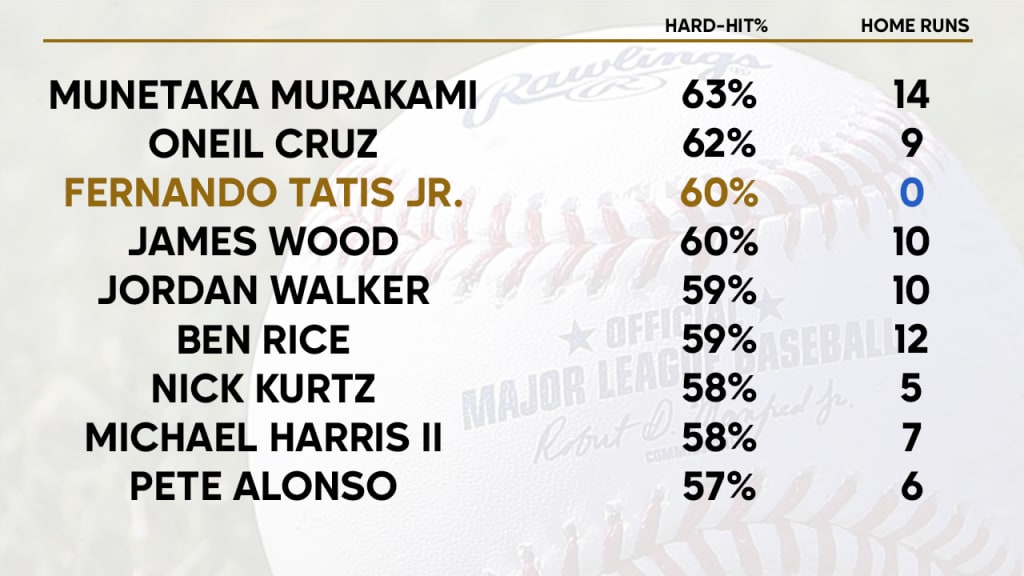
It’s not an indictment of whether hitting the ball hard matters, because we know that it does; hard-hit balls over the last two seasons have a slugging percentage of .939, and softly-hit balls are a mere .255. Nor is it bad luck, because Tatis has hit only one ball all season (his April 5 sacrifice fly in Boston) that would have been a home run in multiple other parks.
Instead, for Tatis, it’s a little about grounders (up from 49% to a career-high 52%), a little more about strikeouts (up from 19% to 25%), and an absolute ton about going to the opposite field at an extreme level.
Tatis, when he hit 42 homers back in 2021, put 22% of his batted balls in the air to the pull side, compared with the league average of 17%. His issues this year can be pretty well summed up in this image of what’s happened since.
In May, so far: Zero. Wednesday afternoon's game had one fly to right field, and three grounders to the pull side.
Only seven qualified hitters have a lower pulled-air rate than Tatis does, and that group can be split into “low-power speedsters,” such as Chandler Simpson and Victor Scott II, or “veterans off to disappointing starts,” such as Bo Bichette and Gleyber Torres. If you’re James Wood, you can get away with all-fields power. For most anyone else? You’ve got to pull the ball in the air at least a little.
It’s never entirely clear if this sort of thing is intentional or not, if it’s poor timing or simply trying to use all fields for hits, as has been preached for a century-plus. It’s probably a little bit of both, if we’re being honest, and that story is easily told through the following two numbers.
It might be intentional: Look at his stance.
Last year, Tatis had one of the dozen most open stances in the game, at 38° open, where neutral would be 0°. This year, it’s tied for 125th, at 10°. It's pretty easy to see the change here:
That’s neither good nor bad; Scott II had an even more extremely open stance and he’s one of the least powerful hitters in baseball. It’s not something that happens by accident, either, although it did start last year as Tatis got progressively less and less open each month before making a huge jump even further closed for 2026. But unlike a lot of other things in this sport, this is something a player can fully control. Tatis is choosing, for whatever reason, to set up in this different way.
It might be timing: Look at fastballs and attack angle.
One thing that hasn’t changed, though, is Tatis’ swing path. That is, on a scale where the biggest, most uppercut swings (like Riley Greene’s) have a swing tilt around 45°, and the flattest, most level swings (like Yandy Diaz’s) have a swing tilt nearer 22°, Tatis’ has remained constant 30° for years. It’s not that.
What has changed, though, is the attack angle, or the vertical angle of the bat when it meets the ball, and that’s gone from an above-average 12° a few years ago to a below-average 7° this year. This is almost certainly about timing, rather than intent; as this Statcast video shows, his attack angle is lower than average now, and his bat is positioned in an opposite-field angle.
If your stance is closed, and you’re late, and you’re going opposite field more often, you’d expect to find some problems against fastballs, and that’s exactly what’s happening here.
Without any real change in his bat speed, Tatis is getting overwhelmed by four-seamers this year. Over the previous four seasons, Tatis hit .293 with a .544 slugging percentage against four-seams; this year, it’s .179 without a single extra-base hit.
It all resolves to this seemingly incredible outcome, which is that almost no hitter has a higher rate of base hits going 200 feet or less – and while you can understand slap-hitting speedsters like Simpson or Justin Crawford there, or Arraez’s particular brand of contact-hitting excellence, you would never expect this from an established, powerful hitter like Tatis.
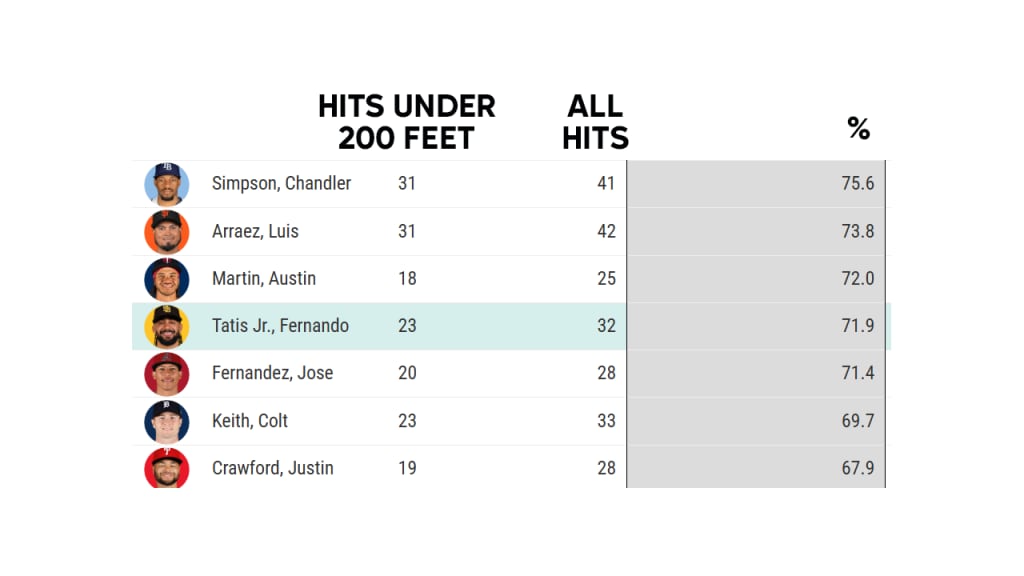
This is, perhaps unbelievably, all more good news than bad. After all, you’d rather have a hard-hitting masher who hasn’t found his way out of the park than one who’s simply not able to make good, strong, contact.
Yet while Tony Gwynn may have made a career out of going to the opposite field, it’s not quite working out for Tatis, who has been nearly 30% below league average as a hitter. Hitting it hard is great; hitting it over the fence is better. In order for that to happen, we’re going to have to see some amount of pull power showing up here – and given his past track record and current hard-hit skills, it seems pretty easy to assume it will. It's just going to require some serious changes in approach.