




As you may have heard by now, Carson Benge's defense is pulchritudinous.
Mets play-by-play broadcaster Gary Cohen used the SAT word to describe Benge’s spectacular ninth-inning grab on Sunday, when he laid out to take an extra-base hit away from the Angels’ Vaughn Grissom.
The 23-year-old Benge certainly seems to be coming into his own after a tough first few weeks in the Majors. For one, Benge’s bat is heating up: He’s hitting .303/.361/.545 in his last nine games, boosting a struggling Mets offense. But it’s his glove, especially after another highlight-reel catch on Monday, that may be most notable.
Benge entered play on Tuesday with +3 outs above average, according to Statcast. Only three outfielders had more -- Pete Crow-Armstrong, Chandler Simpson and Cam Smith. Unlike each of those players, Benge has accumulated his OAA while juggling all three outfield positions, making 12 starts in right field, 10 in left and six in center. He’s recorded positive OAA at each corner outfield spot, while grading out at average in center field.
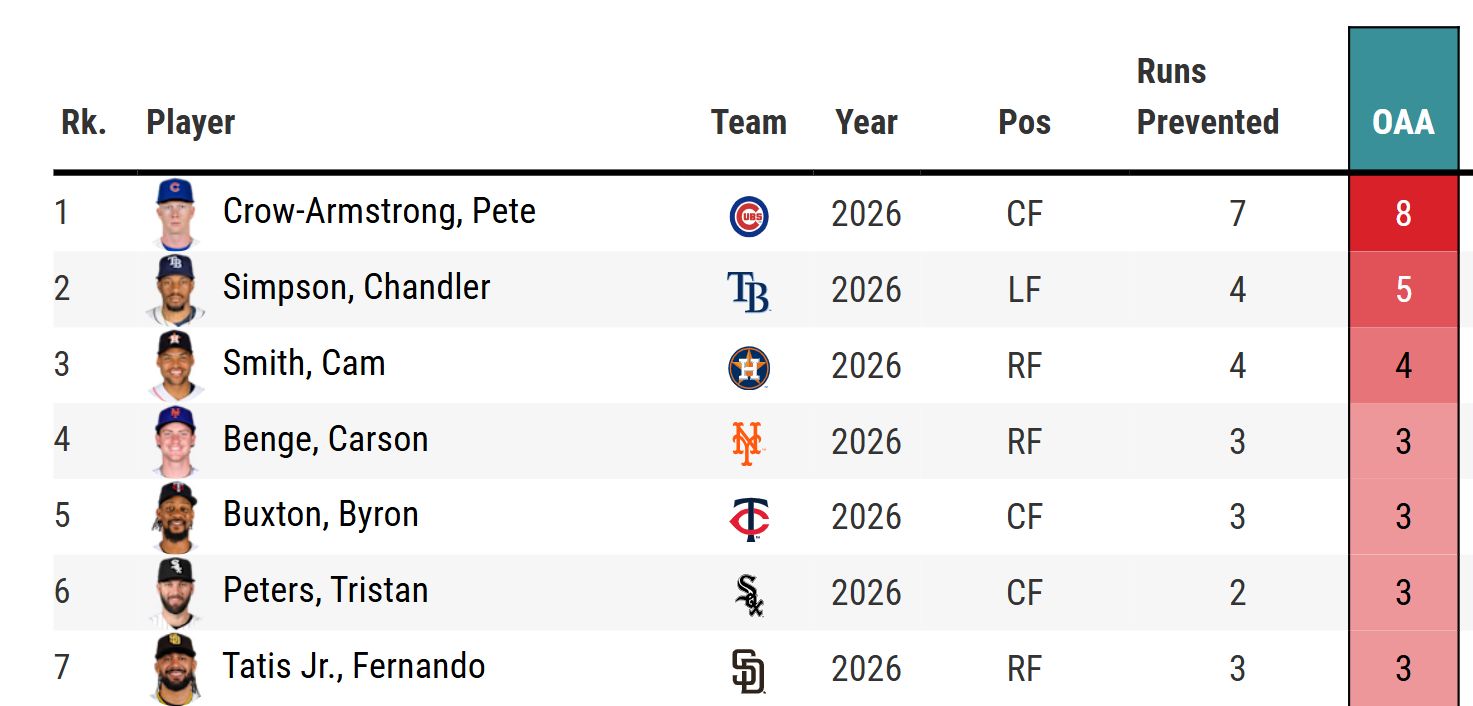
Amid the club's offseason facelift, Mets president of baseball operations David Stearns preached the importance of "run prevention." So far, that has seen average results -- quite literally, given that New York entered Tuesday with a fielding run value of zero, 14th best in the Majors. But Benge, who loomed as a centerpiece to Stearns' vision once the team traded Brandon Nimmo, has played plus defense.
He also offers something that the Mets haven't had much of in recent history.
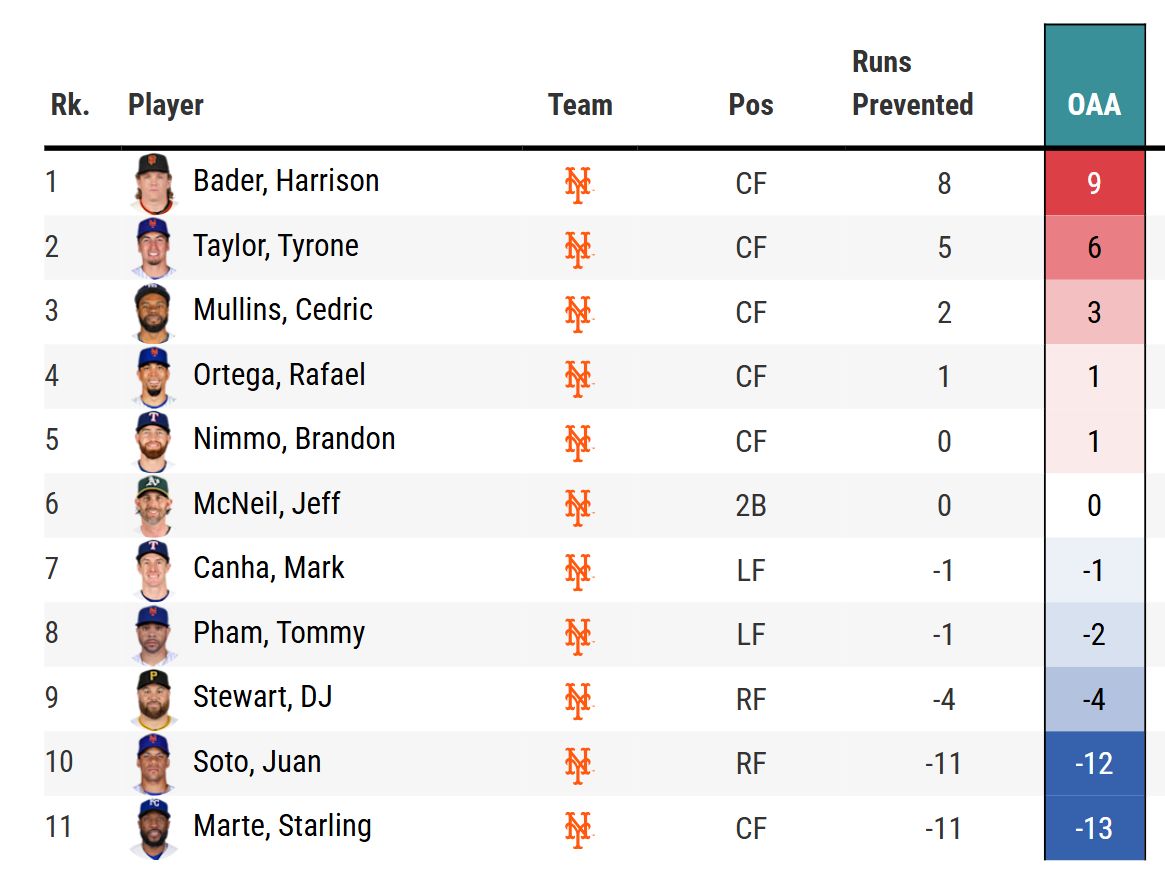
In the three-year span from 2023 to 2025, 11 different outfielders had at least 75 fielding attempts for the Mets. Of that group, only five posted a positive OAA.
It's not a perfect comparison, but it gives us an idea of what Benge brings to the table that the Mets have lacked.
Already, Benge is one of nine players with multiple 5-star catches -- these are the most difficult opportunities with a Catch Probability of 25% or less. He's made two 4-star catches, too. Only Crow-Armstrong (nine) and Simpson (five) have more catches of at least four stars than Benge.
But beyond percentages, let's get a look at what all of this actually means. Outfield defense is tricky, because so much of the play has already happened by the time a fan -- watching at home -- sees the outfielder on their TV.
Benge sets himself up for success before we even see him on the screen. He is getting jumps +2.8 feet better than average; “jumps” are measured as feet covered in the right direction in the first three seconds after the pitch is released. Before robbing Grissom, Benge benefitted from a jump that was 7.4 feet better than average. His catch below to rob Troy Johnston saw him have a jump 6.9 feet better than average.
With a quick reaction time and 87th percentile sprint speed, Benge is able to get to balls that others can’t.
Last year, all four qualified Mets outfielders -- Juan Soto, Tyrone Taylor, Cedric Mullins and Brandon Nimmo -- had jumps that were below average.
How important is a good jump?
“Whether or not I get a good jump, a good read on the ball, if that’s good, then normally the result is there,” D-backs outfielder Alek Thomas told MLB.com last month at Citi Field. “The jump is definitely the biggest thing. If you make one misstep, you’re probably going to miss the ball.”
It's not surprising, then, that this is something Benge has worked on. Mets senior vice president of player development Andy Green told The Athletic in Spring Training that Benge has improved his jumps and his reads. It’s also not unreasonable to expect Benge to continue to grow here. Take Crow-Armstrong, the game's premier outfield defender. In 2024, his first year in the Majors, Crow-Armstrong’s jumps were 2.8 feet better than average; this year, his jump is the best in the Majors, at 5.3. That’s not to compare Benge to Crow-Armstrong, but rather to say that this is something that a player can continue to improve, especially with more reps.
The floor is already high.