



When Nationals pitcher Miles Mikolas stepped to the plate in extra innings on Thursday and put down a successful bunt to drive home a run, it was viewed mostly as an unexpectedly entertaining moment in the midst of an unexpectedly entertaining Washington season.
It was, surely, that. After all, Mikolas was just the third pitcher (setting aside Shohei Ohtani) to drive in a run since the National League adopted the DH in 2022.
“It’s like when you bring the 20th man off the bench, [and him] getting his at-bat in a Senior Night-type thing,” said fellow Nationals pitcher Jake Irvin of watching Mikolas, 37, nearly a decade his elder. “So special.”
Special, yes. Memorable, sure. But it was more than that, too. It was the most stunning way to end a streak we’ve spent weeks watching: It was the first plate appearance the Nationals have given to a player in his 30s all season long.
Even for a team that’s really leaned into youth as it seeks to avoid a sixth straight 90-loss full season since its 2019 World Series title, that’s a true extreme. And this from a squad that leads the Majors in runs scored, homers and slugging percentage.
It was also trending toward being a baseball first. No team had ever gone a full season without having a player in his 30s step to the plate. But we’re actually underselling it a little, because while “in his 30s” is an easy hook, it is, somehow, even more than that. The oldest hitter on the Nats this year is currently injured backup catcher Drew Millas, who doesn’t even turn 29 until January. He’s a full nine years and four months younger than his occasional batterymate, Mikolas.
If that sounds like you haven’t seen that before, it’s because you haven’t. In seasons of at least 115 games played, a mark the Nationals crossed this week, getting this few plate appearances from batters age 29 or older just doesn’t happen. (Numbers below are as of the beginning of play Friday.)
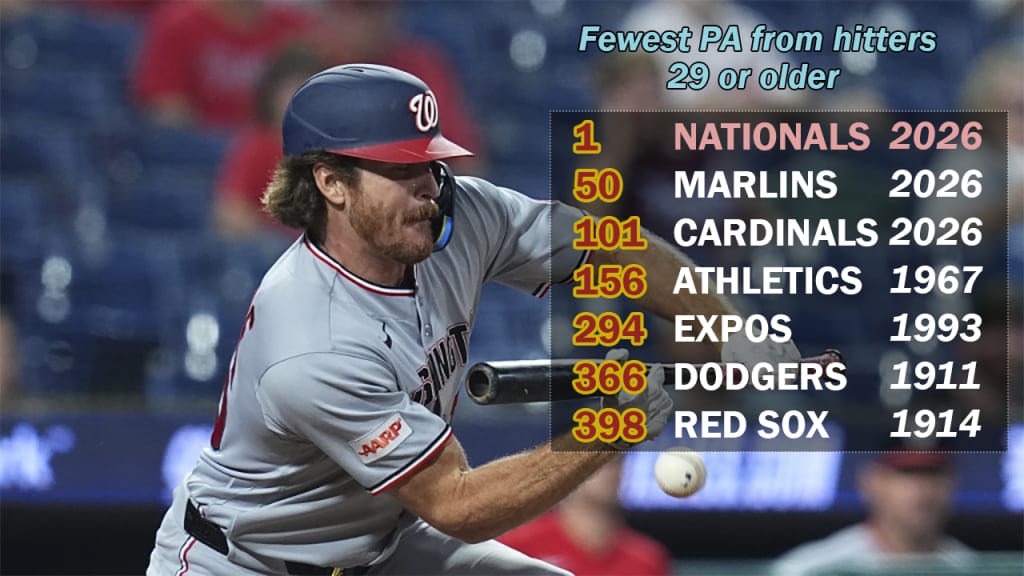
The Marlins and Cardinals both have had at least a few dozen of these plate appearances, and there's the potential for more as the season progresses. Miami catcher Brian Navarreto (age-31 season) remains on the active roster, while St. Louis infielder Ramón Urías (32) -- who is working his way back from right elbow lateral epicondylitis -- is currently on a Minor League rehab assignment at Triple-A Memphis.
The Nationals have one. It’s from Mikolas.
In order to find a more youthful group over a full season, you have to go all the way back to the 1967 Kansas City Athletics, in their final season before moving to Oakland in 1968. Those A’s were all-in on a youth movement. While it didn’t go well (they lost 99 games), they did introduce Reggie Jackson, Catfish Hunter, Joe Rudi, Rick Monday, and Sal Bando -- all 23 or younger at the time and all to become heroes of 1970s baseball. You’ll be forgiven if you don’t recall the few scattered plate appearances given to 34-year-old Ed Charles or 29-year-old Ossie Chavarria, a relative senior citizen on that roster.
(Ironically, much later, Jackson also figured in on the team that gave the most plate appearances to players age 29 and older. That was the 1982 Angels of Jackson, Rod Carew, and Brian Downing, who gave 6,105 plate appearances to the older group. The entire team made 6,350 trips to the plate all season.)
We waited until the Trade Deadline to dive into this, just in case something happened to bring an older hitter to the Nats, given all the roster manipulations that come at this time of year. Perhaps it would be a veteran trade addition, to aid an obviously youthful team. Perhaps it would be the promotion of a journeyman veteran biding his time at Triple-A Rochester, like 30-year-old Riley Adams, who had appeared for the Nats in each of the previous five seasons, or someone like 31-year-old Zack Short, who briefly cycled through the system before stints with the Tigers and Mets.
Or, ideally for our narrative purposes, no one at all.
But, no. We can’t say we expected the streak to be broken by a (nearly) 38-year-old pitcher who made his debut on the 2012 Padres (alongside veterans like Jeff Suppan and Orlando Hudson, in a game started by opposing pitcher Mark Buehrle). Baseball always finds a way to make the unexpected interesting.
“[Mikolas is] always itching to get out there [to hit],” said manager Blake Butera. “He reminds me every chance he can that he has two career home runs.”
Yet, while the Mikolas plate appearance counts -- because it’s real, and we all saw it, and video exists of it -- it also doesn’t put an end to this (potential) achievement: this heretofore unprecedented run of “no old hitters,” insomuch as being a mere 29 years old can be “old.” After all, pitchers batting are not position players batting, especially not in a post-universal-DH world. Hilarious extra-inning flukes aside, the Nationals are still running out a position player group where no hitter has reached the age of 29 years old. And that, still, has never happened before. (Numbers below are as of the beginning of play Friday.)
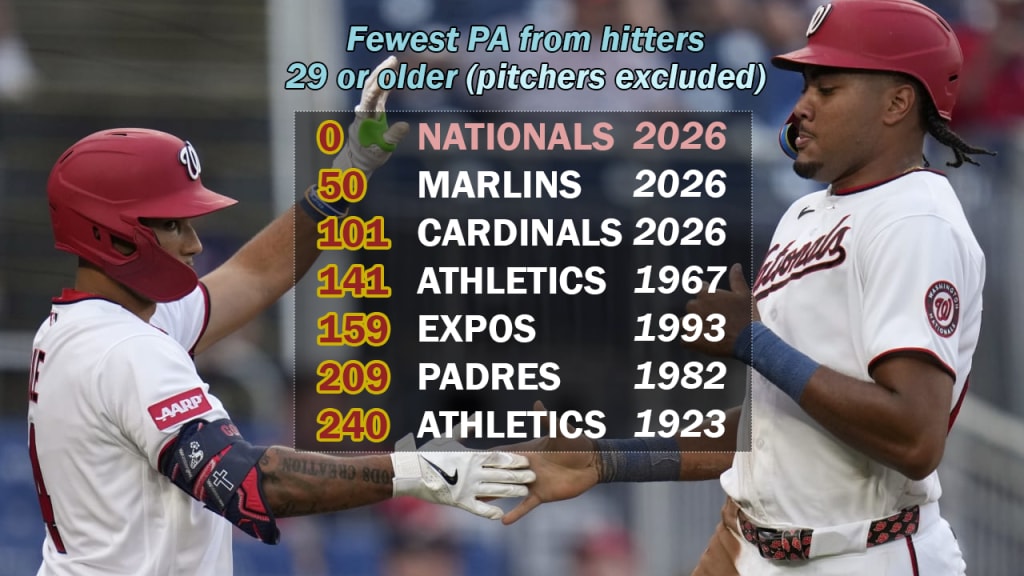
(Technically, we should add, for the sake of record-keeping, Mikolas doesn’t count as “a pitcher,” because he appeared in Thursday’s game as a pinch-hitter. But our figures here are showing primary positions, not what they were in that moment.)
The Nationals have given most of their plate appearances this year to James Wood (23), CJ Abrams (25), Daylen Lile (23), Nasim Nunez (25), and the since-traded Luis Garcia Jr. (26). With Millas injured, their eldest position player is currently catcher Keibert Ruiz, who turned 28 three weeks ago. He is, by these standards, a senior citizen.
The Nats -- who proudly wear an AARP patch (for an organization once known as the American Association of Retired Persons before shortening its name) on their sleeves -- have leaned entirely into their youth movement. One day, perhaps soon, with luck and good fortune, maybe we’ll think of this group the way we do those ‘67 A’s -- as the first look at a group ready to make playoff runs for the first time in years.