


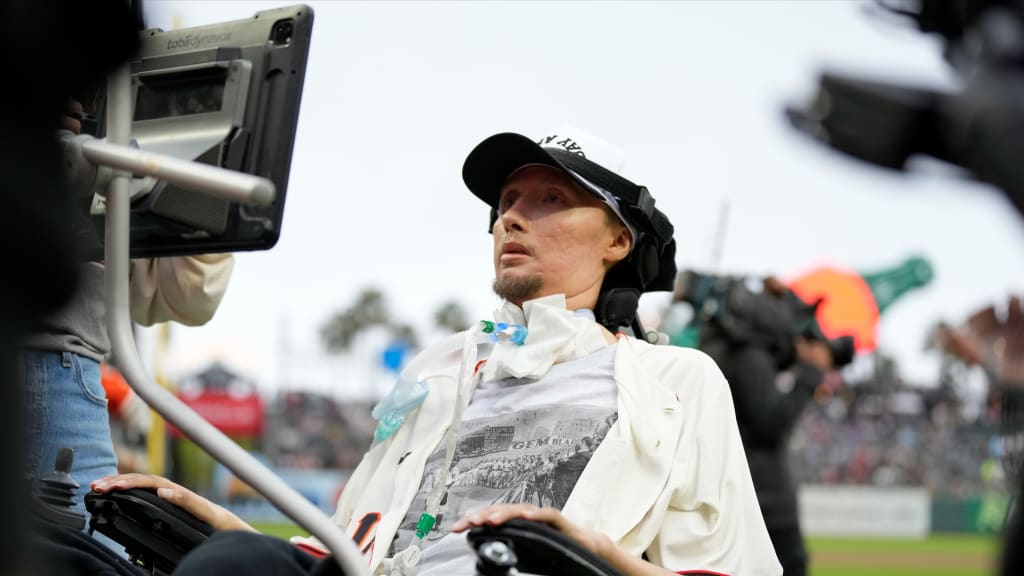
SAN FRANCISCO – The Giants on Monday night preempted their usual “Play ball!” exhortation from specially selected kids in favor of a 31-year-old man with Lou Gehrig’s Disease.
The Giants were marking ALS Awareness Day ahead of their first home game since the MLB-wide event on June 2. Osiel Mendoza, who has lived with the disease since 2017, was able to say “Play ball” in his own voice, which was remarkable because, until last weekend, he had not been able to produce or hear his own voice for six years.
The disease robbed Mendoza of his ability to speak. He has been able to communicate using a device that recognizes his eye movements as he scans a virtual keyboard. His words then appear on a screen.
ALS patients, and those who have lost their voices to cancer and other diseases, have long been able to speak through technology that converts words into text in a robotic voice. Mendoza now can speak in his own voice through a serendipitous meeting of the long-time Giants fan with a team sponsor that creates the technology. This technology is available to anyone living with ALS thanks to ElevenLabs’ partnership with a nonprofit called Bridging Voice.
London-based ElevenLabs, started in 2022 by a former Google machine-learning engineer and a Palantir strategist, is using artificial intelligence to make leaps in text-to-voice technology, specifically teaching machines not just to read words, but to read them with proper inflection and emotion, and not just in English.
Mendoza had taken part in previous ALS Awareness Days at Oracle Park, so the Giants brought him and their new sponsor together.
ElevenLabs markets its technology to corporations, but along the way they learned how the technology could help those who lost their voice through illness, or soon will. The ElevenLabs software synthesizes sentences that people read into a computer to create their voice profiles.
In cases where people have lost their voices before they can speak into a recorder, the company can use old voicemails, speeches, home movies or any recording to accomplish the same thing. Gabi Leibowitz, who represented ElevenLabs at Monday’s event, said the technology can re-create a person’s entire voice pattern with just 30 seconds of old recordings.
Before Monday’s ceremony, Mendoza did an interview with the Giants’ in-house video crew. After answering questions, he directed the software to read it in his own voice through speakers.
“It has been one of the most life-changing experiences of my life,” he said. “My family has been grateful to hear my real voice again. It has been six years without it and I’m eternally grateful to the Giants and ElevenLabs for this opportunity.
“With ALS, so many things are constantly being taken away from you, and this has given a piece of me back.”
Lisa Mendoza, Osiel’s mother, confirmed how emotional she and other family members got when they heard his voice for the first time over the weekend.
She said she walked into his room and asked, “What are you guys doing?”
“He started talking in his own voice and I started crying,” she said. “We then got to see his reaction to our reaction, and it was gold. Oh my gosh, he was so happy and smiling.”
Leibowitz said the company has gifted its software to 10,000 people who have lost their voices to disease. They hope to give it to 1 million people.
The company believes its technology will help give people a voice.
Moments before Monday’s game, Osiel Mendoza did not just say “Play ball” in his own voice. His enthusiastic “Plaaaayyyy Ballll!” resonated through the park.