



It’s not exactly a secret that the Dodgers, set to embark on a quest for baseball’s first three-peat since the Yankees in 1998-2000, have an embarrassment of riches.
That is especially true in their starting rotation, which FanGraphs projects to be the second-best unit in the Majors in 2026. If last October’s dominance is any indication, this could be one of the best groups in club history.
At the same time, L.A. knows as well as anyone that surviving the grind of a 162-game season requires a stable of arms. Last season, the Dodgers used 17 starting pitchers; only the Braves (19) and White Sox (18) deployed more. In fact, L.A. has used exactly 17 starting pitchers in each of the last three seasons.
“We know that pitching depth is fleeting,” general manager Brandon Gomes said at the Winter Meetings in December.
The 2026 rotation, while undeniably talented, still carries plenty of risk. Shohei Ohtani and Emmet Sheehan are set for significant workload increases on the other side of elbow surgery. Tyler Glasnow and Blake Snell each spent time on the injured list last season, as did Roki Sasaki, who threw just 47 innings as a rookie, between the regular season and the postseason. Yoshinobu Yamamoto was an unquestioned workhorse, but he also threw 102 1/3 more innings than he did in 2024, when he missed three months with a strained rotator cuff. As a group, they are coming off an October run in which they were worked tirelessly.
Point being: As great as the top-six starters look on paper, the depth guys will inevitably be a part of the equation. And this is where River Ryan comes into play as a name to follow in ‘26.
MLB Pipeline recently tabbed Ryan as the Dodgers’ best prospect outside the latest Top 100 Prospects list. But Ryan is not your typical prospect: He’s 27 years old and hasn’t pitched since Aug. 2024, spending all of last season rehabbing from Tommy John surgery.
While he is older for a prospect, Ryan really hasn’t pitched much at all. He was a two-way player in college at NCAA Division II UNC Pembroke, throwing just 93 innings across three years while starring as a second baseman. When the Padres selected Ryan in the 11th round of the 2021 Draft, they allowed him to pursue a two-way path, first sending him to the Arizona Complex League as a hitter.
A year later, San Diego flipped Ryan to L.A. for Matt Beaty. Ryan's first professional pitch came in 2022, when the Dodgers convinced him to focus on pitching full time.
In total, between the Majors and the Minors, he’s thrown just 196 1/3 professional innings. But when we have seen Ryan, he's impressed: He pitched to a 1.33 ERA in four MLB starts before injury in '24, briefly showing the sort of pitcher he can be when healthy.
Statcast has a “similarity score” that looks at a pitcher’s arsenal -- in terms of velocity and movement -- and finds other pitchers who are the best comparisons for them. In 2024, the pitchers with the closest stuff to Ryan included Gerrit Cole, George Kirby, Edward Cabrera, and Jared Jones. That’s pretty good company.
Let's look a little more at the comparisons with Cole and Jones, since both righties also missed the 2025 season with injury. Here’s what Ryan’s pitch profile looked like in ‘24 compared to Jones, his second-closest comp, and Cole, his fourth-closest comp.
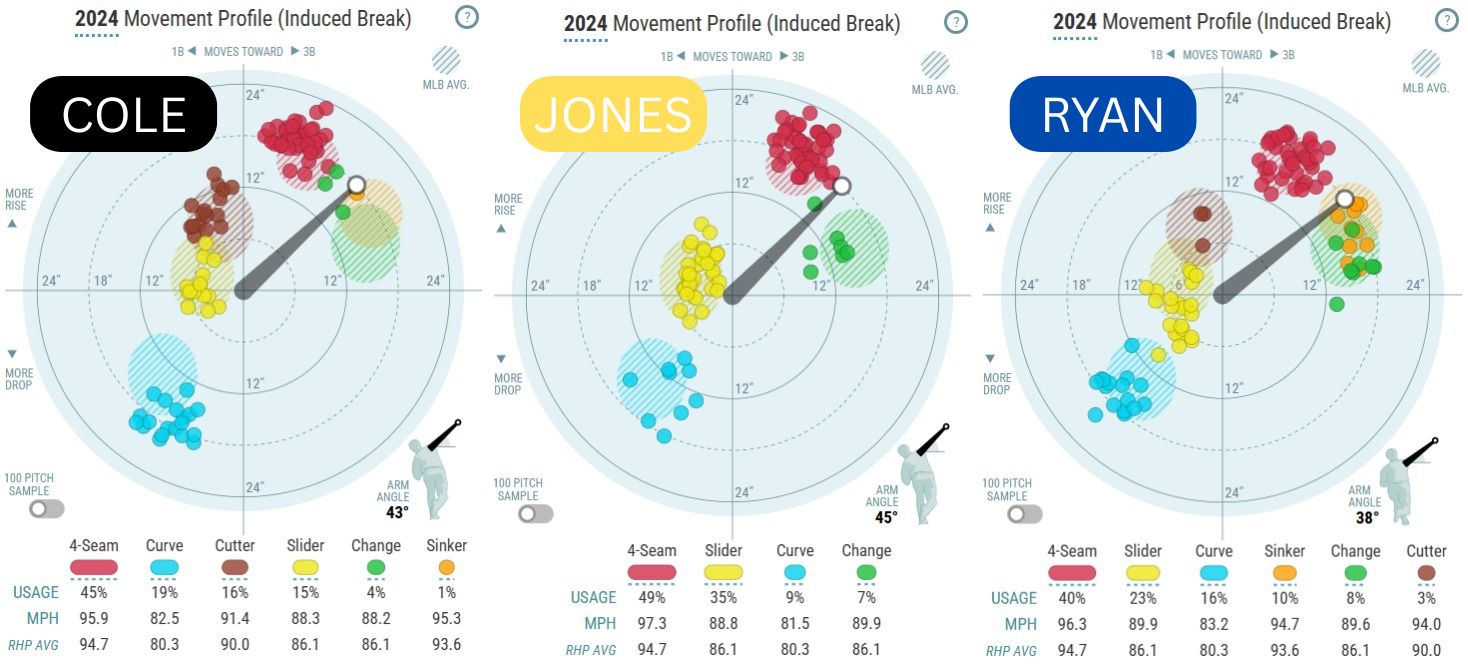
All three pitchers use a high-90s fastball, a high-80s slider, and a curveball with plus drop. It's worth noting that Jones even added a two-seamer last spring, strengthening the Ryan comp, in terms of pitch shapes.
The good news for Ryan is that he appears to have retained his velocity on the other side of elbow surgery; in December, he told Dodgers Nation that he was sitting in the 98-100 mph range during his most recent live sessions. Ryan spent last season strengthening his shoulder, and thinks his fastball is in a "really, really good" spot.
But beyond the pure stuff, Ryan wields a fairly complete arsenal, especially for a pitcher with so little experience. He has three fastball shapes, with a sinker to pour in on righties and a cutter that he's used primarily against lefties. That gives Ryan three pitches in a similar velocity band with distinct movement profiles, which makes life difficult on the hitter.
Ryan’s best secondary pitch is his slider, which is a harder offering, averaging 89.9 mph in ‘24. His curveball has a rare combination of velocity and vertical movement. In 2025, only 12 qualified curveballs averaged at least 83 mph with at least 51 in. of drop, including two of Ryan's comps -- Kirby and Cabrera. Meanwhile, Ryan's changeup gives him a pitch that darts away from left-handed hitters.
Ryan isn’t done, either. He teased that he’s added a seventh pitch to his arsenal, another “strikeout option” that he can turn to when needed. Speculatively, because of his spin profile, that could be a sweeper, something to throw off the plate and away to righties.
Most importantly, Ryan is having a normal offseason. That should set him up to join the big league club at some point during the 2026 season.
"We have guys that are on the come and guys that have done it," Dodgers manager Dave Roberts said. "I think, again, it just speaks to how well equipped we are for not only this year but beyond."
For the first time in two years, Ryan seems poised to play a role.