



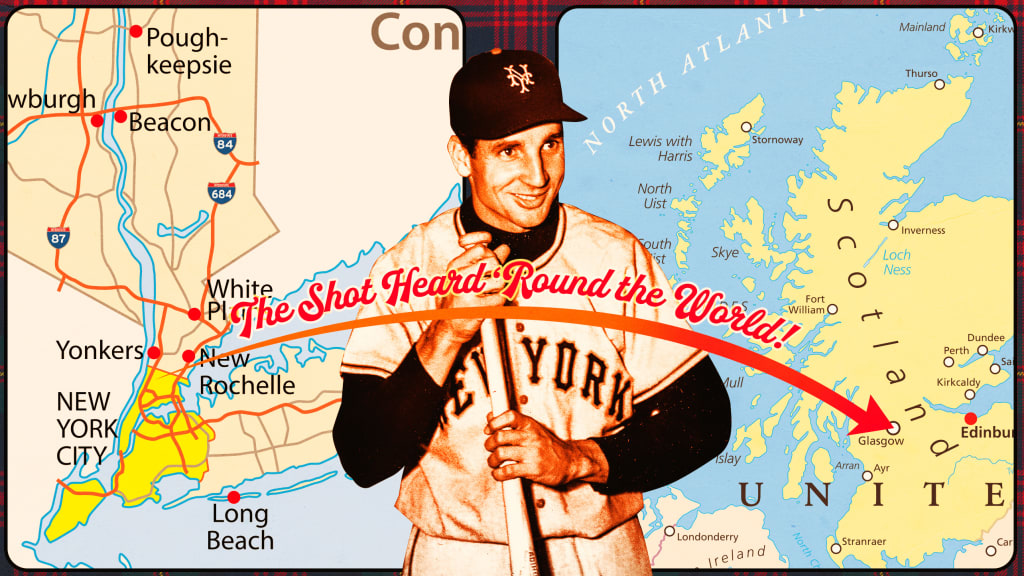
It was called “The shot heard ‘round the world” – though the newspaper editors who coined it likely had no idea how right they were. While American baseball has never been shy about applying a global moniker to its domestic contests (it is called the World Series after all), Bobby Thomson’s iconic pennant-winning home run against the Brooklyn Dodgers on Oct. 3, 1951 really did deserve the globe-spanning moniker.
These games were among the first to receive nationwide broadcast on television and radio, with the call also going out to U.S. service members around the world thanks to Armed Forces Radio. And then there was Thomson, who was originally born in a two-room tenement building in Glasgow, becoming known in the States as “The Staten Island Scot.”
But what was the reaction back in Thomson’s homeland of Scotland?
“Every once in a while, you do come across somebody who's aware of Bobby Thomson, but I wouldn't say it's in everyday Scottish sports folklore,” John Tafe, an American ex-pat and the current president of Baseball Scotland, told MLB.com. “He's not on the pantheon of Scottish heroes or anything like that. It's more of a novelty for people who know about it.”
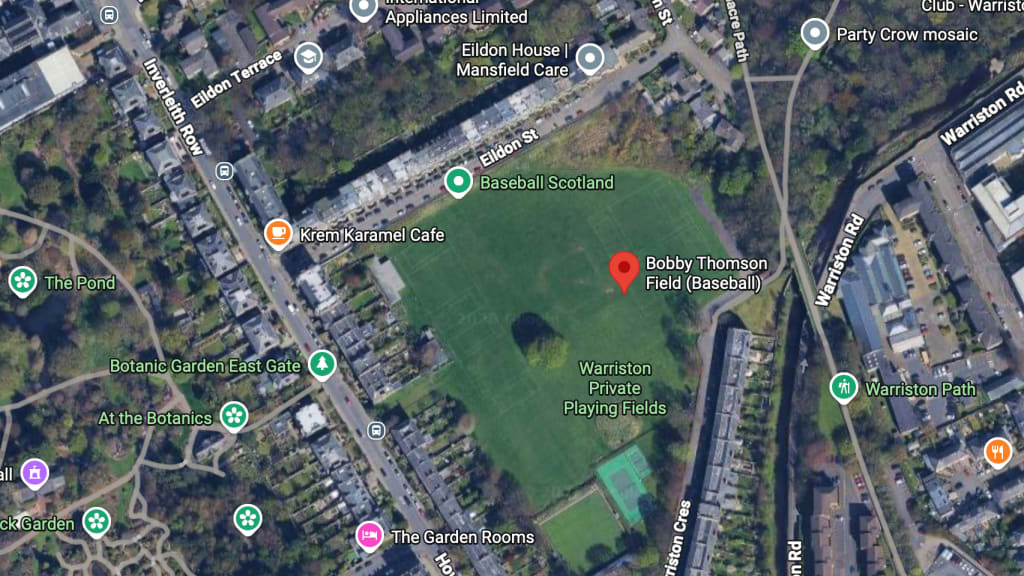
While there may not be Scottish baseball fans who turn on Russ Hodges’ call every Oct. 3 the way some in the states still do, there are a few signs that the home run did reach his countrymen -- even if it took a few decades. Thomson was inducted into the Scottish Sports Hall of Fame in 2003, and he traveled back to Caledonia that year to accept the honor and see the Edinburgh Diamond Devils rename their field in his honor.
“He came down and did a little ceremony, which basically consisted of taking a photograph with some of the players,” said Paul Convoy, the former president of Baseball Scotland, who is now working on the national team’s development program. “Funnily enough, that original field was down in Tranent, just outside of Edinburgh. Since then the Edinburgh club moved into the city center, but they took the name Bobby Thomson Field with them.”
As for Thomson's extended family that still lives in Scotland -- what do they think of their connection to one of America’s most iconic sporting moments? Thanks to the help from Bobby’s daughter, Megan Hann, and granddaughter, Megan Miller, I was able to reach Bobby’s second cousins, Iain and Ken Thomson. Both now middle-aged, they grew up in Glasgow, but have since moved away to nearby environs, Ken to Linlithgow and Iain to Perth.
“I think I heard about [Bobby Thomson’s home run] when I was quite young, but it didn't really make a huge impression on the basis that baseball was a sport that was played in America and not in Scotland,” Ken said. “If he'd played soccer and was a soccer superstar, it would have been different.”
“I want to add one thing,” Iain interjects. “I think also our own parents – and Bobby’s side of the family, too – they’re not up and at ‘em type people. They’re quite reserved and I think that made a contribution to us not realizing how important it was.”
While there are a few other sporting figures in the family -- “our father was a tennis champion at his local club,” Iain joked -- Bobby’s home run stands alone in the family’s legacy.
Ken would know: He’s become the Thomson family’s unofficial historian and record keeper.
“I've looked at the 1921 census as to where they lived, which was a place on 29 Tennant Street,” Ken said. “In those days, a lot of the buildings were called tenement buildings. They were three or four stories high, and there were maybe three or four flats at each level. They were in one of them, but they were very cramped.”
The Thomsons lived in the Townend part of Glasgow, a rough-and-tumble industrial area that had seen a massive population increase over the previous decades, with workers and families coming from the Irish Great Famine and the Highland Clearances. It was into this working class world where Bobby would be born.
At the time of the ‘21 census, there was Bobby’s father – James – mother, and four children living together in the apartment on Tennant Street. By the time Bobby was born two years later, there were two more children – including Bobby – bringing the total number of family members in the space to eight.
“The census indicates that there were two rooms in the flat, no bathroom, no toilet,” Ken said.
Life before the family moved into the tenement building wasn’t easy, either. James had served in World War I, fighting in the trenches and even surviving a poison gas attack. Unfortunately, his brother wasn’t so lucky. It was this brother that gave Bobby his name.
“Robert Brown Thomson, the full name,” Ken said. “[Bobby] was named after him. Bobby’s uncle was killed in World War I in horrific circumstances out in what is now Iraq, fighting against the Ottomans.”
Bobby was just two days old when his father left the family, heading to New York in search of work and opportunity beyond the family's cramped quarters in Glasgow.
“He was in America for 32 months on his own before he could afford to bring the family across,” Ken said. “He left two days after Bobby was born and they didn’t see him again for two-and-a-half years.”
***
Decades later, long after Bobby’s side of the family had established roots in Staten Island, Iain traveled to the States and looked up his relatives. In a sign of great cosmic coincidence, it was another day long remembered in American history.
“I traveled across to Staten Island in the morning before the first moon landing in '69,” Iain said. “I had a whole day with the family: Bobby, his wife, and the children. And then I came back on the ferry, and I was crossing on the ferry from Staten Island when your first astronauts landed on the moon.”
Though the connection with Bobby hasn’t turned either cousin into a baseball fanatic, they’ve enjoyed their brush with American fame. Iain worked as a scientist and was often traveling and meeting people from all over the world. Any time he met an American, “they always know about it,” he joked.
He even got to feel a little like a celebrity himself while playing on a basketball team with many American teammates.
“I happened to mention Bobby Thomson, not even thinking about it, and literally they were queuing up to get my autograph,” Iain said. “I thought, ‘But I'm just a distant relation.’ That, of course, didn't matter.”
Though Bobby was only 2 years old when he emigrated, eventually becoming known for his place in America’s pastime, his Scottish ancestry never left him.
“I have always felt Scottish in my blood, my feelings and my thoughts and I know where my roots are,” Thomson told The Times in 2003. “Even though I was 2 when we left Glasgow, I used to ask my older sisters about what it was like. My upbringing and my personality are Scottish.”
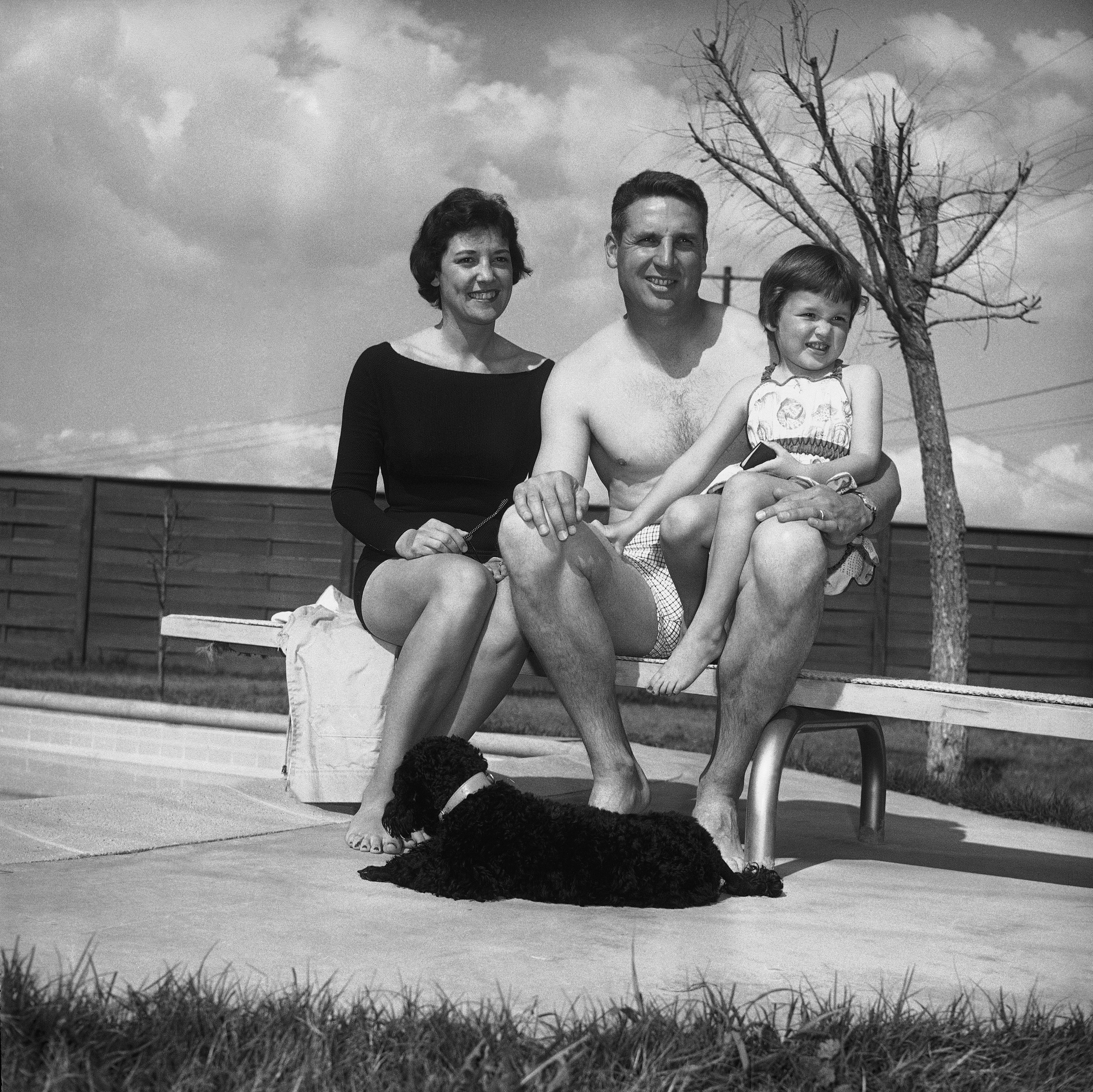
Even Ken and Iain can see that connection – in their family, in Bobby’s behavior, and even in the star-making turn that Scottish soccer fans had when they were visiting for the World Cup earlier this summer.
“In terms of what Bobby's father did, the determination to do the best for his family and to give his family the best opportunity in life, that's a common theme that runs through all the different branches of the family,” Ken said. “They were brought up in a very close community, and people were all poor, but they all looked out for each other. That was the culture, and that culture has continued in a lot of Scottish people, including Bobby Thomson's family. The charity work he did and other things that he did are very much the flavor of what typical, good Scottish Glasgow people would do.”