



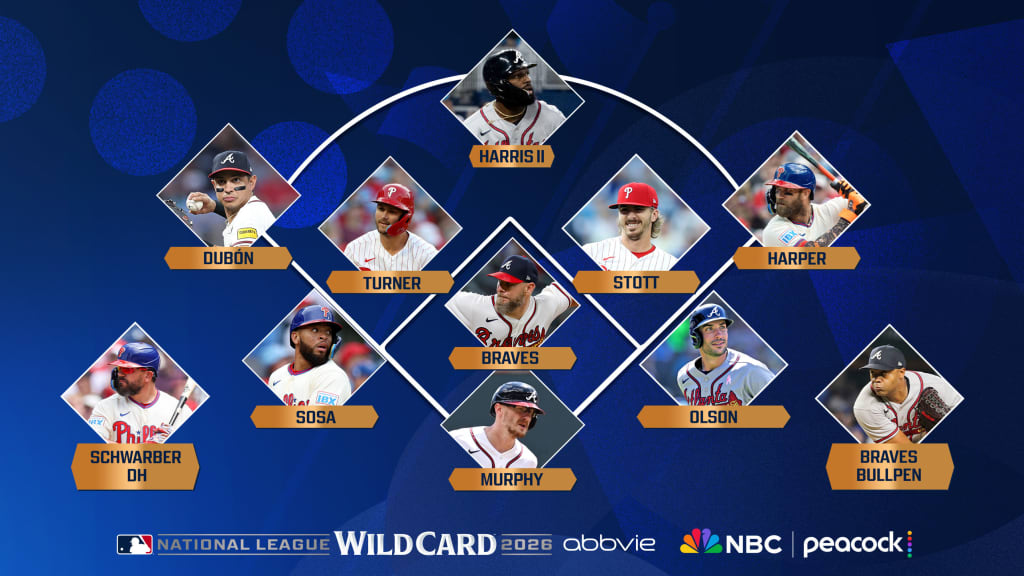
For the third time in five years, we’ll get the Braves vs. the Phillies in the National League playoffs. In 2022, the Phillies won the NLDS 3 games to 1. In 2023, the Phillies won the NLDS 3 games to 1. We don’t know how this year will go, other than to say it won’t be 3 games to 1. The Wild Card, after all, is a best-of-three.
Breaking it down, position by position ...
Catcher
Our first problem arrives immediately, in that we have a few catchers with strong name value who have just not performed well at all this season. Three-time All-Star J.T. Realmuto, considered The Best All-Around Catcher In the Game for a solid half-decade, hasn’t hit a lick (65 OPS+), isn’t the Gold Glove defender he once was, and was riding an 0-for-34 skid before a final-day RBI. It’s not like Sean Murphy, himself a former All-Star and Gold Glover, has been any better, not with a 49 OPS+ in a season mostly lost to injury. It’s a weak spot on both sides, with the edge to Atlanta clearly because of Drake Baldwin, though it’s not entirely clear how much time he’ll actually spend behind the plate as opposed to serving as designated hitter.
Advantage: Braves
First Base
Here’s the first of several places where Luis Arraez’s ankle injury affects the entire Phillies lineup. It’s easy enough on the Atlanta side, because you know you’ll have Matt Olson, along with his 41 homers and his outstanding defense. (And, if we’re being fair, a pretty decent second-half slide, though we’ll look past that for now.) But for the Phillies, it was Arraez’s arrival that forced a defensive reconfiguration, pushing Alec Bohm to first base – which is just about the time his disappointing bat perked up, coincidental or not – and Bryce Harper to the outfield. Bohm, to his credit, has been far better in the second half. He’s still not Olson, on either side of the ball.
Advantage: Braves
Second Base
Without Arraez, we think this is going to be Bryson Stott, moved back to second base, and while name value might say this is a close race – Ozzie Albies, after all, is a four-time All-Star who just posted his fifth 20-homer season – we don’t really think this one is close at all. That’s because Stott holds a sizable edge on defense, and Albies, while capable of a homer, simply hasn’t hit that much. A .294 OBP won’t get it done, and a .195/.255/.325 second-half line is one of the weakest in baseball. Stott was having something of a breakout year on offense before a September slump, like the rest of the Phillies, set his overall line back.
Advantage: Phillies
Shortstop
Trea Turner hasn’t been good. His defense, after a surprising step forward in 2025, has been a large problem in 2026, and the bat has lost 137 points of OPS. It has been, by all measures, his weakest season as a full-time Major Leaguer. And yet: the Braves may start Ha-Seong Kim, who has an OPS+ of literally two. It is one of the weakest hitting seasons ever. If they don’t, it would likely be Mauricio Dubón, who had some big hits earlier in the year, but mostly didn’t hit much after that, and may end up seeing time in left field anyway. The Braves are 28th in shortstop WAR this year. The Phillies are 25th. That’s not why the Phillies get the edge here. But it does show how porous both of these spots are.
Advantage: Phillies
Third Base
What happened to Austin Riley? Between 2021-’23, he looked like the next big star, hitting 108 homers with a 135 OPS+ and rating as essentially baseball’s best third baseman. The last two seasons were worse, and this one has been an outright disaster, with a .220/.291/.366 leading to a mere 80 OPS+. Arraez’s status will help define whether Bohm or Edmundo Sosa take the hot corner for Philadelphia, and while it hasn’t really been a great year for any of these three, Bohm’s late season offensive rebound does tilt the scales slightly towards the Phillies.
Advantage: Phillies
Left Field
Look, if you know what version of Brandon Marsh we’re going to get, you’re in better shape than we are. Marsh started the All-Star Game on his home field, having finally been entrusted to hit lefty pitching. He followed that up by being the absolute weakest hitter in baseball in the second half. He might not even play against lefty Chris Sale, which would likely put journeymen Bryan De La Cruz or Derek Hill in the lineup. It’s not that the Dubón / Mike Yastrzemski tag team is a superstar duo for Atlanta – necessary, in part, because Lane Thomas is injured – but the second-half Braves left-field situation has been mildly below-average, while the Phillies have been, well, the worst in baseball.
Advantage: Braves
Center Field
Finally, an easy one. Philadelphia rookie Justin Crawford’s game is built around speed, but a general inability to get on base meant that he stole only 17 bases, thanks to a 79 OPS+. Atlanta’s Michael Harris II has been one of the game’s better defensive center fielders for years, and he also brought the bat this year, hitting 26 homers with a 120 OPS+. Big advantage on offense, and big advantage on defense? Big advantage, Atlanta.
Advantage: Braves
Right Field
Assuming Harper is here and not at first base, we have a true superstar matchup, with nine-time All-Star and two-time MVP Harper against five-time All-Star and one-time MVP Ronald Acuña Jr. There’s probably not a wrong answer here, to be honest, as these are two outstanding players. It’s hard not to notice how much stronger Harper was down the stretch, after Acuña’s return from a hamstring injury, even with Acuña’s late-season success after a stance change. Despite Acuña’s continually impressive throwing arm, neither is really a plus on defense. This is probably the tightest matchup of any position.
Advantage: Phillies
Designated Hitter
It’s true that Kyle Schwarber, like most of his Phillies mates, ended the season on a dreadfully cold slump. It’s also true that he hit 45 homers and finished yet another year as a top-25 hitter. No combination of Baldwin, who was excellent, or Dominic Smith, who got off to a hot start before tailing off badly after that, can match up with one of the generation’s preeminent power hitters.
Advantage: Phillies
Starting Pitchers
Let’s be very specific about what this is, and is not. It’s not “who do they have on the roster,” which would clearly favor the Phillies, it’s “who will be starting.” It’s a two-game series, possibly three; Philadelphia used both Zack Wheeler and Jesús Luzardo on the season’s final day. It’s expected that Atlanta would go with Sale in Game 1, followed by Tyler Mahle and then, if necessary, Grant Holmes.
For the Phillies, it was such a scramble to end the season that their rotation is at considerably less than full strength. Luzardo is expected to start Game 1, but he's thrown all of four pitches in the last month, which may, improbably if you saw him earlier in the season, lead to rookie Andrew Painter playing a large role in Game 1. To his credit, he was far better upon his return after a midseason return to the Minors, but there’s also not a version of this where you’d take him over Sale, either.
Cristopher Sánchez would likely be lined up for Game 2, and then likely Aaron Nola, though you'll note that this may end up with Wheeler not being available at all. (“I mean, maybe at some point,” Mattingly said when asked.)
Philadelphia, clearly, has the talent edge. Atlanta, at least for the next few days, has the availability and reliability edge.
Advantage: Braves
Relief pitchers
Jhoan Duran remains one of baseball’s more elite relievers, but so far as how you get the ball to him, well, “that’s a real issue,” as Todd Zolecki wrote in his playoff preview. It’s long been assumed that one of the five good, healthy Philadelphia starters could operate out of the bullpen, but that also assumed that the Phillies wouldn’t have needed to have asked for every last pitch from those starters until the final day. Atlanta, meanwhile, not only had one of baseball’s best bullpens, but they’re getting Robert Suarez back just in time, too.
Advantage: Braves
Prediction
We’re not going to worry about regular-season record, which has not a great deal of predictive power here, nor especially head-to-head record, because while it’s tempting to put stock in Atlanta’s 9-4 advantage this year, it’s also not that important that things like “Taijuan Walker allowed 7 runs in 4 innings in mid-April” happened. Still, the Braves have been planning for this for weeks, while the Phillies not only have uncertainty in the rotation and the bullpen, but may be without Arraez, plus two relatively weak spots in the outfield.
Prediction: Braves in 3