



Tarik Skubal is the Very Big Obvious No. 1 starting pitcher on the trade market. But there are plenty of other good starters out there, with a wide variety of skill sets.
If you're a contender on the hunt for pitching in the final weeks before the Aug. 3 Trade Deadline, how do you decide which trade target best fits your team's needs?
We're here to help.
Trades and Transactions presented by CohnReznick
• Tracking every Deadline trade
• Skubal heads to Dodgers in Deadline blockbuster
• Rutschman traded to Red Sox for big prospect haul
• Phillies get 3-time batting champ Arraez, relief ace Raley
• These 7 clubs loaded up on prospects at the Deadline
• Every prospect traded before Deadline
• Ranking the 25 top prospects traded ahead of the Deadline
With Baseball Savant's new Player Comparison Tool, we can stack up all the top trade candidates side by side and see who's the best at what, going by their MLB percentile rankings in different stats.
Check this out. Here are nine of the top starting pitcher trade candidates that could be available -- non-Skubal division -- and how they grade out in a wide variety of areas:
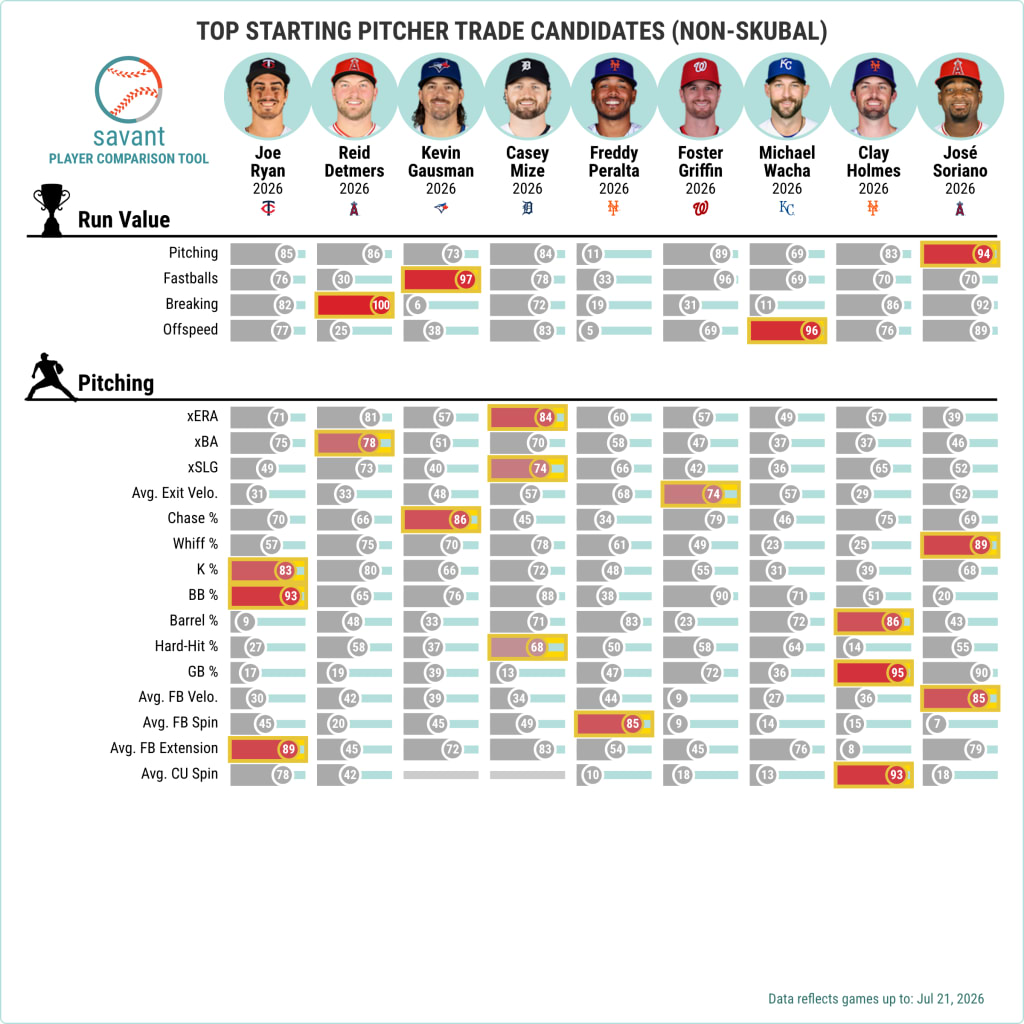
The Player Comparison Tool is fully customizable, by the way, so feel free to swap in your own favorite trade candidates in place of the ones we picked out, or pick out different stats you want to see.
But let's start with these nine pitchers. Comparing those starters, here are some of the things that stand out.
1) If you want a high-strikeout, low-walk ace, Joe Ryan fits the bill
The Twins ace leads our group in both strikeout rate and walk rate, which is a very good combination. (Yes, even after Ryan gave up six home runs to the Guardians in that crazy game the other day.) Ryan's 27.8% strikeout rate ranks in the 83rd percentile of MLB pitchers, and his 5.3% walk rate ranks in the 93rd percentile. There's a gap of over 20 percentage points between Ryan's K% and BB%, which is top-10 among qualified starters.
2) José Soriano has been the best at run prevention overall
Even though the Angels right-hander cooled off after a sensational start to the season, Soriano has still generated the most cumulative value here. His +14 runs prevented in 2026 ranks in the 94th percentile of MLB pitchers, and if you want to trade for a pitcher with overpowering swing-and-miss stuff, Soriano also throws the hardest (96.8 mph fastball velocity, 85th percentile) and has a filthy knuckle-curve that helps him induce the highest whiff rate (31.6%, 89th percentile) of any pitcher on our trade target list.
3) For strong underlying quality-of-contact numbers, look at Casey Mize
The other Tigers starter who might be traded is having a career year (although he's dealing with a couple of minor ailments after his last start). Mize is sporting a 2.79 ERA and striking out over a batter per inning. Statcast's quality of contact metrics also like what Mize is doing, indicating that his success is deserved. Mize has the lowest expected ERA, 3.14, of any starter in our comparison, a mark that ranks in the top 10 among pitchers who've faced at least 300 batters this season, right behind Skubal and in the middle of a group of aces.
4) If your team can turn ground balls into outs, Clay Holmes is the arm for you
This isn't exactly breaking news, but Holmes and his turbo sinker are elite at inducing ground balls. He ranks in the top 5% of MLB pitchers with his 55.3% ground ball rate this season, and is great at preventing hitters from barreling the baseball (hitting the ball hard and in the air where they're likely to do damage). If the Mets right-hander can come back soon from his fractured right fibula, that ground ball ability could make him a nice trade target for the right contender down the stretch -- particularly a pitching-needy team with strong infield defense like the Cubs.
That's our first batch of takeaways. But we've got some more for you, and we're going to give you a sneak peek of a feature that's coming soon to the Player Comparison Tool.
In the very near future, you'll be able to compare pitchers' pitch arsenal stats -- in other words, you'll be able to look at each individual pitch type they throw.
This is what that looks like for our starting pitcher trade candidates:
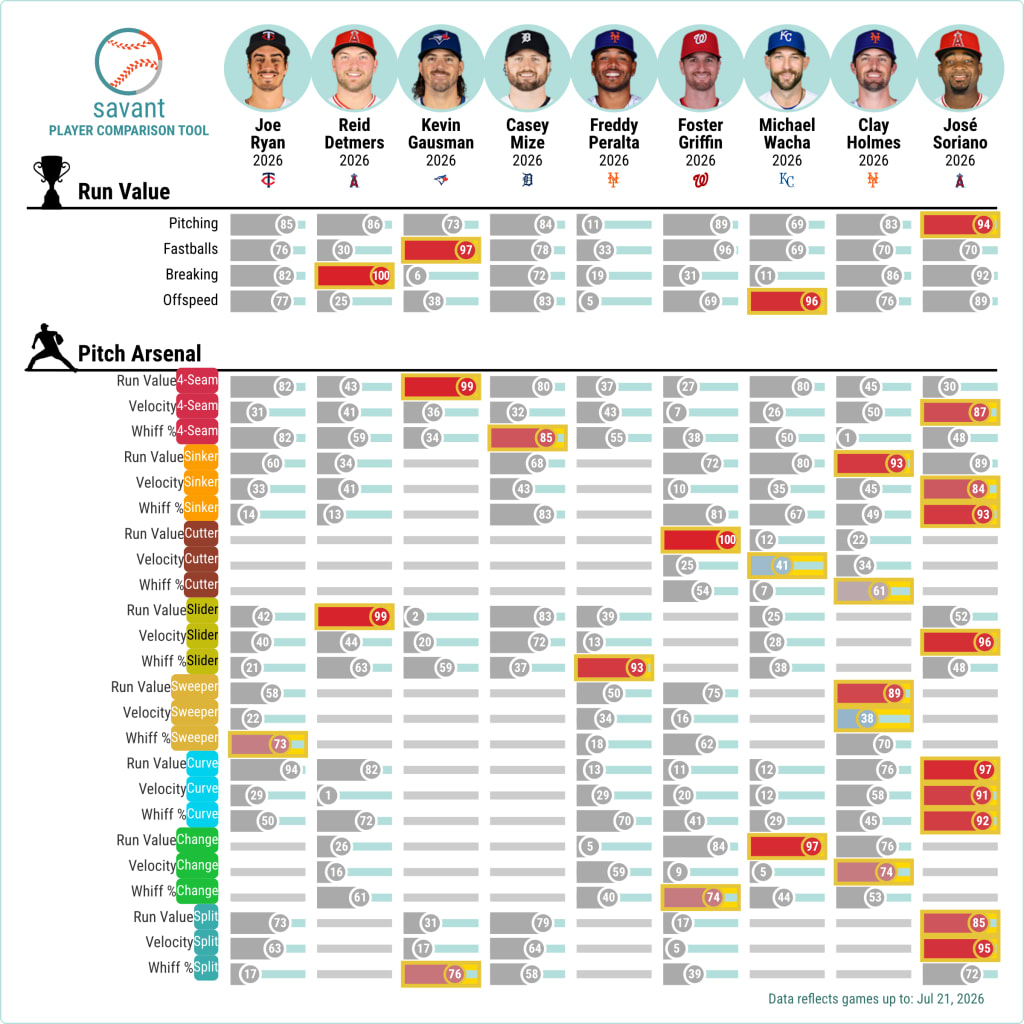
Now here are a few more insights we can glean from that …
5) Any team that needs a breaking ball specialist should go after Reid Detmers
Detmers ranks at the very top of the league in value generated from breaking pitches, and that all starts with his slider. The Angels lefty has thrown one of the nastiest sliders in the Majors this season -- it comes in at 86.1 mph and drops five inches more than an average slider. We don't want to discount his curveball, though, which has also been quite effective. Detmers' 78 total breaking ball K's this season -- 63 on sliders, 15 on hooks -- are sixth most in the Majors.
6) Don't gloss over Foster Griffin's reinvented repertoire, led by his cutter
Pitchers reinventing themselves overseas in Japan or Korea has become a trend over the last few seasons, and Griffin has become a prime example. The Nationals signed the 30-year-old lefty from the Yomiuri Giants in the offseason, and he's been so good in his return to the Majors that he even made the All-Star team. The cutter has been the key for Griffin. He's thrown his cutter 33% of the time this season, twice as much as any other pitch type, and it's been the most valuable cutter in baseball overall. At least raw stuff-wise, he's not a tantalizing frontline starter to trade for, but he could solidify a contender's rotation depth for sure.
7) Kevin Gausman's fastball-splitter combo is still very good
If you look back at our first pitcher comparison chart, you'll see that Gausman had the highest chase rate induced of any starter in the bunch. That's because his splitter is still a nasty, nasty pitch. The Blue Jays veteran righty is generating a 40.2% whiff rate on it this season, and the split works very well in tandem with his four-seamer. Gausman's heater has been one of the more valuable in baseball, with a +13 run value attached to it.
8) Michael Wacha's offspeed stuff can't be denied
Wacha was an All-Star this season for the first time since 2015, and he's a trade candidate mainly because he can be an inning-eater in any rotation that needs one on its way to the playoffs. But the Royals' veteran right-hander has at least one intriguing bread-and-butter pitch in his changeup, which has placed him inside the top 5% of MLB pitchers when it comes to value generated from offspeed pitches. It's not a wipeout Skubal-level changeup, but that changeup has let Wacha neutralize left-handed hitters even without overpowering stuff.
There's a lot more intel you can gather from the Player Comparison Tool, whether it's about trade candidates or anything else. So go test it out for yourself.