



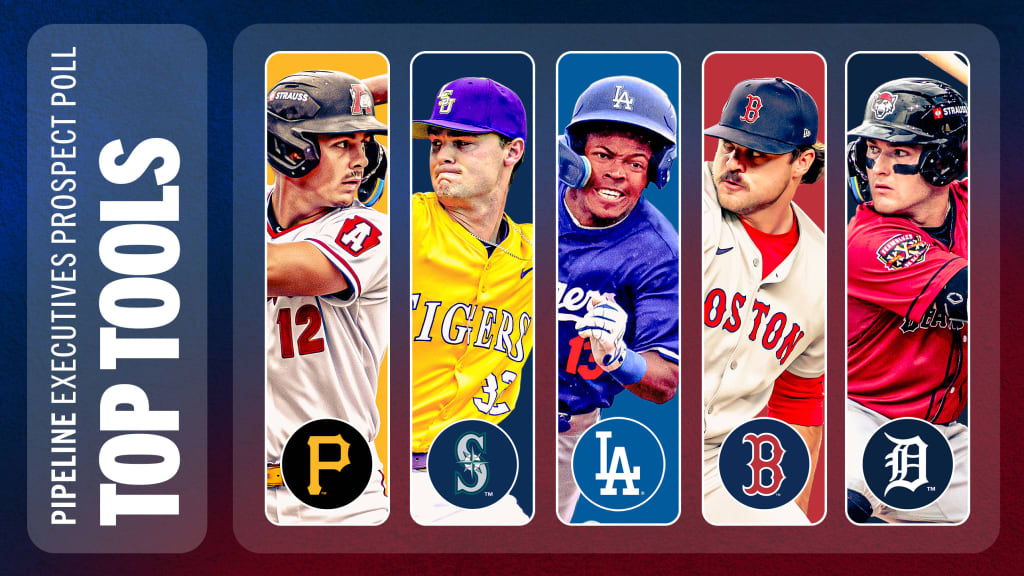
If we had a dime for every time we’ve said or used the word “tools” at MLB Pipeline … we’d sure have a lot of dimes.
Tools are, of course, the building blocks for prospects, and a lot of time is spent evaluating all of them to try to determine the value of a young player and especially how any given tool is perceived to play in the future at the Major League level.
That’s why we’ve turned to tools in Part 3 of the MLB Pipeline Executives Poll. After asking front offices across baseball who they thought would be this year’s Rookies of the Year and who the top prospects are, asking them about specific skill sets allows us to dig a little deeper.
MLB Pipeline Executives poll:
• Part 1: Rookie of the Year
• Part 2: Top prospects
• Part 3: Top tools
• Part 4: Farm systems
We asked execs about six total tools: hit, usable power and speed on the offensive side of the game; fastball, secondary pitch and overall pitchability on the mound.
Which prospect has the best hit tool?
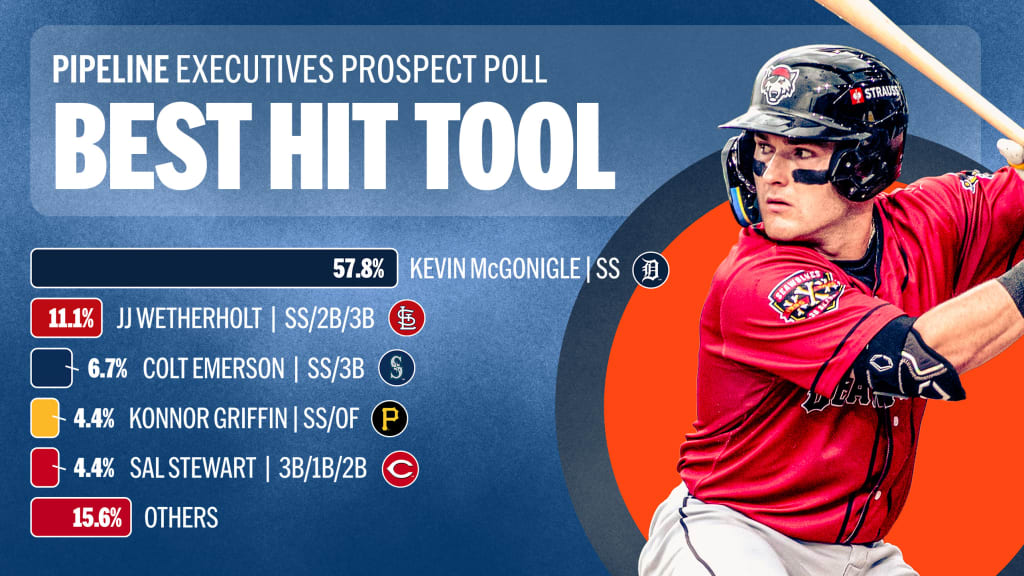
Also received votes: Franklin Arias, SS, Red Sox; Samuel Basallo C/1B, Orioles; Travis Bazzana, 2B, Guardians; Josiah Hartshorn, OF, Cubs; Ethan Holliday, SS, Rockies; George Lombard Jr., SS/2B, Yankees; Jesús Made, SS, Brewers
A year ago, Kevin McGonigle was in a tie for third on this list. Ahead of him was Walker Jenkins, who missed much of 2025 with injury, Jacob Wilson, who graduated from prospect status, and he was tied with fellow graduate Roman Anthony and Travis Bazzana, who had a down year. But while McGonigle missed time with an ankle injury last year, he still hit .305/.408/.583 while reaching Double-A, and now has a career .308 average with a .922 OPS (and an absurd 123/84 K/BB ratio). He solidified his “best pure hitter in the Minors” bona fides by winning Arizona Fall League MVP honors after hitting .362/.500/.710 and putting him on Rookie of the Year radars everywhere.
More from MLB Pipeline:
• Top 100 prospects | Stats | Video | Podcast | Complete coverage
He might be a distant second, but JJ Wetherholt is nothing to sneeze at from a hit tool perspective either. The No. 7 overall pick of the 2024 Draft, Wetherholt comes up in many ROY conversations as well after he hit .306/.421/.510 across the top two levels of the Minors in his first full year of pro ball. His K and BB rates are the same: 14.1 percent. Konnor Griffin received multiple votes here; you’re going to see his name a lot.
Which prospect has the most usable power?
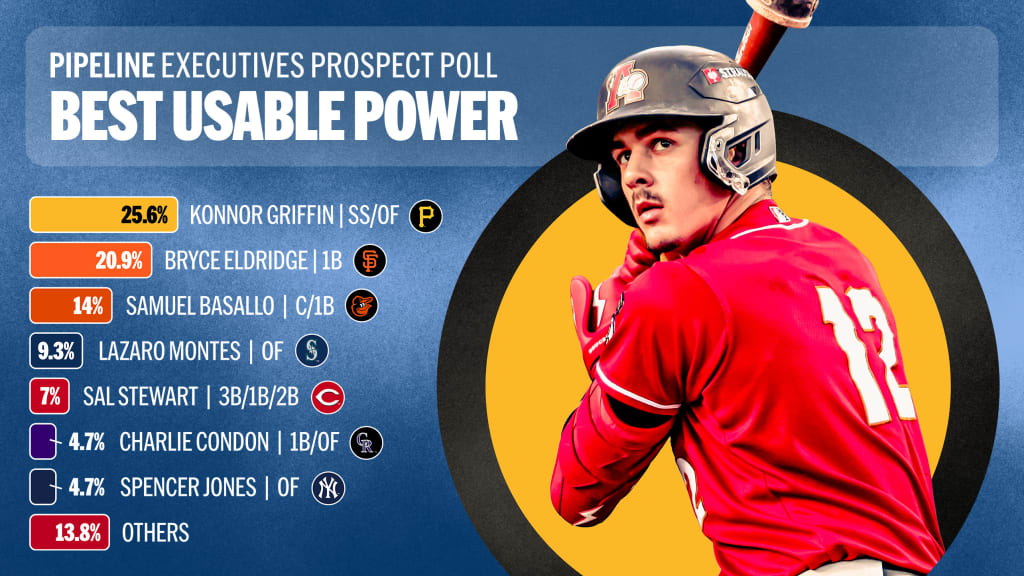
Also received votes: Kemp Alderman, OF, Marlins; Travis Bazzana, 2B, Guardians; Josue Briceño, C/1B, Tigers; Chase DeLauter, OF, Guardians; Zyhir Hope, OF, Dodgers; Kevin McGonigle, SS, Tigers
We specifically say “usable power,” because we wanted a snapshot of who the industry thought would mash in the big leagues. It’s interesting that Griffin landed in the top spot ahead of Bryce Eldridge, who topped this list a year ago. Some of this is because of Eldridge’s 29.3 percent K rate at the upper levels in 2025. Yes, he hit 25 homers too, but perhaps the swing-and-miss has some worrying about the “usable” part of the equation. Griffin entered pro ball with similar concerns about his ability to make enough contact to get to his easily plus raw power. He kept his K rate to 21.7 percent and made excellent adjustments as he moved up the system. The 21 homers he hit (along with a .333 average) might just be the tip of the iceberg.
Which prospect has the most speed?
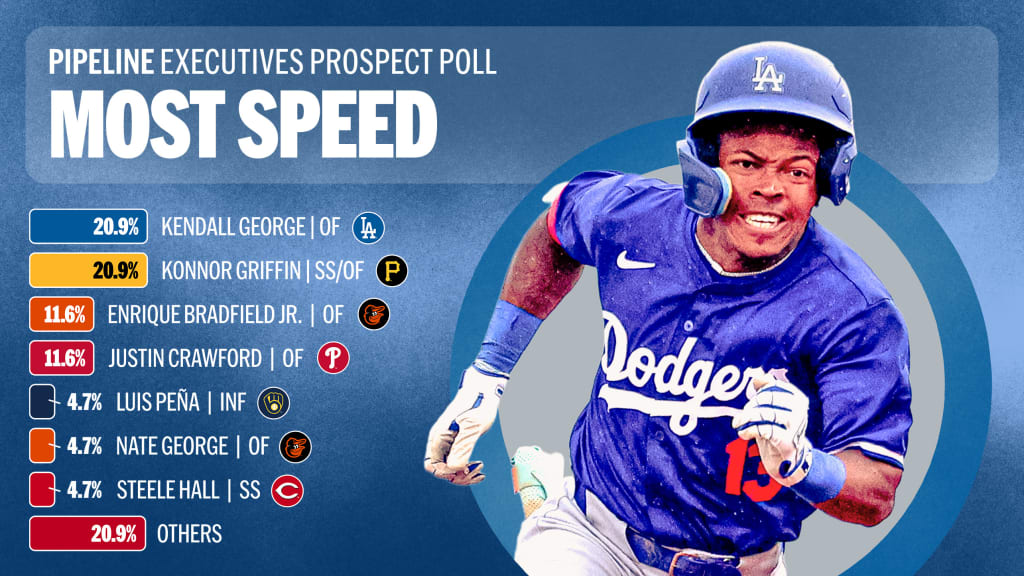
Also received voters: Homer Bush Jr. OF, Rays; Jake Cook, OF, Blue Jays; Leo De Vries, SS, A’s; Spencer Jones, OF, Yankees; Tyson Lewis, SS, Reds; Jesús Made, SS, Brewers; Jett Williams, SS/OF/2B, Mets; Eli Willits, SS, Nationals
Perhaps Enrique Bradfield Jr., last year’s leader, is being unfairly penalized for missing time with injury in 2025, slipping to third despite having 135 career steals in the Minors (vs. just 19 caught stealings) and going 17-for-18 in attempts in the Arizona Fall League. But Griffin-mania is sweeping the nation and he did, after all, use his 70-grade speed to swipe 65 bags in 2025. It was a little surprising to see him tie Kendall George, who led all Minor Leaguers with 100 steals (in 111 games). The feeling here is George would beat Griffin in a straight foot race but there might be some who feel Griffin’s speed is more “usable,” to borrow the term from the power discussion.
Which prospect has the best fastball?
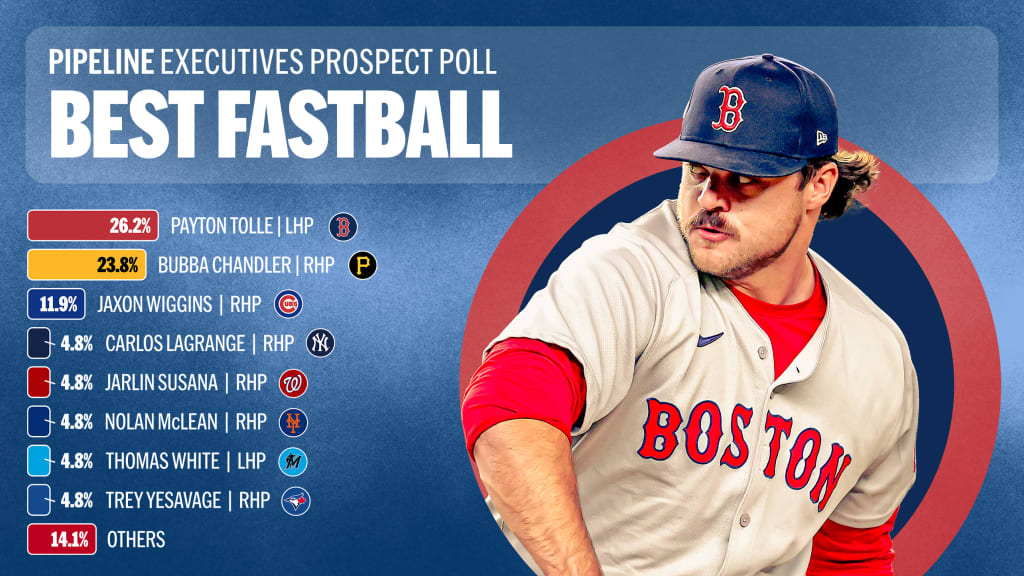
Also received votes: Raimon Gómez, RHP, Mets; Seth Hernandez, RHP, Pirates; Ben Hess, RHP, Yankees; George Klassen, RHP, Angels; Luis Perales, RHP, Nationals; Travis Sykora, RHP, Nationals
Of the 14 pitchers mentioned, only two are left-handed. One is Thomas White, who did receive multiple votes. The other is Payton Tolle, who jumped to the top of the list much like he jumped on the national radar in 2025. And it’s understandable why. With a fastball that averaged just under 96 mph -- topping out at 101, according to Synergy -- across all levels, Tolle used his elite extension and low release height to elicit an impressive 39 percent miss rate with the pitch (It was 29 percent during his big league debut.). Bubba Chandler isn’t far behind as one of two flame-throwers from last year’s survey to get multiple votes again (Jarlin Susana is the other). Between Triple-A and the big leagues, Chandler’s heater averaged 98 mph and produced a combined 32 percent miss rate.
Which prospect has the best secondary pitch?
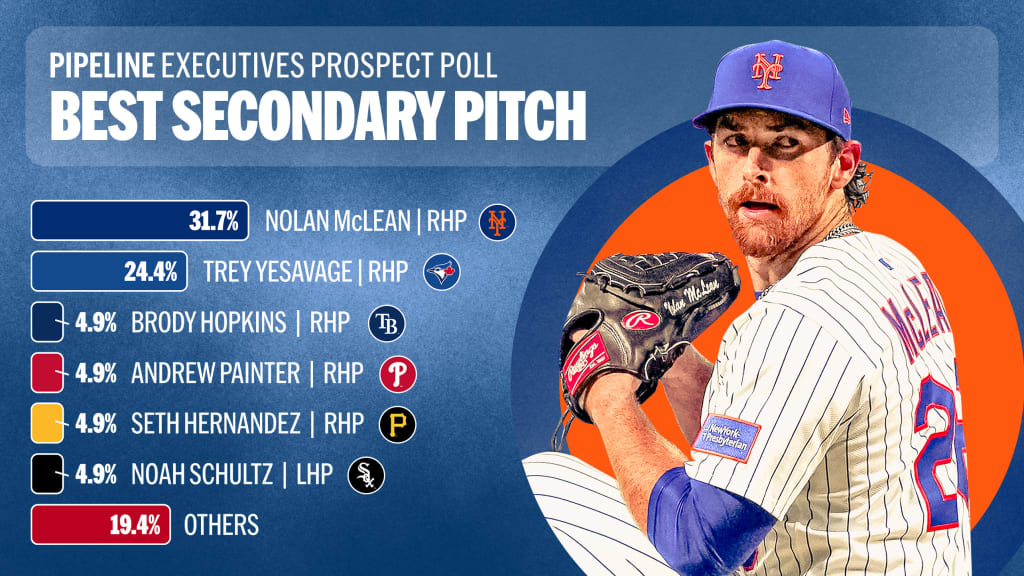
Also received votes: Kade Anderson, LHP, Mariners; Jamie Arnold, LHP, A’s; Jake Bennett, LHP, Red Sox; Bubba Chandler, RHP, Pirates; Jackson Ferris, LHP, Dodgers; Ryan Johnson, RHP, Angels; Gage Jump, LHP, A’s; Alejandro Rosario, RHP, Rangers; Jaxon Wiggins, RHP, Cubs
Anyone who watched Trey Yesavage in the postseason might have thought he and his splitter would run away with this one, and it did get plenty of support after the low-80s offering produced a 59 percent miss rate. That didn’t dip in the big leagues, including the playoffs, as the pitch elicited a 58 percent miss rate at the highest level. But it was actually Nolan McLean’s sweeper that won the day. He throws it a lot (22 percent of the time in 2025 across all levels, more than his fastball, per Synergy), and it’s a 70-grade pitch with elite spin and horizontal movement averaging around 15-16 inches at Triple-A last season. It didn’t miss as many bats as Yesavage’s splitter (30 percent in the Minors, 20 percent in the big leagues), but it was awfully tough to hit, especially in the Minors (.159 BAA).
Which prospect has the best pitchability?
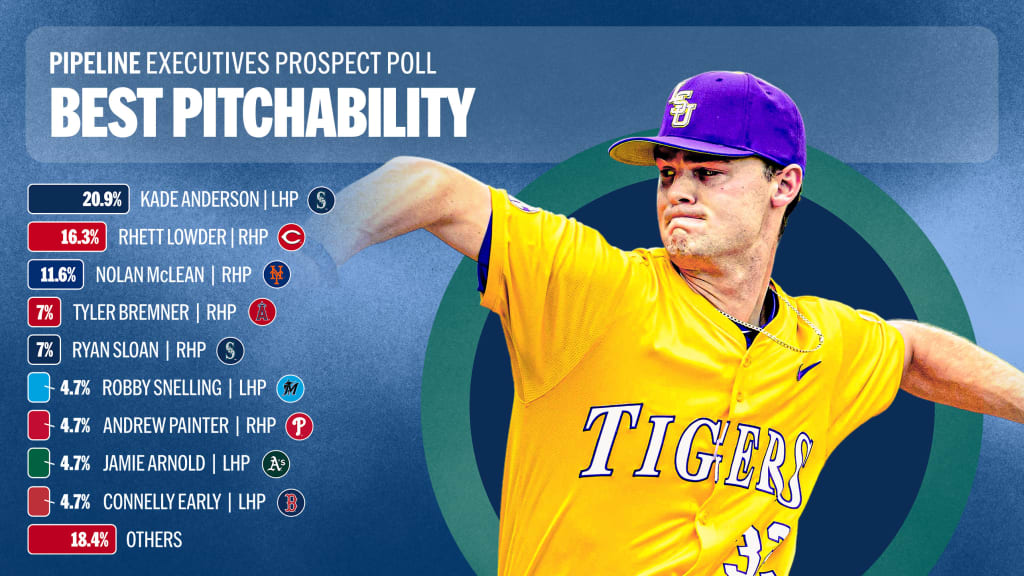
Also received votes: Cam Caminiti, LHP, Braves; Bubba Chandler, RHP, Pirates; Seth Hernandez, RHP, Pirates; Ryan Johnson, RHP, Angels; Jedixson Paez, RHP, White Sox, JR Ritchie, RHP, Braves; David Shields, LHP, Royals; Trey Yesavage, RHP, Blue Jays
“Pitchability” is a made-up word that sounds like what it is, a term used to describe a pitcher’s feel for his craft, his ability to command his stuff in the zone. This year’s leaderboard is bolstered by a trio of 2025 draftees in Jamie Arnold, Tyler Bremner and the leader, Kade Anderson. He went No. 3 in the Draft and a big reason was the confidence the Mariners (and other teams) had in his ability to throw his four-pitch mix – all of which are at least above-average – for strikes. He walked just 2.6 per nine at LSU in 2025 and he did a particularly good job of mixing his secondary stuff in the zone well (70 percent strike rate with his slider, curve and changeup combined). Last year’s leader, Rhett Lowder, is still in second place despite a lost year, with confidence that a return to health will enable the right-hander to get back to the guy who walked 2.3 per nine at Wake Forest and 2.1 in the Minors.