

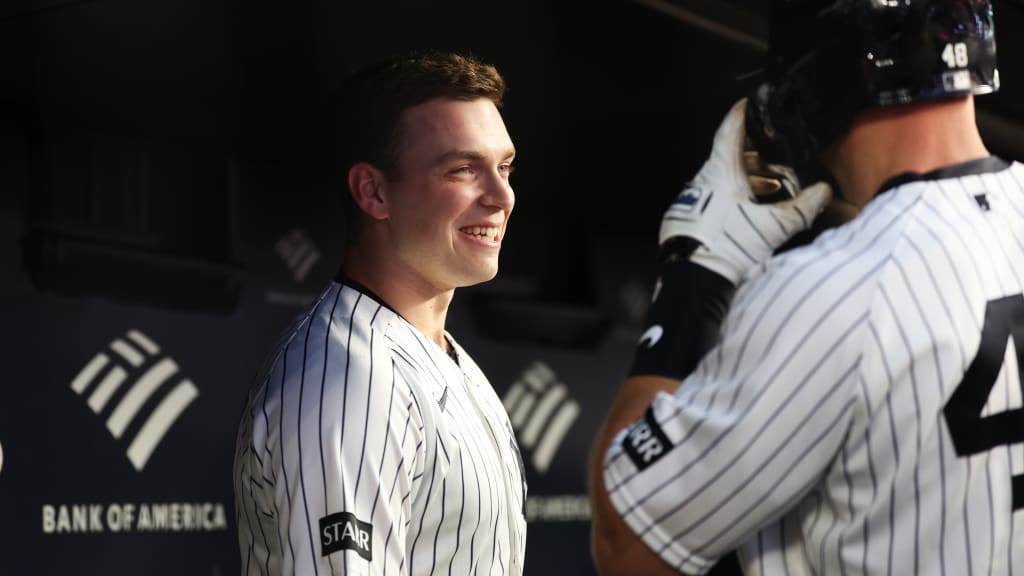
A baseball clubhouse is a sacred and strange place, with rules and codes and language dictating so much. Different people are allowed to do different things, say different things, go different places. The metaphors are truly everywhere.
This isn’t the type of thing that most people get to see, but if you could ever find yourself with a fly-on-the-wall opportunity to watch baseball players in their native environment, there’s plenty to absorb. Who is next to an empty locker? Who’s controlling the music? Whose shoe collection is exploring the studio space and who keeps things neat and tidy? Again, there’s a language to all of this. It all has meaning.
During Spring Training, it’s all a bit on the nose. To account for the overflow conditions in a preseason clubhouse, the Yankees, like most teams, bring in temporary lockers that fill the middle of the room, ringed by the permanent stalls against the outer walls. You can learn plenty about the roster hierarchy just by taking a 360-degree view. As you walk into the home clubhouse at GMS Field in March, the outfielders are mostly in the far-right corner. The pitchers line the left wall. The catchers are straight ahead, situated between the doors to the batting cages and those to the showers. There are outliers, of course, but the blueprint tells most of the story.
In most cases, the temporary stalls go to the guys on the rise, those trying to get noticed during the spring schedule. As Opening Day nears, and as players get sent over to Minor League camp, the middle of the room becomes a graveyard of departed souls, right up until the 26-man roster is set and the big leaguers head north.
It was hard not to be taken aback this year, then, to see Ben Rice serving as a notable exception to baseball’s metaphorical growth chart. The Dartmouth alum and Massachusetts native was positioned in a temporary corner stall directly across from Austin Wells on one side and Aaron Judge on the other. Rice first reached the Majors two seasons ago and spent the entire 2025 season with the big league club, and his bat speed and power potential have been turning heads ever since the July 6, 2024, afternoon against the Red Sox in which he became the first Yankees rookie to have a three-homer game. But if he was essentially dressing in the Minor League section of a Major League clubhouse, it was no accident.
“That locker has been my spot the last couple camps,” Rice says. “But I guess it’s somewhat of a metaphor, balancing the positions that I was playing.”
Now in his third season and firmly established as one of baseball’s rising stars, Rice occupies a strange place on the baseball map. Drafted and developed as a catcher, he mainly plays first base. Through June 15, he hadn’t caught a single inning this season, after playing 36 games at the position last year. Ask anyone on the roster, and they’ll say that Rice is a first baseman, but that doesn’t change the fact that he attends nearly every meeting with the pitchers and catchers, that he studies data for pitches he’ll almost certainly never catch. He is prepared for everything, including the things he probably doesn’t need to know. “There’s a lot of catchers who play first base, but there’s not a lot of first basemen who catch,” Rice says. “So, it’s definitely a unique role, and it’s something I take pride in.”
Rice has plenty to be proud of these days, and much to look forward to. But as he continues to establish himself as a leader on and off the field, it’s the smaller, hidden elements -- the metaphors he represents and the bonds they help forge -- that will help him truly rise to the top.
“He goes about his work like a guy who’s been in the big leagues for 10 or 15 years,” says third baseman Ryan McMahon. “He’s really impressive, man. His conviction in what he’s doing, his belief in what he’s doing and his execution of going through his work, it’s just awesome to see.”
***
Some guys you see coming long before their time. Spencer Jones, like Judge and Giancarlo Stanton before him, could do little to hide his gigantic frame, the offensive might plain to see. Other hotshot prospects debut after years of hype; suffice it to say, whenever George Lombard Jr. gets the call to the Majors, his arrival won’t be particularly quiet.
Rice wasn’t a prospect on that level. He’s an unassuming 6-foot-2, the type of stature that might stand out on a subway but not among professional athletes. He never rose higher in most outlets’ rankings than the top dozen or so Yankees Minor Leaguers, and while the most obsessive prospect-watchers were noticing his impressive bat speed metrics and the home runs that swing produced, few if any gen-pop fans knew about him before his stunning offensive breakout during the 2023 Minor League season.
“I remember hearing about the Northeast kid in our Minor League system, that this guy can really hit,” Yankees manager Aaron Boone says. “He showed that the first Spring Training I ever saw him.”
You can understand fans’ reluctance to put all their faith in Rice; there’s a long list of powerful Minor League bats that never develop into Major League studs. For a 12th-round pick out of a school more likely to produce politicians than power hitters, it was fair to dismiss some of the early signs of what could come. Even after the historic three-homer game in 2024, few predicted that Rice would emerge as a slugging complement to Judge. “He had some good moments for us in ’24, but also some real struggles,” Boone continues. “Last year was kind of a coming-out party for him. And I think he famously hit into some tough luck in and around a great season.”
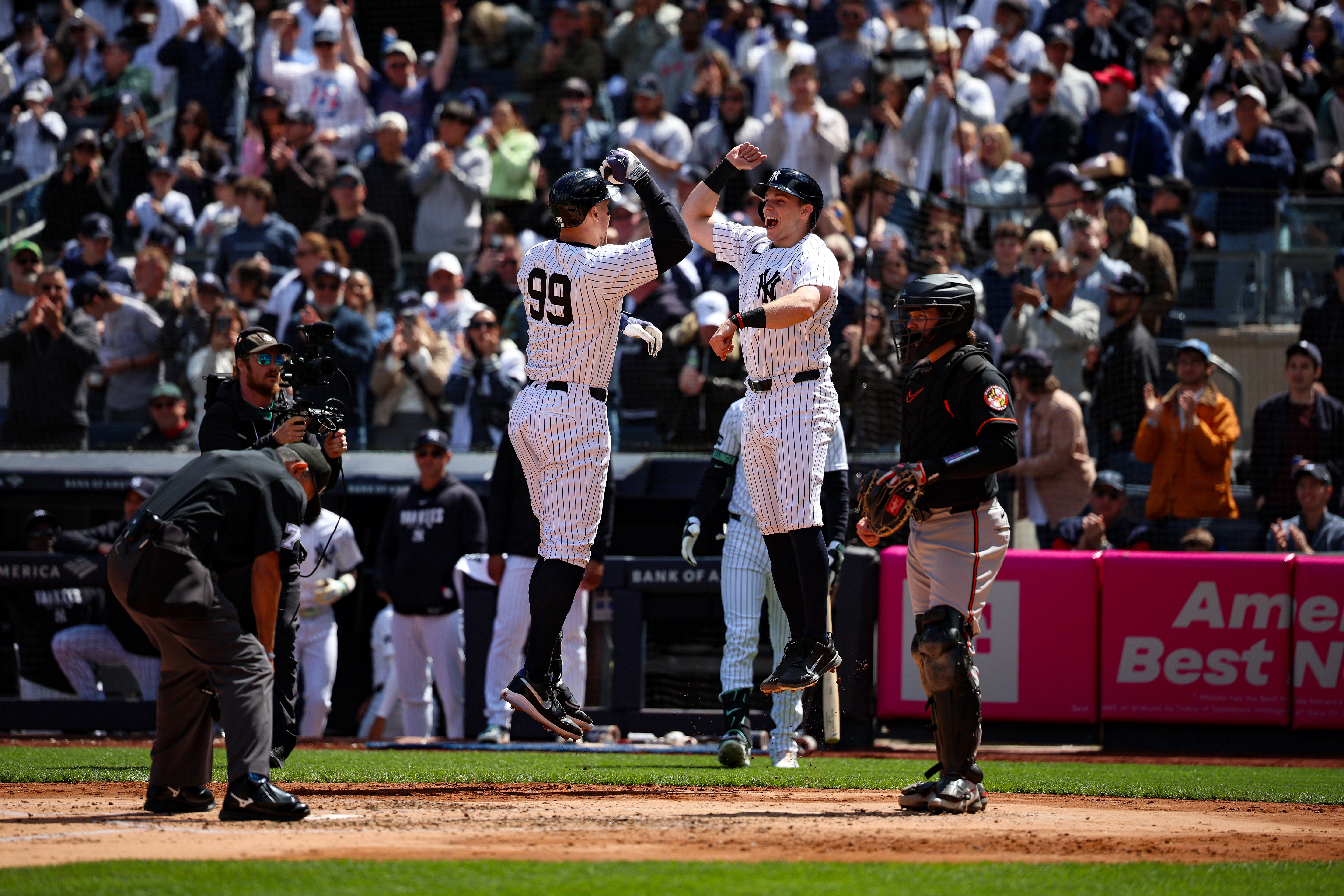
That reintroduction in 2025 better resembled a rocket launch, the type of blast Rice’s bat was producing more and more. He proved that he could hit lefties as well as righties, demonstrating elite-level exit velocity and bat speed metrics. Despite the bad luck Boone mentioned (Rice hit .255 but had an xBA of .280, which would have put him in the top 8% of the league, per Statcast), the slugger still mashed 26 long balls for a team that had been searching for reliable power from the first-base position.
It was thrilling and impactful, the happiest kind of baseball surprise. Except, for the players who had long been around Rice in the Minors, it was anything but shocking. “He’s doing what he’s always been doing,” says catcher J.C. Escarra. Or as Jasson Domínguez says, “If we’re talking about hitting, he always hit. I mean, since I’ve known him, since he’s been on the roster here, he’s always been a good hitter.”
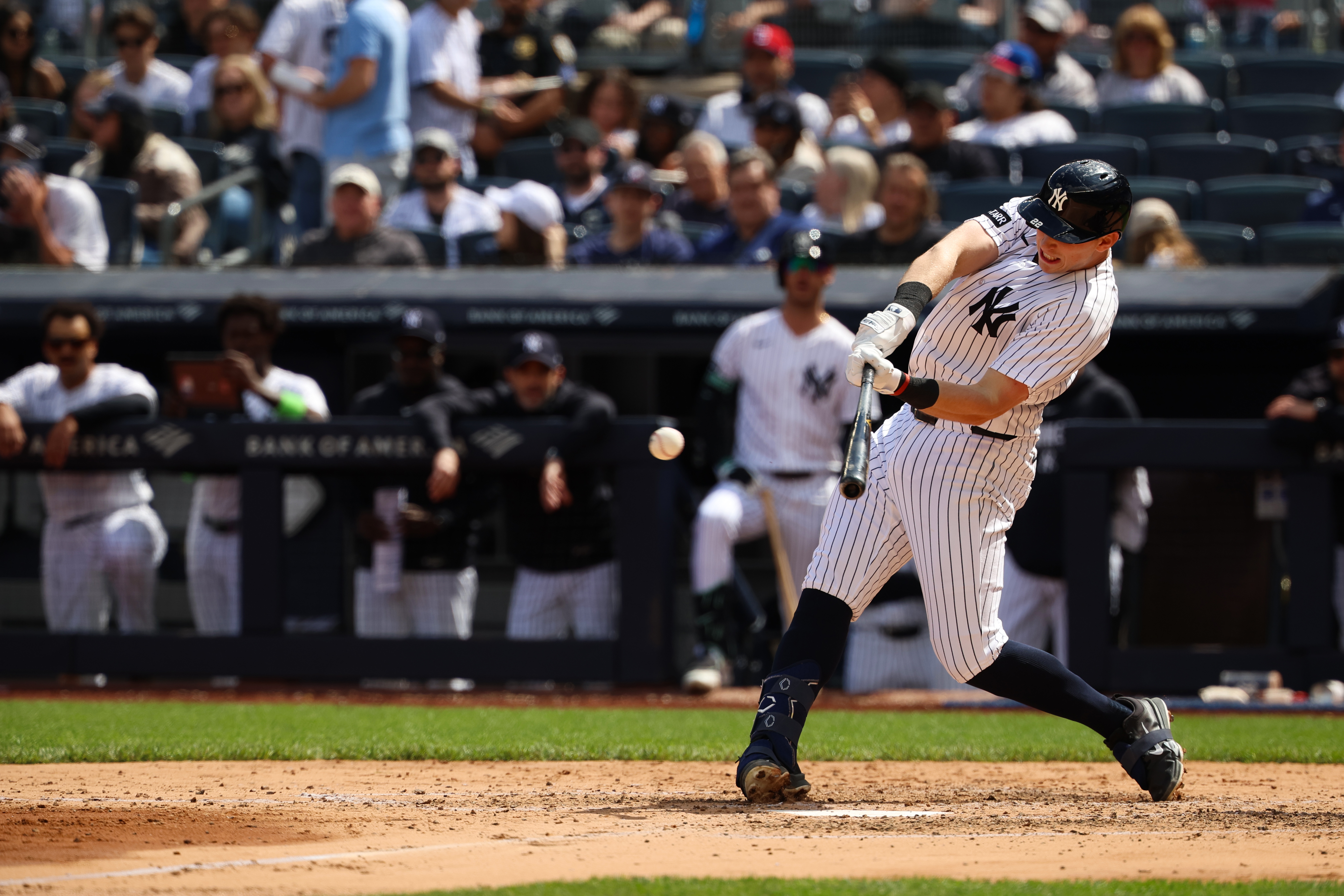
That type of praise -- “he’s always been a good hitter” -- feels like an introductory clause to a “but.” Yet even when discussing Rice’s defense, whether at first base or behind the dish, teammates have nothing but compliments to offer. In Domínguez’s case, he suggests that he is surprised by the strides Rice has made at first, mostly because of how much work he watched him put in as a catcher in the Minor Leagues. At the big league level, though, the Yankees have two dependable backstops in Wells and Escarra (both of whom, like Rice, are left-handed hitters, so there’s no platoon advantage to be found in any corner of the roster).
Ryan Yarbrough notes the value in having a legitimate third catcher on a 26-man roster, a luxury few teams enjoy. While no one is comparing Rice to Shohei Ohtani, there’s a symmetry in the way that Rice can fill two roster spots with one body, giving the front office flexibility around the margins. And there’s also the knowledge that, while no one ever wants to contemplate the situation that might force an emergency catcher into a game, Rice is far more capable behind the dish than most players put in that position.
“We’ve got three guys who can get behind there, and you feel really comfortable with them being back there,” Yarbrough says. “I think it’s been really cool, especially being able to pick his brain about things. ‘Hey, what are you seeing with this or that?’ Last year, when I threw with him a couple times, I was picking his brain throughout, and he really has a good grasp of everything.”
***
The trick, says nearly everyone surveyed (including Rice), is a near-maniacal devotion to preparation. “It’s not an accident,” says Paul Goldschmidt, a likely Hall of Famer who platooned at first base with Rice last season and came back this year despite knowing that his young teammate would be claiming even more playing time. “He’s not just going to out-tools a guy out there. He’s not just going to run into some balls on accident. He’s got a plan for everything he does.”
Goldschmidt’s point is echoed by pitcher Max Fried, who pitched against Rice in 2024. “You knew that he had pop,” Fried says of the scouting report the Braves had on the rookie. “I don’t think that I would expect him to be this caliber of hitter, but once I got inside the building and got to know who he is as a person, see the work ethic, it’s not all that surprising.”
To Rice, it’s all perfectly simple, even if the workload is extreme. “It’s all about preparation for me,” he says. “If I’m prepared, I will feel confident. I’ll feel confident as a catcher. I’ll feel confident as a first baseman. I’ll feel confident as a hitter. It’s all about my preparation. I want to prepare every day for everything that could come my way. And that’ll help me feel free and feel calm when I’m in between the lines.”
Feeling calm is the goal because calmness equals comfort, and comfort is everything in baseball. It’s why Rice never stops taking in data, in ways that might overwhelm other players. Coaches struggle constantly with balancing which players want more information and which want less. Rice is decidedly among the former.
The meetings can wear players down, but when he’s not taking in data, he’s putting it to work in the batting cage. The more he learns about pitching, the more Rice can put it toward his offensive game, all the while ensuring that if needed behind the plate, he’s ready for that as well.
“We have friendly banter with him about being in our meetings and all that,” says pitcher Ryan Weathers, who came to the Yankees this past offseason and through mid-June had yet to witness Rice catch a real game. “Like, ‘You don’t want to catch us this year? You just want to come to all of our meetings?’ Just messing with him about that.
“I have no doubt, if he had to catch right now, he would be perfectly fine. That’s just in his DNA. He’s a hard worker. He hasn’t caught one game this year and still takes notes about how we should attack guys. And that’s just a credit to him as a player.”
It’s about experience, about seeing more and learning more and therefore knowing more. And for Rice, that comes with the added opportunity to share more, as well. Not just with his pitchers, but also with the guys coming up behind him.
Rice may be a relative newcomer on a roster laden with veterans, but the 27-year-old maintains a fundamental insistence on being a support system. When Jones was summoned to the big leagues on May 8, he made a beeline for Rice. “I told Ben this morning, I’m going to be attached to his hip today,” Jones told MLB.com.
Rice was a friendly face and a welcome sight for the Yankees’ newest big leaguer, understandably overwhelmed by everything changing in his life. Like all players, Rice had been there before, and he understood what Jones was dealing with, so he made a point to help the 6-foot-7 outfielder find some Zen amid the insanity, while also managing to pass along some unwritten rules of the road. You reach the Majors because you work hard and enough people believe in you. The last step, making sure that you believe in yourself in that moment? That was what Rice was determined to impress on Jones, the same way he does for everyone in his circle -- a message that is particularly resonant coming from someone not far removed from the sensation.
“I’m there if they’ve got any questions or need to know the lay of the land, how they’re supposed to do things,” Rice says. “I know from being in their shoes, I was always looking to those young guys on the big league roster if I needed some guidance.”
Whatever their role, whatever their service time, his teammates notice.
“He brings a very chill vibe,” Wells says. “He gets pumped when guys are doing great, and he picks guys up really well. He’s a great clubhouse guy, and he’s always grinding. He’s always working.
“But his ability to go in the meetings and be able to retain the information? That’s Ivy League brain.”
***
Rice isn’t the only Ivy Leaguer in the Yankees’ clubhouse. Bench coach Brad Ausmus is another Dartmouth alum and a guy who knows plenty about catching in the big leagues. Back home, though, when he leaves the ballpark, Rice finds even more representation of the so-called Ancient Eight.
His girlfriend, Sara Falkson, played field hockey at Dartmouth, where she earned a degree in human-centered design before moving on to Harvard to pursue a master’s in design engineering.
“We’re both nerds,” Falkson says, laughing. “We’ve been picking up chess. I don’t want to say he’s winning, but he’s brilliant. And he beats me more often than I’d like to admit, unfortunately.”
Falkson’s putting her engineering degrees to good work with a company that she launched called Robyn Athletic, a brand of high-performance athletic gear meant to empower women by focusing on fit and body confidence. Aiming to launch with meticulously designed sports bras and shorts in spring of 2027, Falkson knows confidence is comfort, and that too often, women athletes are underserved by sportswear companies that, as she says, insist on a “shrink it and pink it” approach: take gear for men and just make it smaller and a bit more colorful for women. While no male professional athlete would ever be expected to perform in gear that fits poorly, women are often afterthoughts. Falkson notes that 50% of girls drop out of sports around age 14 due to body confidence issues, an unacceptable loss especially in an era that is seeing huge growth in the popularity of women’s sports.
“We want to design for female athletes by female athletes,” Falkson says, “because there’s just different things when it comes to the way you might chafe in certain areas or the fear of wearing white shorts to practice because you’re scared of bleeding through. Different areas that don’t necessarily come to life unless you’ve lived it.
“One thing that I really live by is confidence comes from knowing you’re prepared.”
Falkson’s words, perhaps unsurprisingly, almost perfectly echo Rice’s own comment linking comfort with confidence and preparation. “You can tell we spend a lot of time together,” she says. “But confidence also comes from being in an environment where you feel supported and like the best version of yourself.”
Rice is taking that ethos to another level entirely. Shortly after he debuted, a video went viral of him shocking the Reds’ Elly De La Cruz at first base by speaking in Spanish with a perfect Dominican accent. He has been studying the language since middle school in Cohasset, Mass., which is no different from many of his teammates and friends. But where most people max out at asking for an apple or for directions to the library, Rice -- or Ben Arroz as his Spanish alter ego is known — has become fluent, and not just in the stuff you’ll find in a textbook.
“He just came out of nowhere, pronouncing words that are not common,” says pitcher Fernando Cruz. “And I was like, ‘Bro, what are you? Are you serious? Where are you from?’ I thought he was, like, from somewhere in Latin America. Really, really deep. The words that he was saying had some kind of slang in it, too. It was like, ‘Bro … this is impressive!’”
As with most things in Rice’s world, there are practical and personal reasons. From a competitive standpoint, a catcher who can speak to his pitchers without needing an interpreter can be more effective. But there’s a distinct humanity in the strides that Rice takes as well. He notes that while he makes the Spanish sound easy, he feels utterly exhausted after just a 45-second interview in his second language, then thinks about Spanish-speaking teammates such as Amed Rosario who have had to endure crucial English-language meetings multiple times a day for years. “It just gives me another way to connect with my teammates and go that extra mile,” he says.
To Falkson, who has known Rice since high school, none of this is particularly surprising.
“He really leads with empathy and putting himself in other people’s shoes,” she says. “I think he always tries to hear everyone’s story and support them in any way possible. He knows that everyone’s experiences and everyone’s story contribute and bring value to the team, no matter what.
“I think that’s where you can really see the synergy between connection and performance and confidence. We can’t expect people to perform their best if they don’t feel like their best selves in a given environment. And I think getting to know people as people and not just athletes is really important, too.”
***
Weathers and Boone both grew up in clubhouses, and both are fully aware of the advantages that they had while climbing the baseball ranks. They understood how the rooms worked, the rules, the metaphors. But even among those who didn’t have fathers and brothers and grandfathers with big league bona fides, there is no doubt that some players have an easier road than others.
Oftentimes -- especially for American-born players -- comfort is assumed. Confidence is expected. And while everyone wants to be the teammate who can bridge gaps and reach across cultural divides, few do it on the level of the Yankees’ 27-year-old third-year stud. Being bilingual isn’t a magic trick. It’s a concerted effort that a young player has made to better serve his own career and the careers of everyone around him. It’s barely different at all from a brilliant young woman putting a pair of Ivy League degrees behind an effort to support other young women’s dreams.
“Understanding people’s values, people’s why, and making sure that they feel comfortable and supported to be their authentic self is where people can perform their best,” Falkson says.
That’s why Rice made sure that Jones had all the support he needed when he reached the bigs. But too often, baseball clubhouses -- even the tightest, most functional ones -- break down along cultural lines. It makes sense; you want to talk to the people who speak your language, whether you’re a Panama native in New York or an American in Japan. Those are the guys you’re inevitably going to get to know best. And when there aren’t a lot of people who you can talk to, says José Caballero, “you’re almost by yourself in the whole journey.”
Does attending every pitching meeting help a first baseman at the plate? Probably. Does it help him understand how opponents might game plan for him, how they might attack? Almost certainly. Does every edge help? Of course.
And maybe that’s the reason Ben Arroz has emerged with pitch-perfect Dominican slang, just to make sure he can have the quickest possible conversation with a pitcher on the mound. But Rice’s teammates see something even more important.
“I think that’s the only way we have to know each other more and know the culture, know how a person really is,” says the Puerto Rican Cruz, notably in perfect English. “If you don’t know the language, you’re just mimicking everything, imagining everything. But you don’t really know the person. People go from this game, go out of this game, not getting to know a lot of their surroundings. They retire, and they don’t even know who was on the other side of the locker room. And that’s how important it is. You’re surrounded by people that you don’t know who they are? It’s really hard.”
Baseball is always going to be hard. No matter how much work Rice puts in, no matter how many meetings he attends or languages he learns, there are going to be struggles. There are going to be slumps and freak injuries and moments when nothing seems to work.
All that Rice can do, then, is prepare. To create a state where he can be confident and calm and comfortable. If the Yankees need a catcher, he’ll be ready. If they don’t, he’ll be fine. And if his preparation can make everyone around him more comfortable, themselves? That might be the most value a player can possibly add.
Jon Schwartz is the deputy editor of Yankees Magazine. This story appears in the June 2026 edition. Get more articles like this delivered to your doorstep by purchasing a subscription to Yankees Magazine at www.yankees.com/publications.