

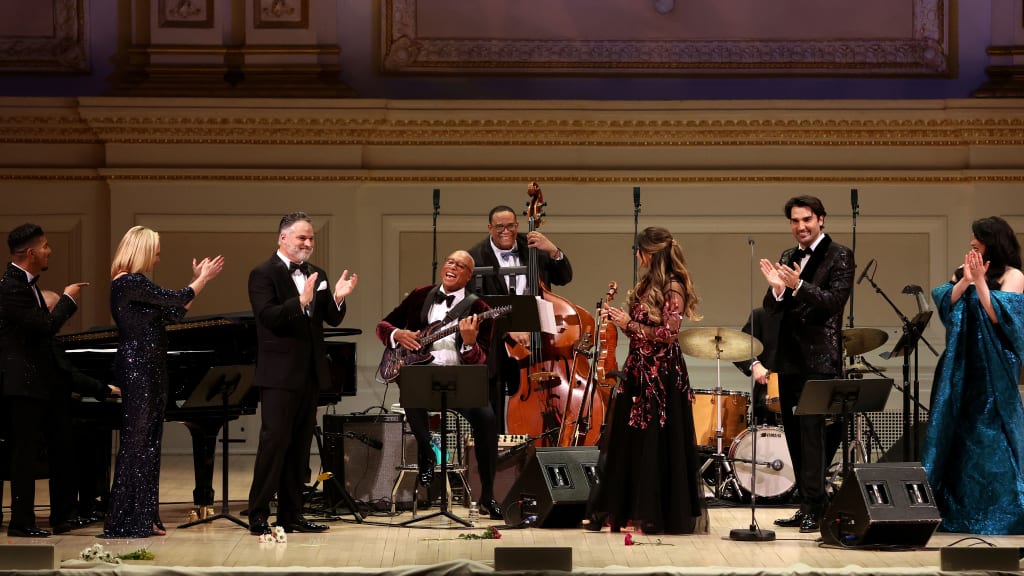
As the legendary Yankees center fielder stepped into the spotlight on one of the world’s most famous stages, a familiar chant, emanating from fans seated far away, filled his ears.
“Ber-nie Wil-liams!” clap-clap clap-clap-clap
“Ber-nie Wil-liams!” clap-clap clap-clap-clap
The Bleacher Creatures had made their way to Carnegie Hall, trading their usual aluminum benches in Yankee Stadium’s right-field stands for the plush red chairs of the Isaac Stern Auditorium’s second tier. “Section 203 gets cultured,” wrote one Creature, Marc Chalpin, on Instagram.
They were there to support Williams -- who has turned his focus to jazz guitar since retiring from baseball in 2006 after a decorated 16-year career in pinstripes -- in his most ambitious musical endeavor to date: co-headlining Carnegie Hall with world-renowned opera tenor Jonathan Tetelman. Joined by musicians from the Metropolitan Opera, a choir from the Manhattan School of Music and an array of special guests, Williams and Tetelman curated a wide-ranging program that pushed both performers outside of their comfort zones, highlighted the immense talents of every person on stage and provided something for everyone in attendance.
Two hours later, after Tetelman and Haley Steinbrenner Swindal had belted out “New York, New York” to close out the second set and earn a standing ovation, emcee Darren Rovell stepped forth and addressed the sellout crowd:
“Carnegie Hall opened in May of 1891,” he said, “and I think it’s fair to say that this hall has not seen anything like tonight.”
***
The Jan. 13 concert was the brainchild of 40-year-old Adam Unger, founder of All-Star Encore. The Long Island native, an opera singer himself, first met Williams while serving as a Yankees batboy decades ago, and the two connected over their shared love of music. For years, as he watched Williams’ music career advance, he dreamed of pairing the guitarist with one of the world’s greatest opera singers. He found the perfect complement in Tetelman.
Born in Chile, the 38-year-old tenor was raised in New Jersey and schooled in New York City. He is universally acclaimed -- “the American Pavarotti” Unger calls him -- performing regularly at the most venerated opera houses throughout Europe and the rest of the world. But Tetelman’s wish isn’t to perpetuate the staid traditions of going to the opera, a formal affair reserved for the upper crust. He seeks ways to branch out and reach new ears, and performing with Williams for a crowd that comprised not only Yankees fans but several groups of New York City schoolchildren -- including 300 kids from different organizations in the Bronx whose tickets were provided by the New York Yankees Foundation -- was a golden opportunity.
“It’s my mission to try to conjure the same feelings and the same passion that I have for this art in everyone because I feel like there is a place for everyone’s emotion in this music,” Tetelman said from Germany during a phone interview two weeks after the Carnegie Hall concert. “It’s not just for the rich people or the cultured people. I think this music can touch you no matter how far you are away from it.”
As the head of All-Star Encore, “where sports, music and culture collide,” Unger worked to bring in talent from every arena. He partnered with New York City basketball legend Stephon Marbury to promote the event. He tabbed Rovell, the former ESPN personality, to host. Violinist Katia Lindor -- whose husband, Mets shortstop Francisco Lindor, was in attendance, along with their three young children -- performed. Steinbrenner Swindal, the granddaughter of the Boss who, in addition to spearheading many of the Yankees’ community efforts, has had success on Broadway as an actor and producer, was a natural addition to the lineup.
“I was in Chicago on Broadway for a very long time, which is the same composer as ‘New York, New York,’” she said. “So, for me, it’s kind of like my Broadway career meeting my baseball career, and what better night to do it than for Bernie?”
Williams welcomed family members and longtime friends from near and far to the show, including several former Yankees who expressed their pride -- but hardly surprise -- in seeing what he has accomplished in the music realm, including earning a degree in jazz performance from the prestigious Manhattan School of Music.
“He was different than your average ballplayer,” said David Cone, now a YES Network analyst who played six seasons with Williams. “He had his eyes on bigger and better things down the road. I saw how dedicated he was and how good he is, how much he wanted to get better -- just like baseball. That’s why he went back to school and learned his craft, continued his education, and this is what we get tonight.”
“When he told me about this, I said, ‘I have to go,’” said Tino Martinez, whose name often appeared in the Yankees’ lineup alongside Williams’ as they won four World Series together in five years. “We had a world-class baseball player who played the guitar throughout our bus rides and on the airplanes, and we didn’t know how good he was or how good he was going to be, but obviously he has taken it to a whole other level.”
As a coach on those championship teams, Willie Randolph recalled how they would sometimes needle Williams, imploring the guy with the acoustic guitar on the plane to knock off all that racket as they flew back to New York. “Just busting his chops,” Randolph said with a grin. To see that quiet, humble, yet fierce competitor co-headlining Carnegie Hall all these years later filled Randolph with awe.
“How many guys can you name that mastered both?” Randolph said. “There have been athletes who have done rock and pop or whatever, but not classical in Carnegie Hall! I’m so proud of him, and I would never miss this.”
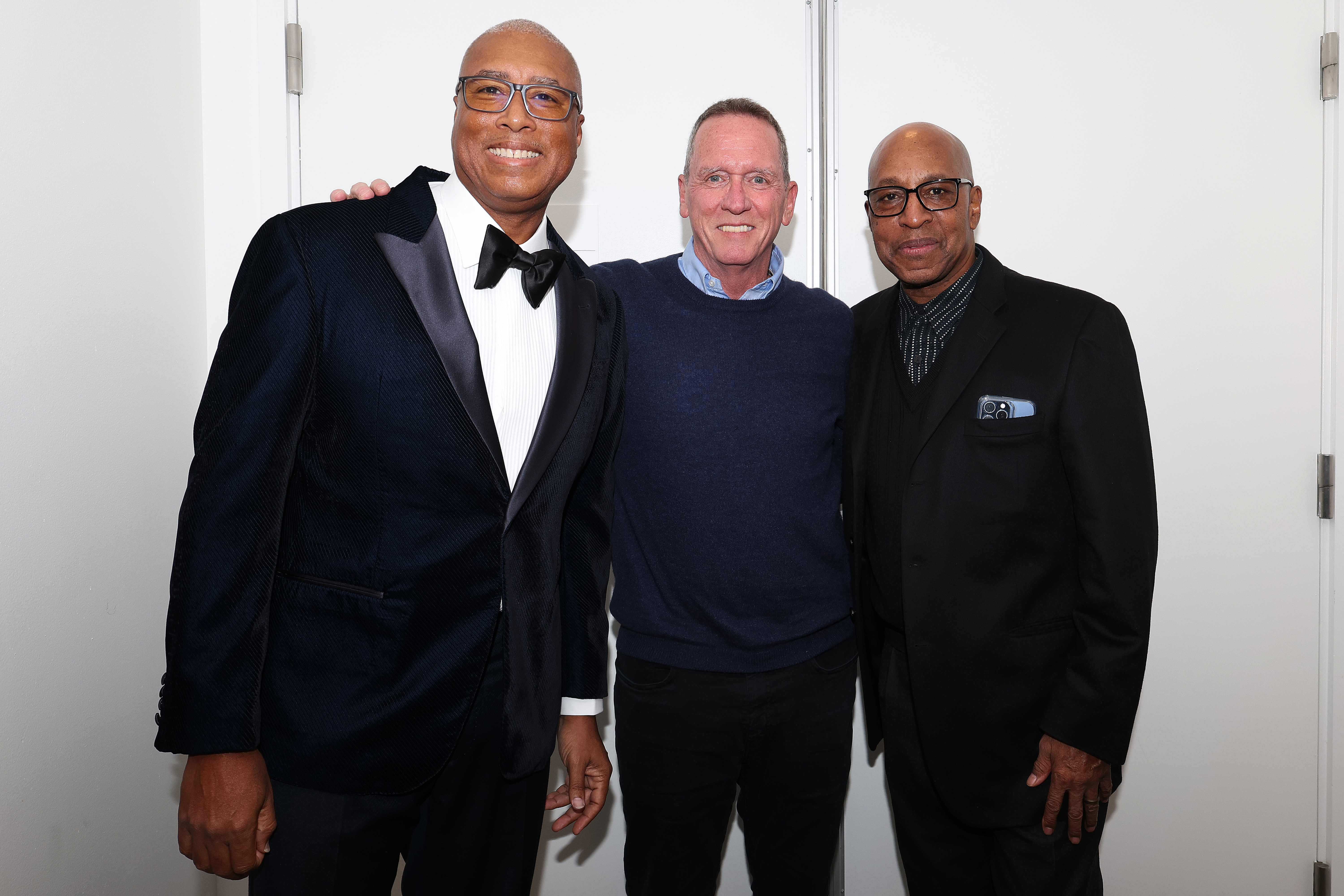
The stage had been set for an incredible evening, but it would only be as good as the music, and the eclectic mix of songs and musicians involved had Williams feeling nervous in the run-up to the show. As was the case during his playing days, preparation was key.
“You know what they say, ‘How do you get to Carnegie Hall? Practice, practice, practice,’” Williams said about an hour before taking the stage. “And I’ve practiced a lot.”
***
On Jan. 13, 1900, Tosca was set to premiere in Rome, but it was a turbulent time in Italy, and a bomb threat postponed it by a day. The three-act opera remains one of famed composer Giacomo Puccini’s most revered works, with the aria “E lucevan le stelle” becoming a standard of the genre. It is a haunting tune, sung by a man about to be executed, and its melody is traditionally played by a single clarinet.
More than 125 years later, translating it to guitar was causing a different sort of unrest for Williams.
While jazz in its many variations comes naturally to the 57-year-old, backing up Tetelman on “E lucevan le stelle” would require serious dedication. It is a slow, emotionally wrenching piece that relies on feeling rather than a steady beat; there are no drums. “The notes needed to be played with this sort of special cadence that only classical players know,” Williams said during an exclusive interview with Yankees Magazine in late January. “To breathe life into the part, I needed to do a lot of research because I wanted to play it as genuine and as true to form as I could.”
He took notes from everybody who was familiar with the piece. He studied videos of the greats -- Plácido Domingo and Luciano Pavarotti -- performing it. On occasion, he would wake up in the middle of the night, grab a guitar and play it from memory while still only half-conscious. In December, he flew to Germany to rehearse with Tetelman and spent the bulk of his time there focusing on “E lucevan le stelle,” working one-on-one with Tetelman’s coach at the Berlin Opera House.
“That’s when I really saw him sweat,” Tetelman said. “I saw him dig deep and realize that it’s not really what’s in his head or what’s in his fingers. He has to find this music in his soul. He has to find it in his breathing. And that was the big change, where I was like, He can do it. He has all the qualities to make it happen.”
The carefully constructed setlist for Carnegie Hall gave Williams a chance to find his footing before having to perform the challenging Puccini piece. Unsheathing an eye-catching Cordoba guitar that he picked up from Rudy’s Music in Scarsdale, N.Y., just days earlier, Williams set the tone for the evening with “Granada,” a favorite of the Three Tenors written in 1932 by Mexican composer Agustín Lara. After Tetelman sang another Spanish-language standard, “No Puede Ser,” Williams performed two of his own songs,“Para Don Berna” and “El Ritmo de Otono.” The latter appeared on Williams’ Latin Grammy-nominated 2009 album, Moving Forward, and reached No. 1 on the Billboard singles chart for contemporary jazz, while the former is a tribute to his father, Bernabe Williams Sr., who passed away in 2001 after a long battle with lung disease.
“It almost got me teary-eyed as I was playing it because I was just thinking back to all those nights that I was listening to him playing music in the living room way past our bedtime,” Williams recalled. “And I had this thought in my mind that he was kind of looking down and smiling. Even now talking about it, I get emotional because it was just a fitting tribute to him and all he has meant to me in my life and my family. I wouldn’t have had the concert without having that piece in the show.”
Next, a selection from Rigoletto -- “La donna è mobile” -- by another titan of Italian opera, Giuseppe Verdi, elicited shouts of “Bravo!” for Tetelman’s powerful vocal performance. Then it was Puccini time.
The opening notes that had given Williams nightmares sounded heavenly as they reverberated throughout the iconic concert hall. The opera aficionados in the crowd instantly knew that something extraordinary was taking place.
“His instrument was so ... vulnerable,” Tetelman said. “I’ve never heard that sound in this aria, and it brought a different sense of purpose to the piece. For me, it was a really touching moment. I looked around the room and, even before I opened my mouth, I could see people tearing up because they felt this longing, this intimacy and this vulnerability in his instrument with Puccini’s music. And it was really something special, not only for the audience, but I think for classical music to say that not everything is always set in stone. It doesn’t have to be like it was. We can also interpret things and connect to the modern way, or the way of someone else. That’s what makes music so wonderful.”
“I got a lot of great compliments about the piece and the interpretation that we did,” Williams said. “To respect it and play it the way it was supposed to be played, to me, was probably one of the most gratifying moments of the concert.”
The heaviest lifting done, the first set closed on a light-hearted note. Rovell got the fans sitting upstairs to chant Tetelman’s name -- “That was probably the first time that ever happened in Carnegie Hall, where an opera singer had his name chanted out by a bunch of Bleacher Creatures,” the tenor said with a laugh -- before soprano Ariana Maloney joined the ensemble for “one of opera’s greatest drinking songs,” according to Rovell, “Libiamo.”
The vibe in the room at intermission was one of wonder. Anything was possible. And there was still much more to come.
***
As a baseball player, Williams didn’t need to be a showman to put on a show. In an era that saw hulking sluggers with unchecked egos smashing hallowed records to pieces, Williams played with a grace and quiet confidence that endeared him to legions of fans. Even as he hit enormous October home runs and made five All-Star teams and won a batting title among a slew of other awards, there was never any chest-pounding, “look at me” mugging for the cameras. As impossible as it sounds for someone who played center field and mostly batted cleanup throughout a Yankees dynasty, Williams managed to avoid the spotlight to some extent, preferring to let his talents speak for themselves and reserve praise for those around him.
“He’s one of the best teammates I’ve ever been around,” Cone said. “He’s a genuine, authentic guy. He is what you think he is.”
With a guitar in his hands, “it’s the same quality,” Tetelman observed. “It’s the same kind of passion. It goes through him. It’s not a projection. It’s something that he believes in himself. It’s not something that he’s proving to himself. It’s connecting yourself to the music and connecting yourself to the moment. And I think it’s the same with sports.”
Nimbly transitioning from the Cordoba to a Benedetto guitar to the tried-and-true Suhr that he has played for years, Williams was on fire during a second set that was as unpredictable as it was entertaining. It began with “On the Street Where You Live” -- Tetelman’s first English-language tune of the night -- from the 1956 Broadway musical My Fair Lady. Stevie Mackey, a renowned vocalist who has shared stages with Jennifer Lopez, Michael Jackson and Coldplay and has been a vocal coach on The Voice for more than a decade, came out to sing “Maria” from Leonard Bernstein and Stephen Sondheim’s West Side Story. Katia Lindor was welcomed to the stage to play violin on “The Prayer,” sung by Tetelman and Maloney.
By the time the next tune ended with Tetelman and Unger singing in perfect harmony, “I did it my way,” roses were being tossed from the balcony and every patron could have gone home happy. But Williams still had more in store, especially for the jazzheads in attendance.
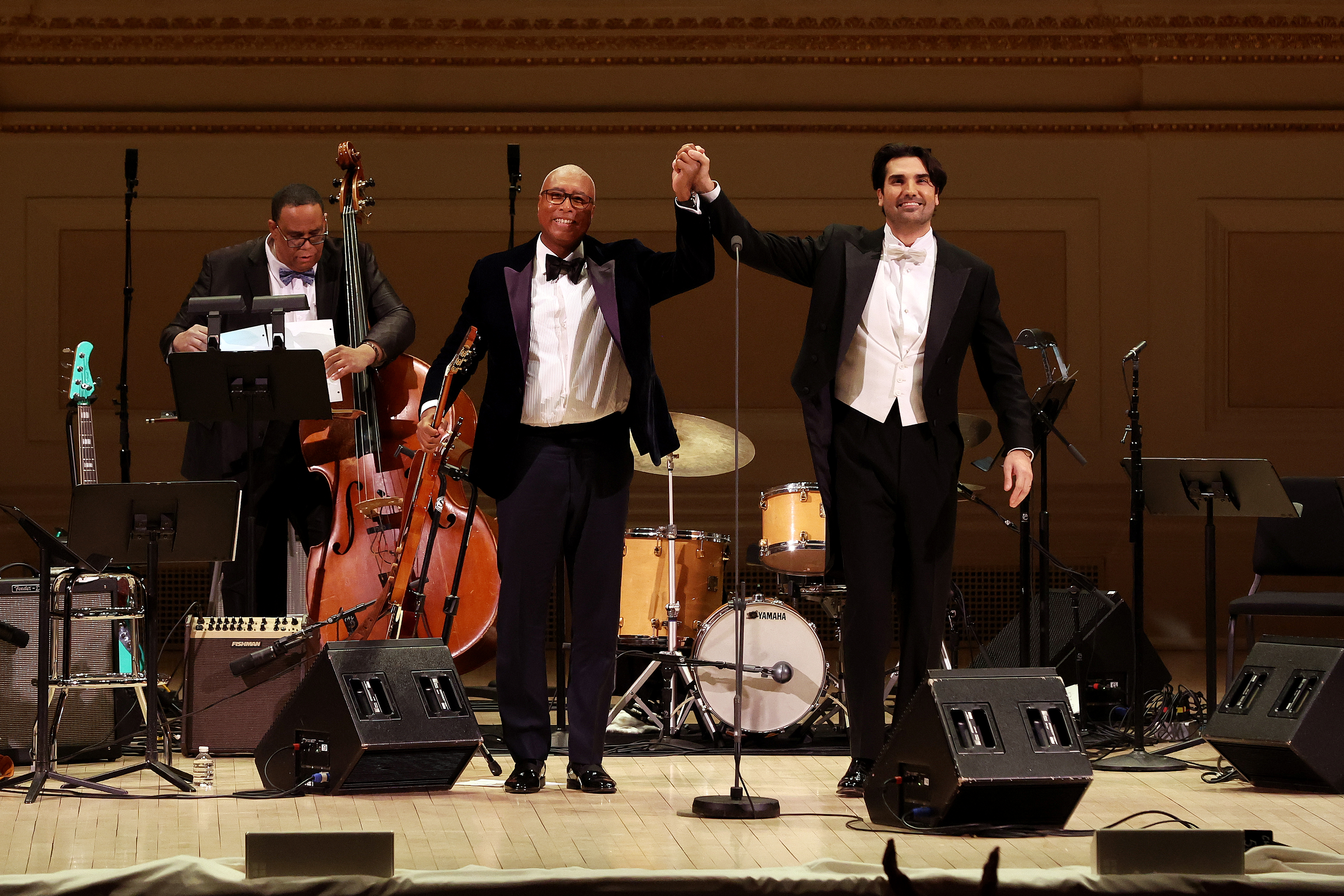
The quartet of Williams, drummer Ari Hoenig, bassist John Benitez and pianist Michael Bernabe was a musical “Core Four” that could set any stage ablaze. And after a “Let it Be” tease segued into a pulsating, swinging version of the Beatles’ “Can’t Buy Me Love,” they did just that. The up-tempo arrangement gave each musician a chance to shine, taking solos that stretched deep into uncharted waters before modulating to a deep groove as Hoenig capped it off with a stunning display of percussion prowess. At more than nine minutes, it was the night’s longest number, and the one that evoked the most head nods, hand claps, foot taps, hoots and hollers.
“That is as good an ensemble as I’ve played with in my career as a musician,” Williams said. “These are some of the top musicians in the jazz scene right now. I don’t know what got into me when I made that arrangement, but I think it was a very fitting tune, paying tribute to the Beatles, this iconic group that has been so influential in the history of music and who played at that venue. It just filled a lot of boxes, and so I really liked the idea of playing the tune, and these guys just killed it.”
The New York crowd devoured the final two songs in the set: “Parla Piu Piano,” the theme from The Godfather with its instantly recognizable melody played on trumpet by former subway performer Eganam Segbefia, and the show-stopping “New York, New York.”
Before spilling back out onto the wintry streets of Midtown Manhattan, the satisfied crowd was in for two last treats. Tetelman’s rendition of “Nessun Dorma,” another of Puccini’s most well-known arias, brought the house down, his vocals swelling in the final crescendo toward a volcanic explosion, just as Pavarotti did so many times in performing the song.
The final number was one that Williams has become synonymous with, having performed it all over the country. It started with just his guitar, but gradually included everyone in Carnegie Hall. Every special guest and musician returned to the stage, and the crowd sung along to the familiar words of “Take Me Out to the Ball Game.” Because as much music as there is in Williams’ soul, baseball remains embedded there as well.
“There was a time that I was trying to make this sort of divide between the musical world and the sports world because I didn’t want people to say, ‘You’re a good guitar player, for a baseball player,’” Williams said. “With that said, I’ve always appreciated how much support I’ve gotten from the New York Yankees fans in everything that I’ve done post-baseball. We really spent a lot of time and resources and effort in my tenure with my teammates bringing them the joy that they had with all those world championships and all of that. So, to have that be paid back to me in this seemingly different scenario, to me, it meant the world. I was so appreciative of them coming to Carnegie Hall and supporting my music, and it made it feel like it was a full circle. To have the Bleacher Creatures out there in the nosebleeds going, ‘Ber-nie Wil-liams!’ clap-clap clap-clap-clap, it just felt like home to me. It was such a familiar sound. It just felt like they really appreciated me, and I certainly appreciate them.
“I had all my worlds collide in one place that one night: sports, music, friends, family, childhood, teammates -- everything. It all converged at that point in my life, at that time, and it was just an experience of a lifetime.”
Bernie Williams and Jonathan Tetelman will perform at the Florida Grand Opera in Miami on May 6. For ticket information, visit fgo.org.
Nathan Maciborski is the executive editor of Yankees Magazine. This story appears in the March 2026 edition. Get more articles like this delivered to your doorstep by purchasing a subscription to Yankees Magazine at www.yankees.com/publications.