

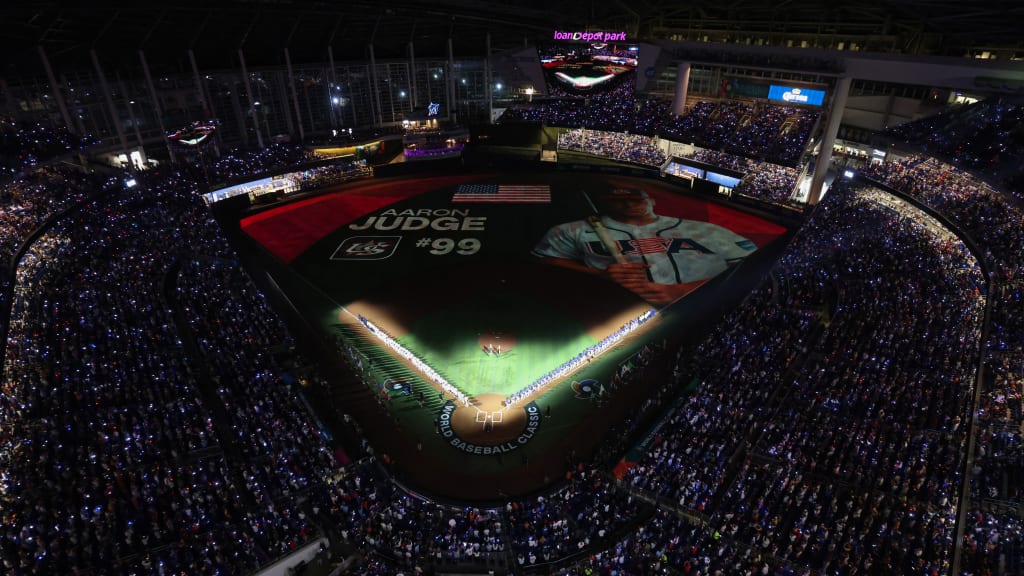
The first, second, third and 97th thing that you notice at the World Baseball Classic is the noise. It is consuming. It compounds. It assumes an almost liquid state, sloshing around in time, meeting some moments and altogether creating others. It is unique and occasionally painful.
It is incredible.
Major League Baseball is a big business and a big nightly show. It’s also a marathon. The great moments sometimes sneak up on you, and at other times, there is a build-up, but the overall intensity for a championship team is still an upward ramp, climaxing at the end of October. The New York Yankees, who have enjoyed that final raucous celebration more often than any other team in baseball history, know well the emotions of a World Series celebration and the sounds it can produce the outbursts of euphoria at home, the blissful silence on the road.
Aaron Judge has orchestrated plenty of sonic booms in his Yankees career, and in 2024, he led his squad into a World Series battle against the Dodgers. The crowds for those games -- tighter and more dramatic than the five-game outcome implies -- were everything a big leaguer could hope to play in front of, the type of atmosphere that makes you think you’ve seen it all. And there is no one who appreciates the allure of a World Series title, at once an unimaginable summit and also something of a supposed birthright for his own organization, more than Judge. He will not now or ever say or do anything to contextualize or compromise what a championship would mean to him.
But in Miami last month for the 2026 World Baseball Classic, he was at least willing to talk about the noise. The captain of Team USA, who led his compatriots and temporary teammates to a runner-up finish -- losing 3-2 in the championship game for the second straight tournament, this time to the Venezuelan team -- Judge acknowledged the obvious after the Americans sent home the Dominican Republic team in a semifinal game that couldn’t have been louder had it been played in Santo Domingo.
“The crowd here, the crowd we had when we played against Mexico, it’s bigger and better than the World Series,” he said after the 2-1 win that sent Team USA into the final. “The passion that these fans have, representing their country, representing some of their favorite players, there’s nothing like it, man.
“It gives me chills right now thinking about how special that was. I try to take a moment every game to look around, appreciate the crowd, appreciate the moment. It’s just a blessing to go out there and do it.”
The thing about noise is that there’s no shortage of ways to make it. You can shout, you can crash things together, you can bang on something metal or, at the World Baseball Classic -- particularly during the semifinals and championship game at loanDepot park, where the Dominican and Venezuelan fans made the Americans feel like visitors -- you could use the brass horn or the drum that you just happened to bring with you. Indeed, posted outside the stadium was a list of which instruments were permitted and which were not. (Bongos, maracas and trumpets, sure; vuvuzelas, ThunderStix or pots and pans, absolutely not.)
It was cacophonous, the loudest thing you’d ever heard until it somehow got louder.
Judge and his fellow Yankees who participated in this year’s World Baseball Classic -- 16 of them, including coaches -- exited the sixth edition of the global showcase with memories of a lifetime and the knowledge that they had done their part to grow the game that they love, the one that they support and are supported by. When the final pitch was thrown on March 17, it was time for the last Yankees standing -- Judge, as well as his Team USA teammates David Bednar, Paul Goldschmidt and Tim Hill; Ryan Yarbrough, who pitched in the early rounds, had already left by the championship game -- to return to Tampa, Fla. The regular season at that point was just over a week away. Sellout crowds in triple-decked stadiums would be the soundtrack of summer, as the Yankees set out to achieve the same goal they have every year: to win the last game in October. Surely, that would be the biggest moment of the year, the greatest achievement on the biggest stage.
But the loudest stage?
When all is said and done, the 2026 World Baseball Classic will undoubtedly lay claim to that title.
***
When Mark DeRosa was named manager of the U.S. team for the 2026 tournament, after leading the Americans to the championship game against Japan in 2023, one of the first things on his mind was bringing Judge along with him. “He’s the definition of ‘captain,’ I’ll tell you that much,” DeRosa said before the semifinal game against the D.R.
With the Yankees, Judge’s contributions go well beyond what he does on the field, even if those in-game exploits continue to defy belief. New York’s players and fans are used to Judge’s aura and his impact, and even though his Team USA teammates were hardly strangers, they still enjoyed the show.
“Obviously one of the best players to have played this game,” said Cubs infielder Alex Bregman, a regular Yankees postseason nemesis turned fellow traveler for a few weeks in March. “And I feel like he’s super knowledgeable about the swing, about the game of baseball in general. So, I’m definitely not taking this opportunity for granted, and I’m trying to pick his brain as much as I possibly can about hitting or anything to do with the game of baseball.”
Roman Anthony doesn’t yet have the same history as Bregman against Judge or the Yankees, but as a surging talent with the Red Sox, that should come. His American teammates couldn’t stop talking about the presence the 21-year-old already brings to the field. Anthony, though, turned it right back toward his once-and-soon-again rival.
“There are so many things I could say about that guy and the type of leader he is, the type of teammate he is,” the outfielder said. “Obviously, we all know what he can do as a player. He’s one of the best players on the planet, if not the best. … Watching the way that he works and leads in the clubhouse, he’s so selfless. You wouldn’t know whether he’s had a good day or a bad day. He’s the same guy every day. Getting to be here with him and to learn from him and to watch the way that he goes about it, it’s no surprise that he is the way that he is. For me, just being around him has been an absolute honor.”
For Judge, the opportunity to rep Team USA was an opportunity too meaningful to pass up. His dedication to the Yankees’ ultimate ambition is unassailable, but so, too, is his omnipresent patriotic fervor. Teammates in the Bronx know what that looks like, the way they’re invited to stand on the lines alongside him, singing the national anthem and “God Bless America.” As Judge walked tall and stoic onto the field before the championship game against Venezuela, he was at once the literal flag-bearer at the front of the line and the young dreamer playing Wiffle ball in his backyard, imagining one day wearing the stars and stripes.
“You feel like a kid again,” Judge said of the experience. “You feel like the kid laying out your jersey before you go to your first All-Star Game or something like that. It’s just been a special moment. I think the coolest thing has been just being a part of this team. Every single guy in this room has been the best at their craft. Just seeing how much they want to win, how much they check their egos at the door; it doesn’t matter if they’re MVPs, Cy Young winners, All-Stars. Each guy checked their ego at the door and stepped in here and threw on the USA, and they’re representing their country the right way. So, it’s been an absolute blast. Just having the playoff atmosphere in March, it definitely gets you geared up for the season real quick.”
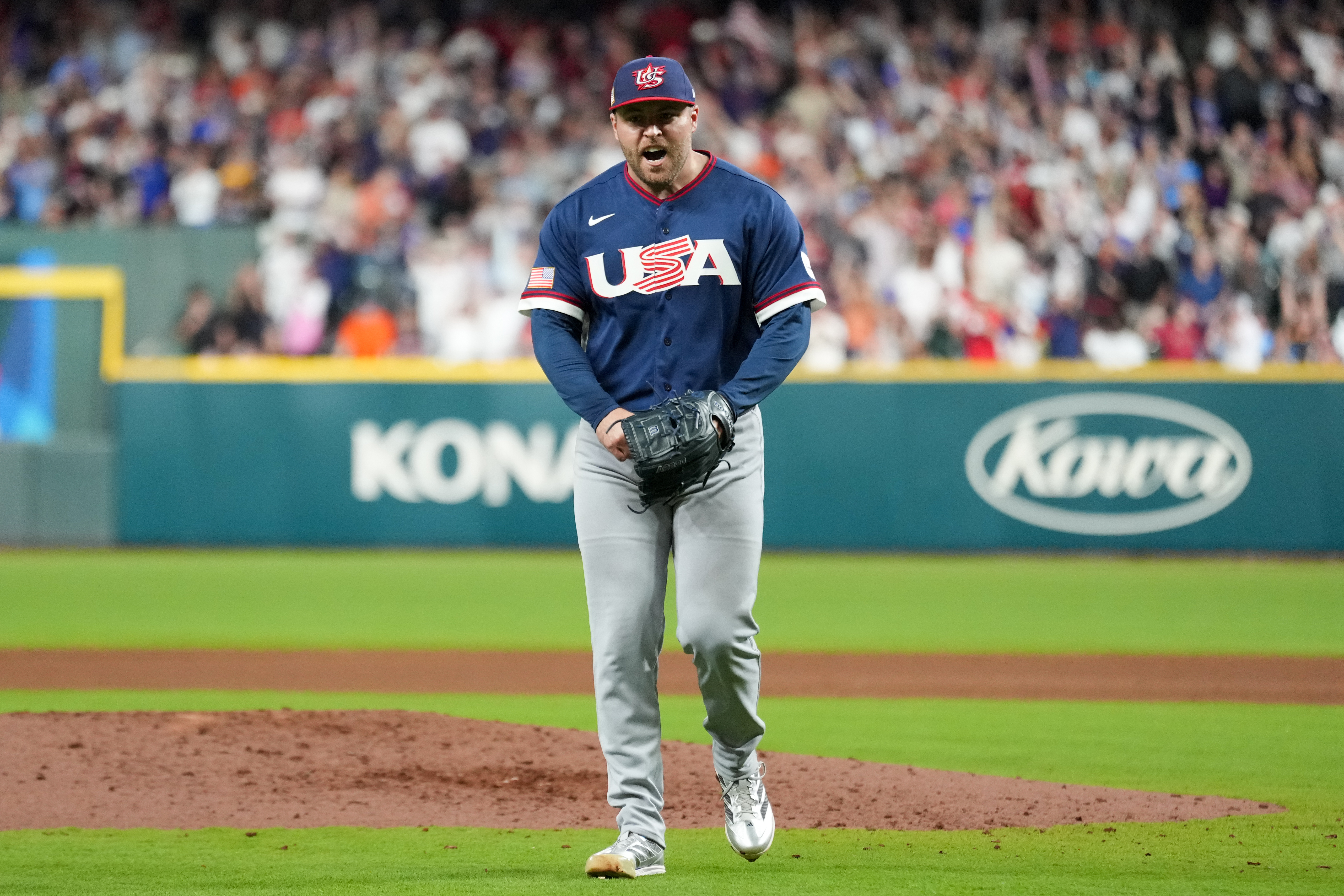
The Yankees competing around the globe -- the tournament was contested at sites in Miami, Houston, Puerto Rico and Japan -- all put in the type of work not usually seen in March, when the ramp-ups are slow and cautious. Spring Training games are constructed to minimize the intensity level. While players in camps around the Grapefruit and Cactus leagues were making their way to their cars in the middle innings, Bednar was firing astonishing splitters to Julio Rodríguez and Fernando Tatis Jr. in front of 36,337 ear-splitting fans, and Fernando Cruz had his chest-bursting celebration in midseason form with each of his three dominant outings for Puerto Rico. Yankees bench coach Brad Ausmus, managing Team Israel, had to answer as many questions about global politics as he did about any lineup decisions, handling them like a master. And Jazz Chisholm Jr. spoke about his Great Britain squad with the same delightful brashness fans know and love. “We plan on shocking the world,” he said. “So, we don’t want the people back home in Great Britain to be shocked. We want them to know that this is what we were planning to do.”
***
It’s an impossible thing, to meet the energy of a World Baseball Classic with anything other than full effort, no matter what the calendar says. Old friend Luis Severino started for the Dominican Republic against the United States and spent his March 15 outing firing high-voltage fastballs. He threw more pitches above 99 mph in 3 1/3 innings than he did in all of 2025. He looked like the young, dominant Sevy that Yankees fans will remember forever.
Perhaps that’s not shocking. Baseball is a time machine. At Yankee Stadium, there’s a game almost every summer night, but also Monument Park. A few hours’ drive northwest, there’s Cooperstown, N.Y., with its museum and legends, some true, some true enough. Heck, in Miami, there’s even a museum of bobbleheads, celebrating the beloved ballpark giveaways.
We watch baseball because of the connections it highlights. A Jasson Domínguez feat in the Bronx can be easily tagged to a similar moment from Mickey Mantle, just as Judge’s power numbers evoke comparisons to Babe Ruth.
The World Baseball Classic, though, is a vision of the future. It is a baseball that is still youthful, still growing. The cultural impact of this sixth tournament felt something like 800 times more resonant than the inaugural edition two decades ago. And it can go anywhere from here, as long as it continues to thrill fans and attract new ones. For the first time in the tournament’s history, Japan didn’t reach the championship round, so joining the United States, Dominican Republic and Venezuela -- three bona fide baseball powers with long-established leagues and histories -- was Team Italy, built on mostly American-born players who embraced the culture of the country on their sleeve while also thrilling -- and creating -- fans across the globe. For as much as MLB teams seek World Series titles, most of them are doing so in hopes of adding to a record book; at the World Baseball Classic, most of the participants are hoping to write entirely new ones. Baseball glory in Czechia and the Netherlands has endured from previous tournaments, and new fans are popping up in places such as Brazil and Great Britain every day. The eyeballs might have been on the Americans and Venezuela in the championship game, but the impact rests in those early round games.
Ausmus’ Israeli squad faced the Dominicans in pool play, and not surprisingly, the formidable, platano-powered hitters such as Juan Soto, Vladimir Guerrero Jr. and Manny Machado, among others, did their thing. Plenty of observers had deemed it the most fearsome lineup ever assembled. “It’s the type of team you put together when you want to win on PlayStation, in MLB The Show,” Ausmus said. “There’s a couple other teams in this tournament that are probably similar.”
Venezuela would be on that list of powers. Representing a nation of 28.5 million that adores baseball, the Venezuelans were the joyful giant-killers all tournament long. They rolled through pool play, tripping up only against the Dominicans, then knocked off Japan in the quarterfinals before dispatching the previously unbeaten Italian squad in the semis. While no Yankees were playing for the Venezuelan squad, the most prominent member of the team’s 40-man roster to hail from the nation is Oswaldo Cabrera, the avatar of ecstasy. Still recovering from the injury that ended his season last May, Cabrera would have fit in perfectly with the scrappy and raucous Venezuelan champs, with their pregame dances and Little League celebrations. Throughout the championship game, the players in the dugout egged on the fans in the ballpark; it was utterly unnecessary.
The Venezuelan fans’ noise was a bit different from the Dominican supporters, whose volume was constant, with pulsing beats blasting ear drums on huge plays. The American fans were there but outnumbered and certainly out-noised; your eyes were not needed to understand the results of any given play, whether the Junior Caminero homer that got the Dominicans on the board or the Gunnar Henderson and Anthony blasts that pushed the Americans ahead. The truly great moments, though, came when the noise took on a manic form. In the third inning, Judge fielded a Ketel Marte single then fired an absolute cannon to third base to nail Tatis, who made the ill-advised choice to test the captain’s arm. At 95.7 mph, it was faster than any throw Judge made in 2025, and considering the elbow troubles that sapped him of his throwing strength late last year, a great sign for 2026.
On an EKG, it would look like a heart attack. In the ballpark, the decibel meter was just the WBC doing what the WBC does.
The Venezuela fans were different. During the championship round games, first against Italy, then the U.S., the fans seemed almost tense out of the gates. But the volume steadily increased as both nights went along. By the ninth inning of the final, after Bryce Harper had tied the game with a titanic blast before Eugenio Suárez immediately put the Venezuelans back ahead for good, it felt borderline dangerous.
“I was just trying to enjoy the atmosphere, the moment, everything,” Harper said of his own celebration after hitting the dinger that briefly rocked the noise balance in the American fans’ direction. “It was very loud in there tonight. A lot of fun. Obviously, Venezuela is a very proud place, for their baseball and sport. So happy to have the opportunity to play them tonight. They did it.”
***
Each moment in the World Baseball Classic is important, from the hours in back rooms and on cell phones putting together a squad to the workouts to the games. It’s purpose driven. Everyone in the tournament is playing for something, playing for someone. Sure, that’s true of baseball in general, but it’s decidedly unlike any other version of the sport you’ll ever find in March. All throughout Florida and Arizona, training and coaching staffs battle to carefully mete out the natural competitive aggression, often mandating that players fight their own instincts lest their ambitions outstrip their bodies’ present states.
“The job’s the same,” Paul Skenes said after pitching the U.S. to victory against the Dominicans, ignoring both the dictates of a calendar and also the realities of life pitching for the Pittsburgh Pirates. “The purpose of why we’re there is the same. … Yeah, there are sacrifices that you have to make. You have to do a little more in the offseason to do things a little bit differently, but easy decision, and I’m definitely glad I made that decision.”
It’s a strange tournament, in so many ways. The Italians, the darlings of the fortnight, leaned into cultural touchstones -- not least of which being the Nespresso machine in the dugout that became a beloved part of the team’s home run celebrations -- and also managed to defeat the United States and briefly put the Americans’ advancement out of pool play into question. The impact will go far beyond the amusing quirks, though; the players all said after their 4-2 semifinal loss to Venezuela that the greatest achievement would be a tournament in the future when they weren’t invited back to represent their ancestral home, but that Italy would instead be able to field a team of players actually born in the country.
Obviously, as baseball grows, the World Baseball Classic will grow, too. The next tournament isn’t yet on the calendar, but it will be soon, and the baseball tournament at the 2028 Olympics in Los Angeles figures to be a highlight of the Summer Games, perhaps even featuring MLB players for the first time. The moments of elation and devastation will endure, the strange bedfellows the WBC creates remaining a beloved aspect as it continues to evolve. The quirky highs -- think Austin Wells, representing his mother’s Dominican heritage by playing against the Americans in the semifinals and hitting a pitch thrown by Bednar over the head of Judge -- will remain, but it will be different. The only thing you can count on for sure is the noise. It won’t stop.
It’s about family in a lot of ways. Baseball players love talking about family, about the once-artificial bonds made real in the clubhouse. But no one -- not even legacies such as Ryan Weathers or Cody Bellinger -- is born a Yankee. The World Baseball Classic isn’t, at heart, about the ties that are created over a spring sprint, a tournament that crescendos in stunning fashion before the players go their own ways to finish prepping for the marathon season ahead. Rather, it’s the family back home, the relatives and neighbors and compatriots you represent with the name on the front of your jersey. You are, in many cases, literally playing for mom and dad.
“I feel more Dominican every day,” said Wells, who was the only Yankees player named to the 12-member All-Tournament Team. “Being able to represent my family and the country, it’s something that I’m never going to forget and hopefully I’ll be able to have the opportunity again.”
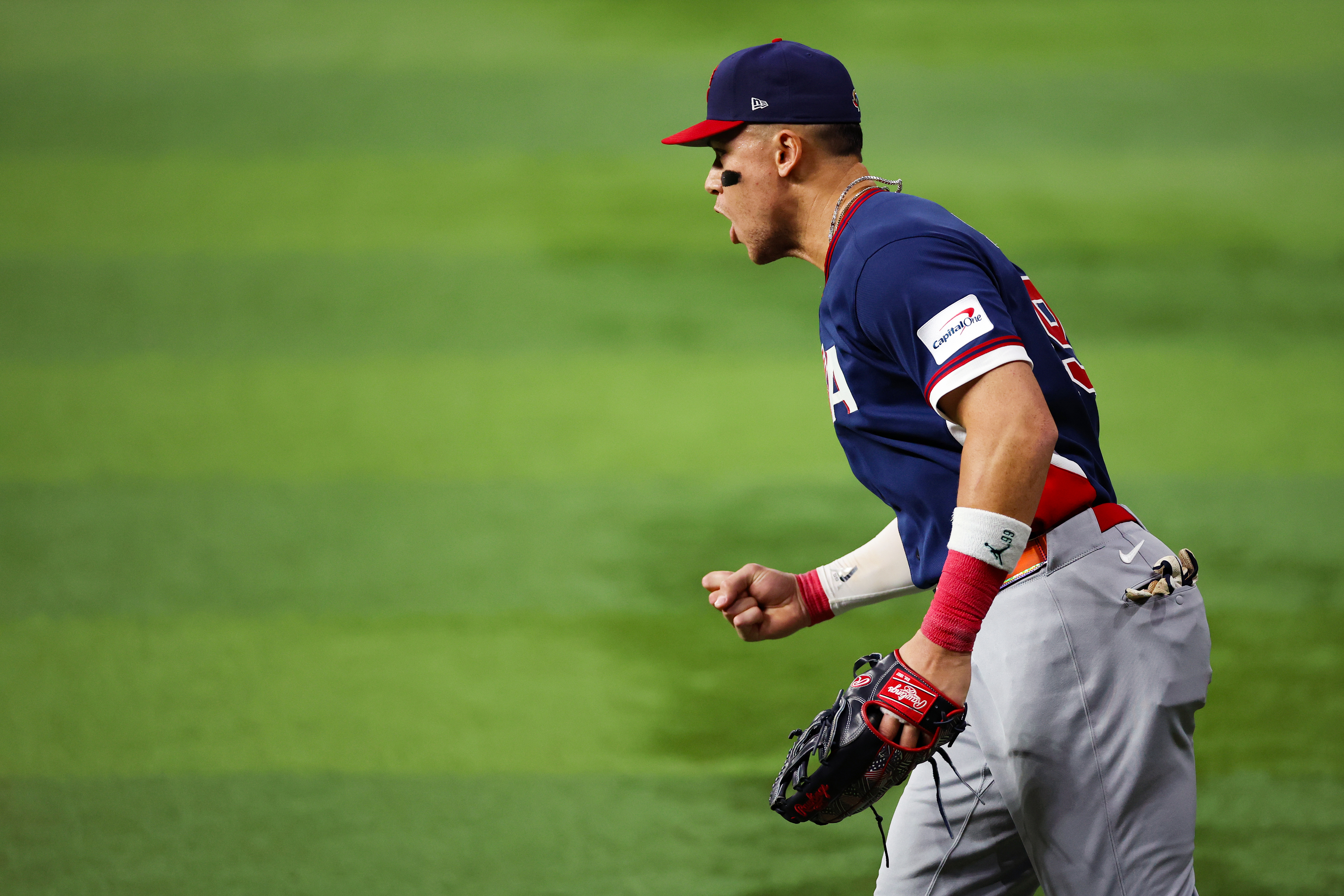
Now, there’s a baseball season to play. Judge is all too familiar with giving somber recaps of seasons that ended too soon, and after the seven-game burst, he had to do it again. Only this time, he wasn’t staring down months stewing over missed opportunities. About an hour after the championship game ended, the calendar read exactly one week until Opening Day. It was already time to begin again. The goal will be to ride out the changing seasons until the weather gets cold in New York and the noise in the Bronx approaches the levels heard in Miami in March.
There will be a World Series in October; maybe the Yankees will be in it. No doubt, it will be the biggest thing imaginable for the players involved. But over two weeks in March, a tournament that has grown leaps and bounds over the past two decades showed something a bit surprising and a bit wonderful. There are always bigger ambitions. There are always bigger spotlights.
Plenty of members of Team USA -- during the highs of the tournament and also the lows -- made seemingly offhand comments about this being the biggest stage in baseball. That would have been an insane thought 20 years ago, but in Miami, as the noise of the 2026 World Baseball Classic kept growing and the joy kept multiplying, it was hard to imagine anything more resonant.
“Each country is getting represented by the best of the best,” Judge said. “I think that’s the coolest thing, is little kids all around the world are getting the chance to turn on the TV and watch their favorite players represent their country, represent it with pride. And I think it’s just going to continue to grow the game.”
Jon Schwartz is the deputy editor of Yankees Magazine. This story appears in the April 2026 edition. Get more articles like this delivered to your doorstep by purchasing a subscription to Yankees Magazine at www.yankees.com/publications.