


How many pitches does it take to win a Cy Young Award?
Do you need a breaking ball? Do you need an offspeed pitch? Or can you do it with all fastballs, if those fastballs are overpowering enough?
These are the questions Cam Schlittler is making us ask.
When Schlittler stormed out to the lead in the American League Cy Young race in the first half of the season, he was all fastballs, all the time. Schlittler's trio of heaters -- his four-seamer, sinker and cutter -- accounted for over 90% of the pitches he threw.
He'd drop in a curveball every once in a while, sure, but it was a "show-me" pitch, just to have literally one thing a hitter might see that wasn't dead-red. (He technically threw a slider, too, but that was so rare it might've been a figment of our imagination … and he scrapped it by June.)
And that was all he really needed. Schlittler's fastballs were fast enough, and different enough from each other, that no one could hit him anyway. Having a true wipeout secondary pitch would be a luxury for him, not a necessity.
Well, that luxury has arrived. Schlittler came out of the All-Star break firing a new-look, power curve. And it's very interesting. This is the pitch you'll want to look out for when he takes the mound against the Blue Jays on Friday night at Yankee Stadium (7:05 p.m. ET) for his second start in a row against New York's AL East rivals.
Schlittler's curveball has gained 2 1/2 mph from the first half to the second half. He is absolutely ripping it. It's gone from the mid-80s to the upper-80s, and sometimes it even cracks 90.
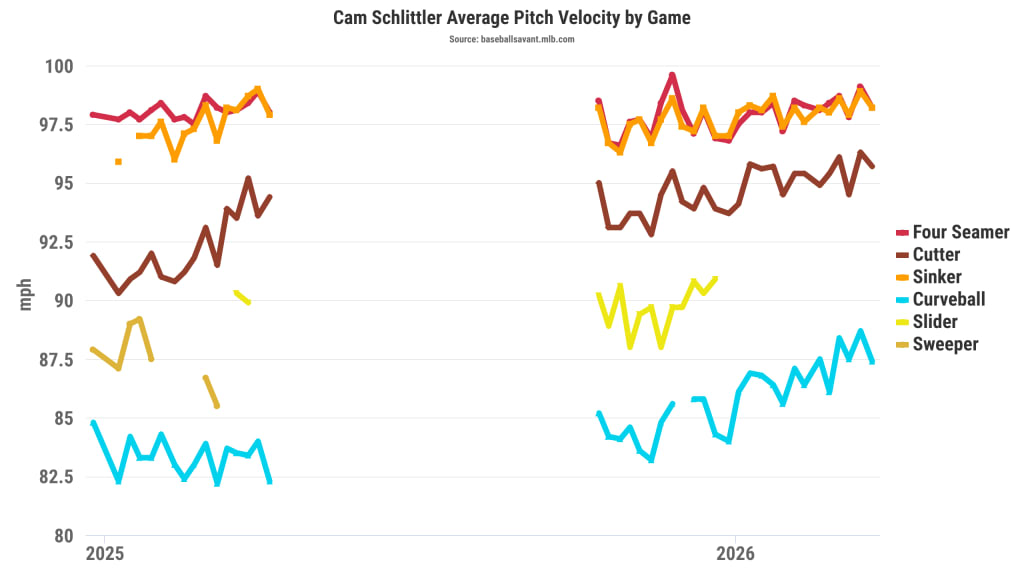
That is extremely fast for a curveball. But is it good for a curveball? The short answer here is "Yes." Schlittler's curveball is just nastier at its new, high velocity. The key is, he's managed to add that velo without sacrificing how much it moves. That's always a risk when you start throwing pitches faster, because they have less time to break on their way to the plate.
"The harder you can throw it, the better it can be," Schlittler told us at Yankee Stadium last week. "The question was more of: If I throw it harder, can I keep the same movement? Which I've been able to do."
Once Schlittler figured out that he could pull off the harder curve without losing movement, he just had to decide the last part of the equation: Would it be a better pitch?
"And it's like, 'Well, yeah, obviously,'" Schlittler said. "It's kind of as simple as that."
Simply, his curveball is sharper than it was before. By Stuff+, which is just a way to measure the raw nastiness of a pitch, Schlittler has a top-10 curve in baseball since the All-Star break.
Schlittler's curveball, 1st half vs. 2nd half
- 1st half: 85.1 mph / 10 inches induced drop / 37% whiff rate
- 2nd half: 87.6 mph / 11 inches induced drop / 47% whiff rate
"Realistically, if I'm going to throw that pitch at 85, and then I'm gonna throw it at 90, the pitch at 90 is probably going to be better," Schlittler said. "At least, it's going to grade out better."
For most pitchers, a 90 mph curveball is a pipe dream. For Schlittler, it fits right in with the rest of his arsenal. His four-seamer is sitting at 98.4 mph in the second half. His sinker is at 98.3. His cutter is at 95.5. He had no problem dialing up his curve to meet them.
"I feel like I hold my pitches loosely. I don't grip them too hard," Schlittler said. "That pitch is easy for me to just throw 85. So you just put more intent behind it and you're able to get those into the 88-90 range. It's been a very easy adjustment."
What he's doing with his curveball right now parallels what he did with his cutter late last season, when he started throwing that pitch much harder, too, to make it more of an outlier compared to other big league cutters. That turned out to be a critical change that triggered Schlittler's dominant run since, which carried through the 2025 postseason and into this year.
"Well, Gerrit [Cole] was the reason for the harder cutter last year. That was his suggestion, and I rolled with it," Schlittler said. "So it's coincidental, the timing, but who wouldn't want a 90 mph curveball with [12 inches of depth]?"
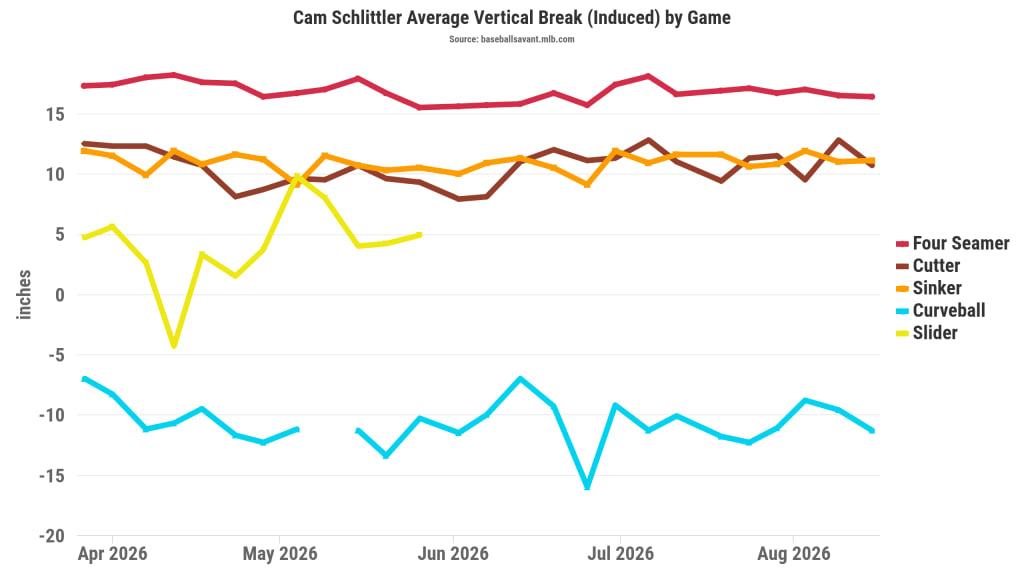
Schlittler's four pitches might be all varying degrees of fast, but no two of them move in the same direction, and when hitters have to be ready for your four-seamer and sinker at 100 and your cutter at 95, a hammer of a curveball at 90 is all the differentiation you need.
Schlittler's jump in swing-and-miss rate on his curve should be enough to tell you that, but it's not just more misses with the harder curveball; it's bigger misses, too.
In the first half, Schlittler's curveball missed bats by an average of 3.7 inches. In the second half, it's missing bats by 5.3 inches. That's a margin of an extra half-a-baseball, and that makes a real difference. Especially for breaking balls, missing bats by wider margins is a strong indicator of a nastier pitch. There's a reason why the pitch that gets the biggest whiffs in the Majors is Mason Miller's slider.
There was no suggestion from Cole to inspire Schlittler this time. It was just the 25-year-old pondering to himself while he was playing catch, "What if I throw this harder?" and deciding, "Hey, let's see what happens."
What's happened is that, just like with his transformed cutter down the stretch last season, Schlittler's curve has become an outlier. There's no curveball in the Major Leagues that perfectly matches Schlittler's combo of extreme velo and sharp downward movement.
The closest thing to it is Jacob Misiorowski's curveball, or Cade Cavalli's. Misiorowski is Schlittler's kindred spirit, in a way: all gas. He's the only starting pitcher in the big leagues throwing a faster curve than Schlittler in the second half, but the Miz has a little less depth. Cavalli is a power pitcher, too, and in the middle of a breakout season with the Nats. His curve comes in just a hair slower than Schlittler's and with just a hair less drop.
And if you go back through the pitch tracking era, there are only a couple of curves that look like the current version of Schlittler's. One is Joe Kelly's circa 2019 with the Dodgers. Another is Craig Kimbrel's in his early years with the Braves and Padres. (Schlittler's is more of a 12-6 curveball than theirs, though, both of which got more horizontal break.)
Curveball comps for Schlittler -- 2026 2nd half
- Schlittler: 87.6 mph / 11 inches induced drop / 5 inches break
- Misiorowski: 88.4 mph / 8 inches induced drop / 5 inches break
- Cavalli: 87.4 mph / 11 inches induced drop / 6 inches break
Curveball comps for Schlittler -- pitch tracking era
- Schlittler (2nd half): 87.6 mph / 11 inches induced drop / 5 inches break
- Kelly (2019): 88.0 mph / 13 inches induced drop / 11 inches break
- Kimbrel (2015): 87.6 mph / 11 inches induced drop / 12 inches break
- Kimbrel (2011): 87.7 mph / 12 inches induced drop / 10 inches break
Schlittler's curveball isn't a true dominant pitch like that yet, but the potential is tantalizing. He hasn't fully unleashed it yet, either. We hope that's coming.
Schlittler is still throwing mostly his three fastballs, but it's not more than nine out of every 10 pitches anymore. He's throwing breaking balls 15% of the time in the second half, and his heaters the other 85%.
That's significantly more breaking balls than the 9% he threw in the first half, which was also split further between his 7% curves and 2% sliders.
The new version of the curveball combines the best qualities of the two breaking pitches Schlittler was throwing before -- the velocity of the slider he scrapped, and the movement of the old version of the curve. Better to consolidate into one good breaker you can trust instead of two slightly-different-but-worse variations.
"That's true. That's very true," Schlittler said. "I'm confident that I could throw a really good slider, but I'm very confident where I'm at right now."
The curveball represents a small shift in Schlittler's approach with his breaking stuff, but a clear one, and we think it's worth caring about. This is the Cy Young frontrunner, after all, on a team headed for the postseason, and he has a new toy.
But why now? Theoretically, if throwing the curveball harder was an easy adjustment for Schlittler to make, he could've done it at any time, right?
"Well, I could have…" Schlittler joked. Hindsight is 20/20. "I don't know. I think it's like, screw it, I'll start throwing it more -- if I need to, you know? You don't always need to do that. But it's better to get that pitch under control, and if I do need to bring it out, then I can get in the zone and get swing-and-miss with it."
Schlittler could be a four-pitch pitcher instead of a three-pitch pitcher going forward, which is only worth doing if it's a good fourth pitch. A near-90 mph curveball can certainly be that. The Yankees ace can still win the Cy Young without it, but he might be a better pitcher with it.