


The Cole Train has reached its destination -- back in the big leagues.
Gerrit Cole, the longtime Yankees ace and unanimous 2023 AL Cy Young winner, is set tonight for his first start on a Major League mound since Oct. 30, 2024 -- the deciding Game 5 of that year’s World Series, won by the Dodgers.
Although Cole’s rehab process went as smoothly as could have been hoped, that’s a long layoff after undergoing Tommy John surgery in March 2025. Especially for the now 35-year-old right-hander.
It’s safe to say there will be a lot of eyes on Cole’s first outing back, given his superstar status, the crucial division-rival matchup vs. a red-hot Rays team with the best record in baseball, and of course, well, the Yankees factor of it all.
With that in mind, here are five things to keep tabs on as Cole rejoins what arguably has been baseball’s best rotation so far.
1. Can he flash that velo -- and sustain it?
Cole’s fastball velocity will be the most obvious and immediately noticeable aspect of his season debut. The intriguing elements to note: What will his max velo be? What will his average velo be? And how long will he be able to hold, say, 95-plus mph?
Cole’s average four-seam fastball velocity with Yankees, by year:
2026: ???
2025: N/A
2024: 95.9 mph
2023: 96.7 mph
2022: 97.8 mph
2021: 97.7 mph
2020: 96.7 mph
In his final rehab start on May 16 -- his lone outing at Triple-A, where Statcast data is available -- Cole chucked 31 four-seam fastballs, ranging from 95.4 mph to 99.6 mph. That’s a sign that his arm strength is all the way back.
It’ll be interesting to see if he approaches that peak his first time out, particularly in the opening innings, or if he holds back a bit and saves upper-90s heat for high-leverage spots that call for it.
2. Will he show his typically elite control/command?
Conventional wisdom says a pitcher’s command is the last thing to return after Tommy John surgery. That makes Cole’s ability to harness his stuff, be precise and put his pitches where he wants a focal point.
After all, this is a 14-year veteran with a career walk rate of 2.3 per nine (2.2 per nine with Yankees) and a career walk percentage of 6.4% (6.1% with Yankees).
Among pitchers to throw at least 700 innings since the start of 2020 -- again, that’s his first year with the Yankees, with whom he’s accumulated 759 frames -- Cole ranks tied for 10th in MLB in walks-per-nine rate. That’s amid fellow aces like Tarik Skubal (2.0 BB/9), Zack Wheeler (2.0 BB/9) and Logan Webb (2.1 BB/9).
“A lot of strikes -- that’s good,” Cole said after his April 29 outing at Double-A, in which he did not walk a batter over 5 2/3 innings. “Not a lot of large misses.”
It would be understandable if Cole doesn’t show pinpoint command out of the gate, or possibly even for stretches of this season, but it’s worth monitoring each time out.
3. What will his pitch usage look like?
Last time Cole pitched in The Show, his repertoire consisted of six pitches: four-seamer, knuckle curve, cutter, slider, changeup and sinker. The latter two offerings, however, accounted for less than five percent of what he threw, while he relied mostly on a combination of the heater (45.4%), knuckle curve (18.7%), cutter (15.8%) and slider (15.1%).
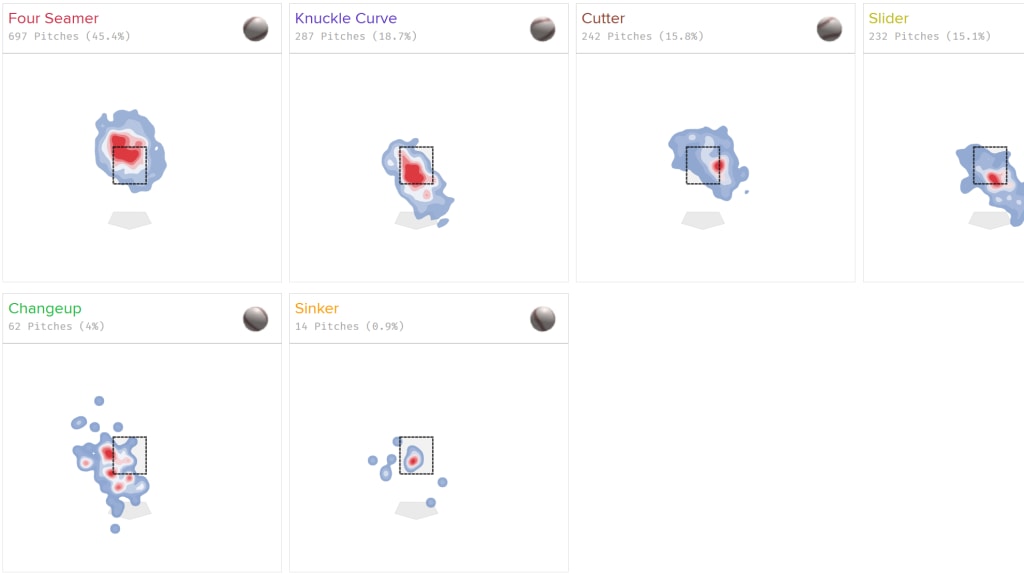
Going back to that Triple-A start for comparison, Cole threw 86 pitches with a breakdown like so: 31 four-seamers (36.0%), 17 sliders (19.8%), 15 sinkers (17.4%), 11 changeup (12.8%), 10 knuckle curves (11.6%) and two cutters (2.3%). That’s a little more diversity in the repertoire, especially the bump in usage for the sinker and changeup.
“Consistency out of all the offerings, which was nice,” Cole also noted from the April 29 rehab start. “I was pleased with the changeup. The shape and location was pretty good … probably the best it’s been [so far].”
Bottom line: The pitch types Cole throws will provide insight into which ones he has the best feel for and trusts the most. Will he hone in on certain pitches, or will he expand his arsenal to navigate a very pesky lineup?
4. How many whiffs and called strikes will he get?
Speaking of that lineup, the Rays enter Friday scoring 4.83 runs per game (eighth in MLB) despite an average exit velocity of 87.6 mph (lowest) and hitting only 41 homers (tied for third fewest) through 48 games.
Yet they’ve made that approach work by striking out in just 18.7% of their plate appearances (tied for lowest), pulling the ball only 35.5% of the time (lowest) and generally just not swinging and missing, with an 80.8% contact rate (highest). In other words, they make crazy contact -- and lots of it, to various parts of the field.
Cole is going to have his work cut out for him when it comes to throwing pitches past the Rays’ bats and fooling them into not swinging to steal called strikes. The Yankees’ defense could help matters by not making mistakes and putting him in high-stress situations.
5. How will his new windup look?
This is more about aesthetic fun than anything else, but Cole did adopt a different, hands-over-the-head windup during his lengthy rehab process. He’s carried that through his Minor League games.
“I was just goofing around one day … during last summer,” Cole said in February. “It felt good. I liked the rhythm. I just kind of stuck with it.”
Before the surgery, Cole deployed a step-back motion leading into his windup, but his hands would lift no higher than chest level. That’s no longer the case when he goes full windup.
“I’ve been checking to see how the stuff is relative to the stretch and the windup,” Cole said in late April, “since the stretch is the same delivery [from past years] and the windup is new. By and large, [the pitches] are trending the same way, if not slightly better out of the windup.”
The velo. The command. The arsenal. The whiffs. The windup. There will be plenty to watch Friday night in the Bronx.