


Just how good can the Phillies rotation be in 2027?
The floor, as usual, should be high. Cristopher Sánchez, Zack Wheeler and Jesús Luzardo are bona fide aces. Veteran Aaron Nola is no longer in that camp, but he is a serviceable No. 4 starter who made 33 starts this past season. And then there is Andrew Painter, the 23-year-old whose youth -- and upside -- juxtaposes an aging roster.
Painter's up-and-down rookie season cratered in mid-June when the Phillies demoted him to Triple-A for a reset. At the time of the decision, Painter's 7.06 ERA was the second highest in baseball among all pitchers to have thrown at least 60 innings. The organization wanted to help the 6-foot-7 right-hander clean up his delivery so he could move down the mound better. Big league hitters had clobbered his four-seam fastball, which needed fixing, too.
Painter returned to the Majors on July 31 and promptly threw six innings of two-run ball against the Orioles. He finished the year pitching to a 3.65 ERA in 11 starts. Notably, his four-seamer had more life to it. Painter’s fastball averaged 17.5 inches of induced vertical break, or "rise," in September, compared to 15.5 inches of IVB in June. With a better shape, results followed.
Painter's four-seam fastball
- First 14 starts: .404 BA // .660 SLG // 10.6% whiff rate
- Last 11 starts: .286 BA // .443 SLG // 20.3% whiff rate
This isn't quite the overpowering weapon that Painter wielded in the Minor Leagues, before an elbow injury necessitated Tommy John surgery in 2023. But this was a step in the right direction. Pitch models like Stuff+ graded the new shape more favorably. Painter’s new-look fastball had a 103 Stuff+ score -- compared to 91 Stuff+ before the demotion -- making it an above-average pitch.
The fastball did not make this leap in a vacuum.
At Triple-A Lehigh Valley, Painter turfed his splitter and incorporated a changeup into his arsenal. On its own, Painter’s splitter fared well. The opposition hit just .195 off it with a 38.4% swing-and-miss rate. Under the surface, problems lingered.
Painter struggled to control how his splitter moved. The plot below shows a range of teal dots -- representing the movement profile on Painter’s splitter -- and they are scattered everywhere. Sometimes, the splitter cut as much as his four-seamer. There was not enough separation between the two pitches.
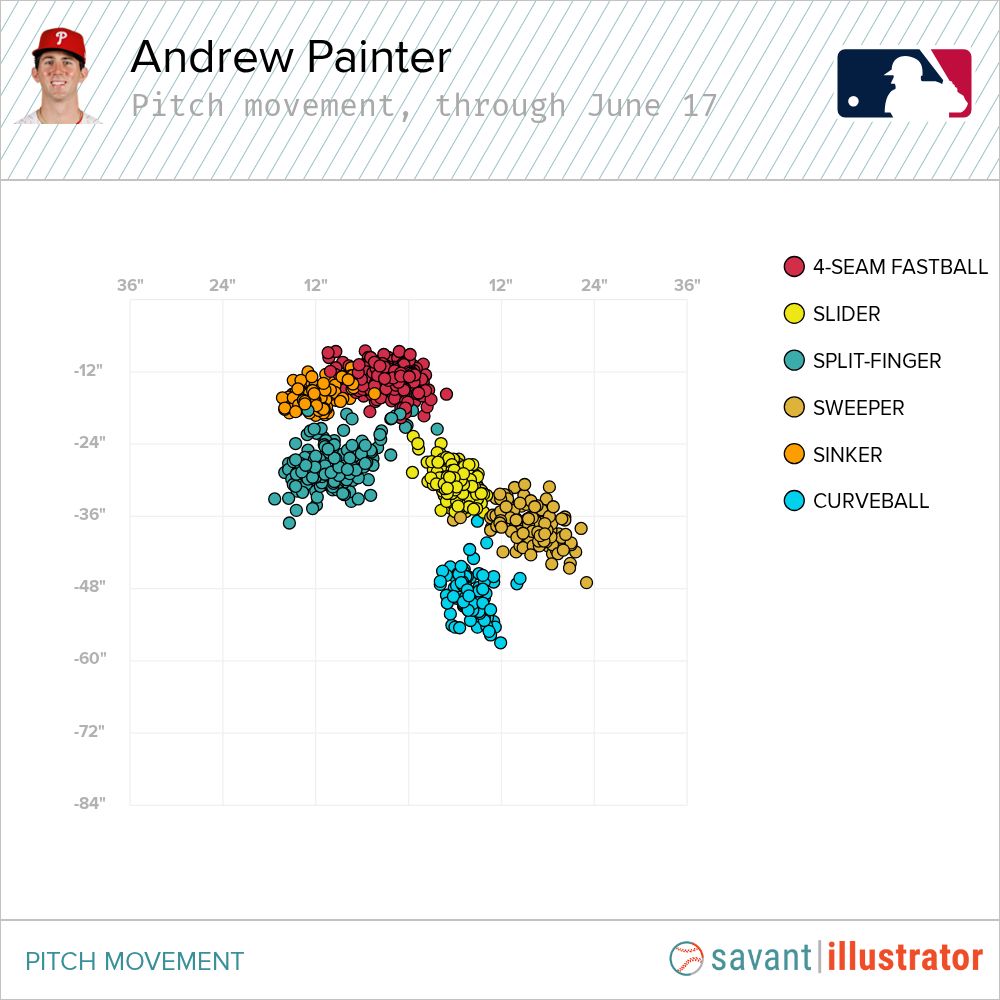
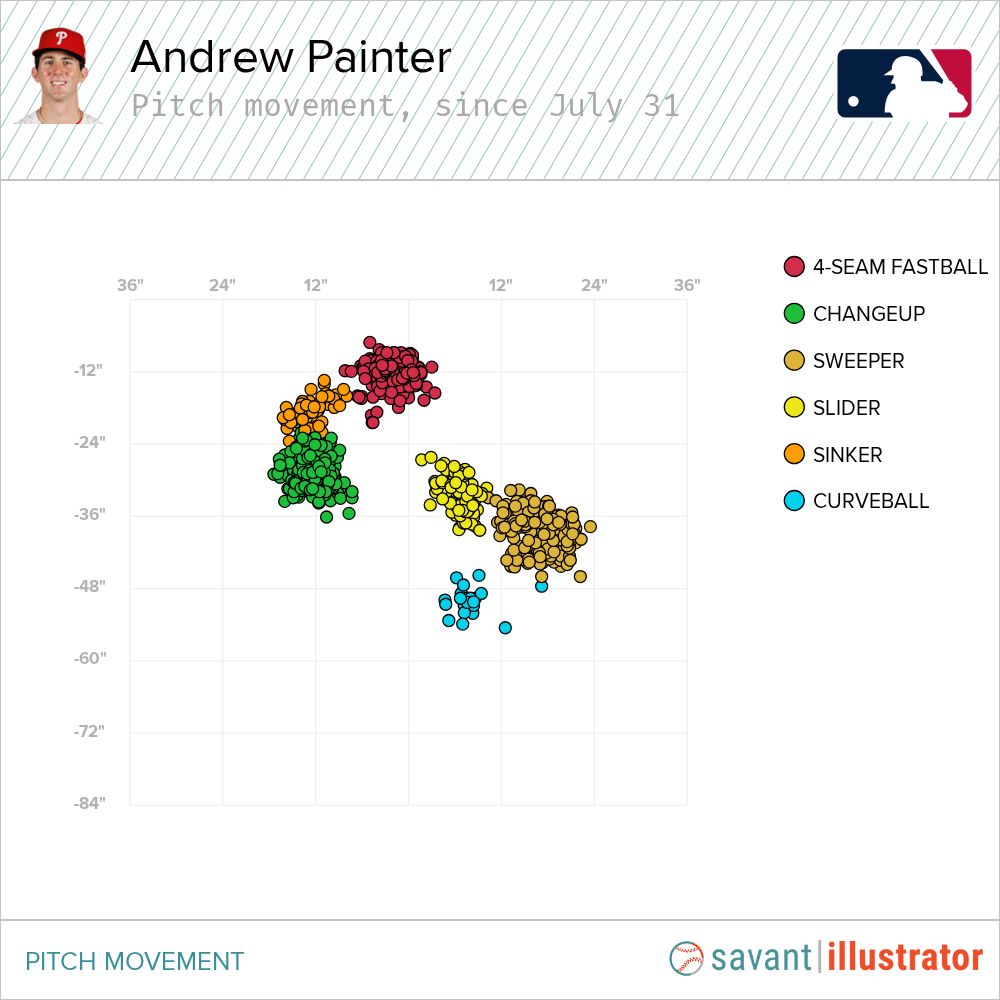
Painter ditched the wide split-finger grip and adopted more of a classic circle change grip. His new pitch grips created a bigger movement differential, improving the relationship between his fastball and his main offspeed pitch. You can see below that there's less variance among the light green dots -- Painter's changeup -- and they are clearly distinct from the red dots, which represent Painter's four-seam fastball.
How are the two pitches different?
There’s plenty of overlap between splitters and changeups. Both are offspeed pitches designed to play off a pitcher’s fastball. Generally, splitters have more tumbling action while changeups prioritize horizontal movement, although we’ve seen that difference blur in recent years amid the popularity of the kick-changeup, where a pitcher uses a spiked grip to cause the ball to drop.
As we mentioned, for Painter specifically, the key here is that his splitter looked a bit too much like his fastball. Painter’s new changeup has more side-to-side movement than his old splitter, which often cut too much to the glove side.
As far as vertical movement goes, the new changeup drops roughly the same amount as the old splitter on its way to the plate. But not all downwards movement is created equally. Painter’s changeup is a firmer offspeed pitch -- at 90.5 mph, it’s a full three ticks faster, on average, than his splitter. Harder pitches have less time to drop on their way to the plate, but the splitter -- the slower variant -- didn’t tumble as much. It actually dropped 3.9 inches less than comparable pitches, or those thrown at a similar velo and from a similar release point.
Well, why is the changeup successful?
Opponents hit .153 with a 35% swing-and-miss rate against Painter's new changeup. That was the 10th lowest BA against an individual changeup in 2026 (min. 200 changeups thrown).
What’s most important here is that Painter can control how the pitch moves, something that eluded him with the splitter.
Painter’s splitter often darted all over the place, but his changeup is pretty consistently thrown low-and-away to left-handed hitters.
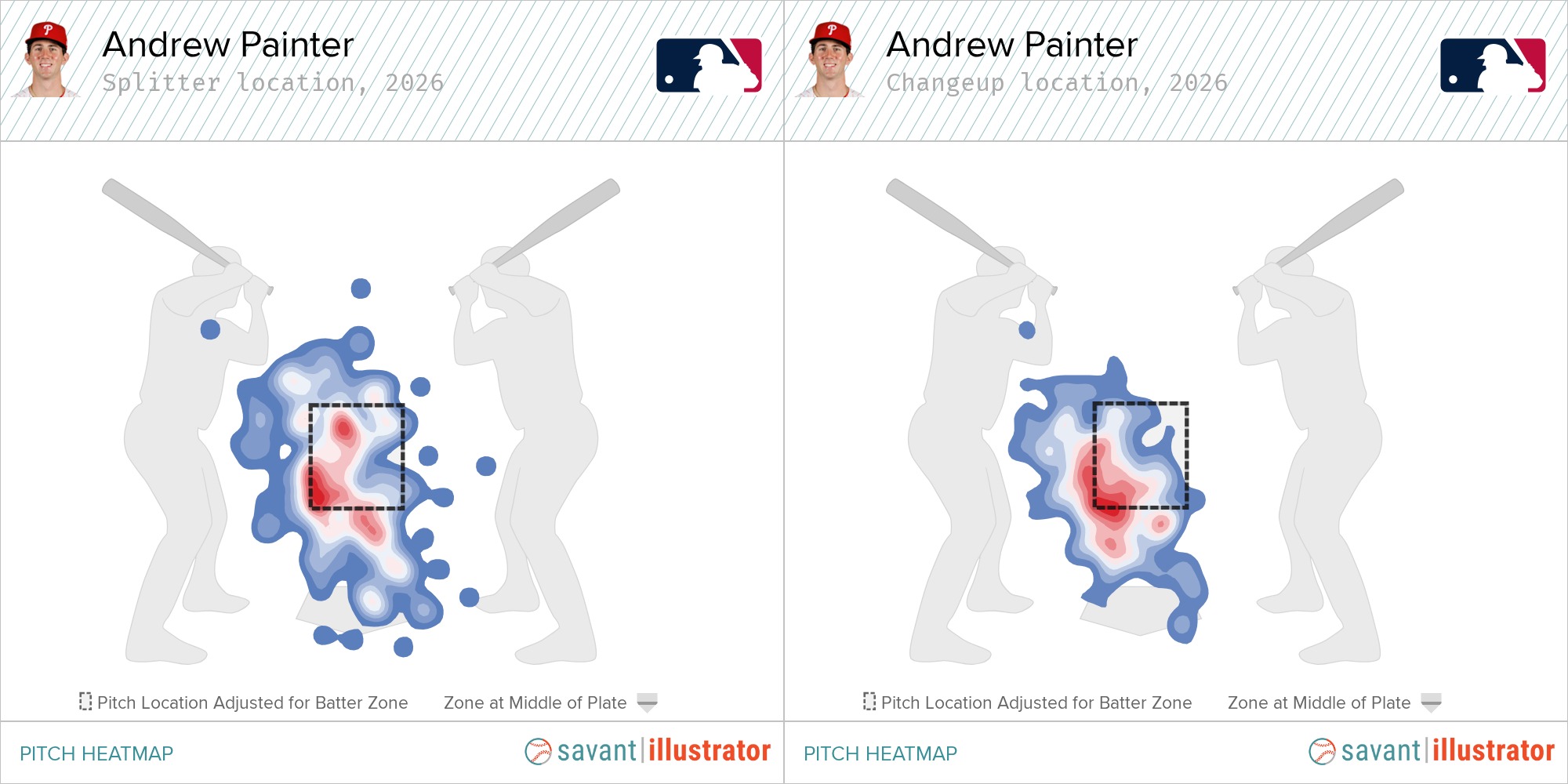
The models are high on Painter’s ability to locate his changeup, too. Command is a messy thing to measure, but we can try. FanGraphs uses a metric called Location+ to attempt to measure a pitcher’s ability to put pitches in the right place. Among the pool of pitchers to throw at least 100 innings last season, only five changeups grade better than Painter’s offering.
What else?
There are two other reasons why Painter’s changeup is unique, and in pitching, being unique is almost always a positive.
We teased the first component earlier. Painter’s changeup is firm, which is to say that it’s fast. Only 11 pitchers, among those to throw at least 200 changeups, threw a harder version of the pitch type in 2026. In the postseason, Painter’s changeup velo ticked up to 92.6 mph. All 16 of his changeups were thrown harder than his regular season average. That could be a byproduct of the fact that he was pitching out of the bullpen -- pitchers tend to let it fly in shorter stints -- but it also could be a sign of where things might be heading in 2027.
The other outlier characteristic is where Painter releases his changeup. The righty throws from a high three-quarters arm slot of 45 degrees. But Painter is also 6-foot-7 and, unlike other long-limbed pitchers, he does not stride exceptionally far down the mound before releasing the baseball. Instead, Painter is fairly upright, which is why he winds up releasing his changeup from an average point of 6.42 feet above the ground.
Here's a good visual of what that looks like, courtesy of Pitching Ninja:
Last season, only five pitchers released their changeup from a higher point than Painter, among those who threw at least 100 changeups last season.
This isn’t a good or a bad thing. Hard changeups aren’t necessarily great pitches, even if they grade out well -- just ask Mason Miller -- and the same goes for changeups thrown with a high release point. This is more about being different, and crafting a pitch that pairs well with the heater. For Painter, a firm changeup from a high release point accomplishes that better than a dancing splitter did.
It is one of Painter’s big midseason changes that should have the Phillies feeling optimistic about the way he can contribute to their rotation in 2027.