


This story was excerpted from MLB Pipeline's newsletter. Subscribe to get it regularly in your inbox.
Mets No. 3 prospect A.J. Ewing was promoted to Triple-A Syracuse on Monday, putting him one stop away from the Majors. Only one year ago to the day, he was just heading to High-A from Single-A after repeating the Florida State League to begin 2025. That said, there were signs that Ewing was cleared for takeoff. Already a plus-plus runner, he boosted his FSL in-zone contact rate by 12 points to 89.1 and cut down on his chases -- a trendline of swing decisions and overall bat-on-ball that carried with him to the upper Minors and onto the Top 100.
As we approach the end of April, we’re still living in the land of small samples, but that doesn’t make some of the early breakouts we’re seeing any less interesting or eyebrow-raising. Call them this year’s Ewings.
More from MLB Pipeline:
• Top 100 prospects | Stats | Video | Podcast | Complete coverage
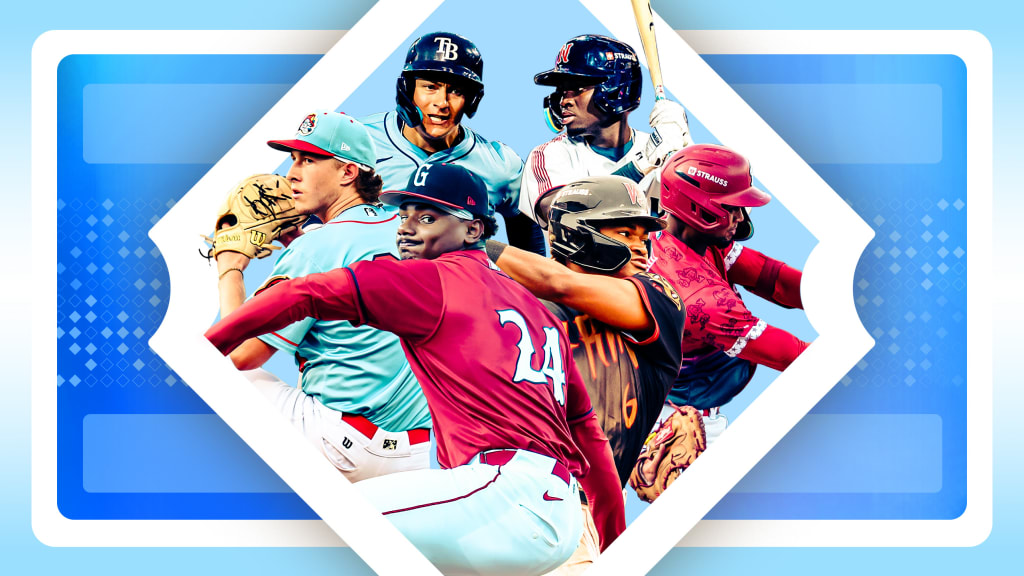
Here are some prospects who weren’t exactly on the precipice of the Top 100 in the offseason but are making quick pushes for that list in 2026:
Ronny Cruz, SS/3B, Nationals (No. 25): Acquired from the Cubs at last year’s Deadline in a move for Michael Soroka, Cruz didn’t play for the Nationals after the trade because of the early Florida Complex League end date, leaving him with a below-average 91 wRC+ in the Arizona Complex League. That lack of success, dragged down by an overeagerness at the plate, and full-season experience dropped him down the Top 30 of a deepish Nationals farm system on our preseason lists, but the praise coming from Washington camp this spring seemed to get more prominent by the day, as Jessica Camerato noted in a recent Nationals newsletter. The tools were always there between above-average power, speed and defense and a plus arm that could fit at either spot on the left side of the infield, and they’ve shown up in spades in regular-season play.
Organizations will tell you plenty by how aggressive (or passive) they get with certain prospect assignments, and the Nationals exhibited their belief in Cruz by promoting him to High-A Wilmington after only 14 games at Single-A Fredericksburg this month. He’s hitting .346/.446/.654 with six homers and 15 steals in 20 games between both spots, and his 185 wRC+ is the highest among Nats Minor League qualifiers. There’s still a good amount of swing-and-miss in his game, and it’s unlikely 28.6 percent of his flyballs will go for homers (as has been the early rate in ‘26). But four out of the five tools are loud, the early promotion was loud, and the climb up the rankings in future updates could be, well, not quiet.
Anthony Eyanson, RHP, Red Sox (No. 9): A third-round pick out of LSU in 2025, Eyanson sat 92-94 mph and occasionally touched 98 in his final collegiate spring. So when he was up to 100.2 mph and threw five four-seamers above 97.8 in the March 20 Spring Breakout game against the Orioles, many baseball folks took notice. (It didn’t hurt that he struck all three Baltimore batters he faced either.) The 21-year-old right-hander has only built on the promise from that outing since, as he enters this week with a 0.54 ERA, 27 strikeouts and zero walks allowed over four starts (16 2/3 innings) with High-A Greenville. His 48.2 K-BB percentage is highest among 1,115 Minor Leaguers with at least 10 innings pitched this season.
The velo bump helps explain parts of the special results, but it should be noted that Eyanson has retained his borderline plus-plus slider and above-average curveball in the South Atlantic League. Through his first two starts, Synergy Sports tabulated the whiff rate on his slider at 70 percent. Combine that with the improved fastball and elite control to this point, and once Payton Tolle graduates, you could make a case that Eyanson is the most promising arm in the Boston system.
Luis Lara/Braylon Payne, OF, Brewers (No. 11, No. 13): Lara and Payne are both speedy outfielders in the Milwaukee system, and that’s about where the similarities end. Standing at 5-foot-7, Lara was more of a high-floor, low-ceiling type entering this season with his plus-plus defense and a severe lack of power. The 6-foot-2 Payne had a higher ceiling with 70-grade speed and loud contact, but his 30.1 percent strikeout rate at Single-A last season brought some concerns that the bottom could fall out of his profile if he never made adequate contact.
The story for both early in 2026 has been significant jumps in slugging output. Lara’s five homers in 26 games for Triple-A Nashville are already a career high. His general contact still isn’t truly loud with a 90th-percentile exit velocity of 102.3 mph and a 54.3 percent groundball rate, but he is making tons of contact on pitches inside the zone. Adding a modest amount of strength and becoming even just a 10-12-homer threat as a switch hitter is huge for his outlook as a potential everyday player who provides more than the glove.
Payne, on the other hand, already has a 115 mph homer that trumps any Brewers dinger in the Major Leagues for exit velo since Avisaíl Garcia’s 116.7 mph shot on Sept. 12, 2021, but we knew impressive high-end EVs were in the tank. His six homers -- only two fewer than his 2025 total in 63 fewer games -- and .796 slugging percentage have come because he’s putting that loud contact in the air more; his groundball rate has fallen from 50.3 percent in ‘25 to 38.2 percent in ‘26. The contact issues are still worthy of further study, as he’ll leak out early in his swing and become vulnerable to sliders, but the power-speed combo is entering rare territory.
Tanner Franklin, RHP, Cardinals (No. 11): St. Louis drafted Franklin 72nd overall last July after he spent all spring working out of the Tennessee bullpen, and the organization has since gotten to work transforming him into a starter.
The early returns are very promising. Through four starts, Franklin has fanned 24 in 14 2/3 innings for High-A Peoria while posting a 2.45 ERA. His 95-98 mph continues to buzz above bats just like it did in shorter stints, and his mid-80s sweeper and 89-91 mph cutter have kept whiffs coming. Franklin is still being built up, as he’s yet to throw more than four innings and 66 pitches in a start in ‘26, and for a former reliever, this will remain the biggest question: how does the stuff hold up over longer outings and deeper into the summer? For now, the arsenal is certainly playing in a way that will get him into Top 100 conversations.
Nathan Flewelling, C, Rays (No. 10): A favorite of many within the Tampa Bay organization, Flewelling produced a 126 wRC+ in 102 games at Single-A Charleston last year. Since 2006, only Samuel Basallo (152) and Jesus Montero (147) have produced better qualifying marks as 18-year-old backstops at the Single-A level. Though it was primarily an OBP-driven performance, the left-handed-hitting Alberta native did have strong underlying data, particularly when it came to his exit velocities relative to his age.
Already in 2026, he’s hit five homers in 17 games with High-A Bowling Green, trailing last year’s total by only one. Flewelling is combining that raw strength with better angles off the bat, as evidenced by a 45.2 percent flyball rate (up from 29.7 percent with Charleston). He is walking a little less, trading in patience for some slug, but the overall performance has few holes: .345/.441/.672 in 68 plate appearances. If trends hold, Flewelling, who will remain a teenager all the way until November, might be becoming a big-time in-game performer quicker than even the Rays might have expected.