


No one throws more fastballs than Cam Schlittler.
Through five starts, the Yankees right-hander is throwing fastballs 89.5% of the time, easily the highest rate among starting pitchers.
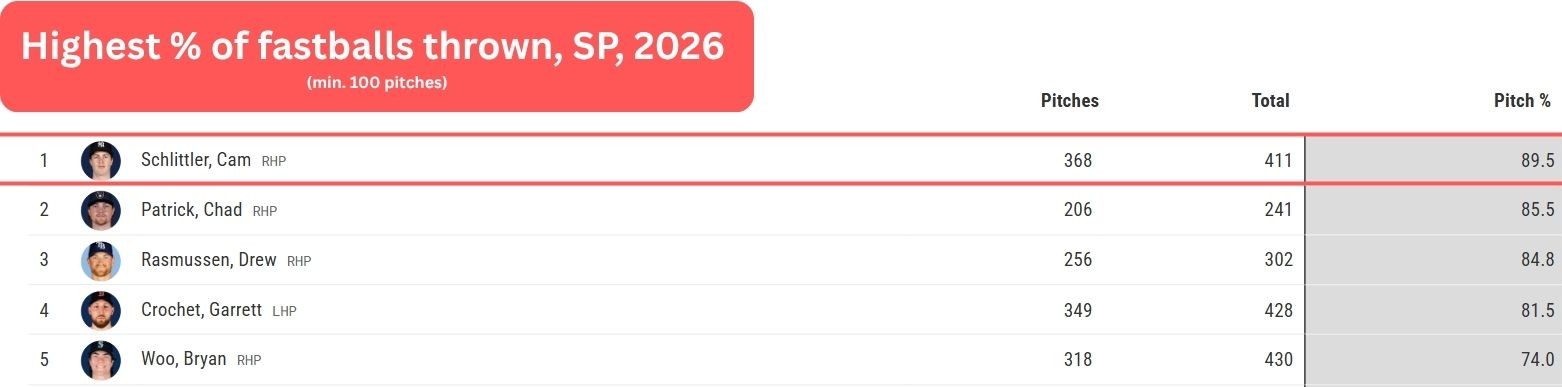
Fastballs -- plural -- is the key here. Because Schlittler isn’t relying on one pitch. He’s weaponizing three.
Schlittler will climb the mound on Thursday night for the Yankees in their series finale against the Red Sox. It will be the first career start at hallowed Fenway Park for the 25-year-old from Walpole, Mass., though he’s already etched himself into rivalry lore. In the decisive Game 3 of the AL Wild Card Series last October, Schlittler tossed eight scoreless innings, authoring one of the best postseason pitching performances you’ll ever see.
That night, Schlittler dominated Boston’s lineup with fastballs: 96 of the 107 pitches that he fired were either four-seamers, two-seamers, or cutters. He will almost certainly run back a similar formula on Thursday.
This isn’t a strategy unique to Schlittler. As MLB.com’s David Adler noted last September, the number of starting pitchers throwing all three fastball types continues to rise. But Schlittler may as well be the poster boy for one of baseball's latest trends.
“I don’t think it was ever a plan, like, ‘Man, we’re going to have you throw three different shapes of fastballs, and that’s how you’re going to attack guys for X amount of years,’” Schlittler told MLB.com last weekend at Yankee Stadium. “... I know it’s tough when you’ve got 95-plus with three different pitches going in three different ways. It makes it tough on them. I know a lot of hitters who are like, guys who have four-seam and two-seam profiles, it makes things a lot harder. Adding a 94 mile-per-hour cutter in there just makes me feel better.”
What really matters here, as Schlittler noted, is how all of this looks to the hitter. The three fastballs start off at similar release points and, since they’re thrown at similar speeds, they’re still on the same trajectory when the hitter has to make a decision. Only then do they diverge.
“It’s really hard to time up balls that are going like this,” said Yankees catcher J.C. Escarra, motioning his arms in different directions. “The timing is the same, but once I swing, I don’t really know where it’s going to hit my barrel. It’s pretty tough to hit unless you sit on one pitch the whole at-bat, and he might not even throw it to you.”
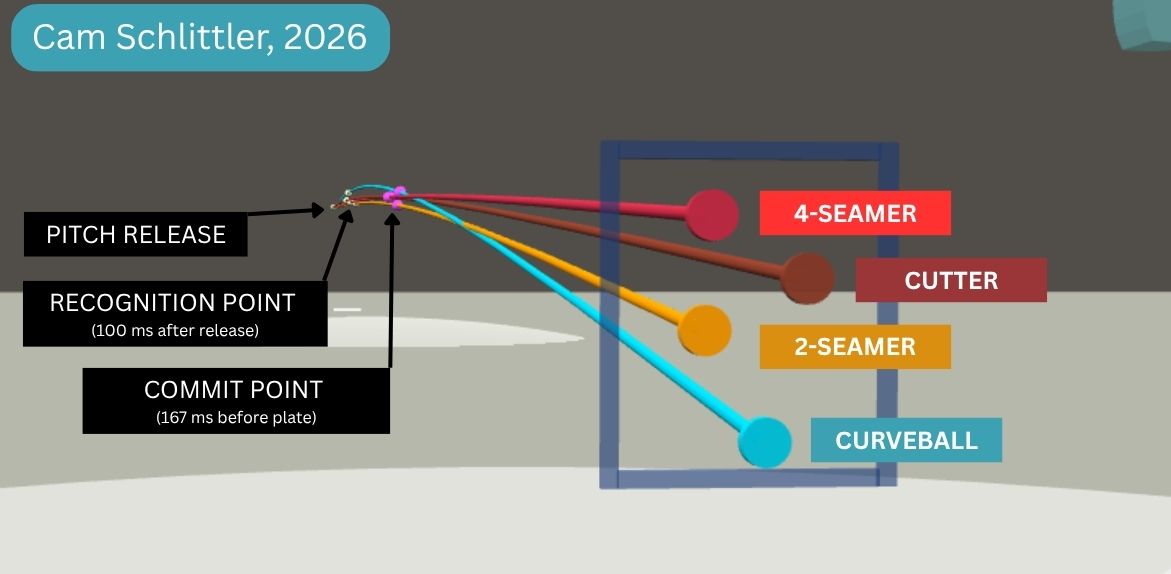
We can see what Escarra is talking about in the above image. Schlittler’s three fastballs start off close together at the “recognition point” (when the batter can discern the pitch type) and stay close at the “commit point,” which is when the batter has to make a swing decision.
"That's why he has so much success, and that's why people are trending that way," Escarra said.
As a rookie, Schlittler threw fastballs 81.6% of the time. He pitched well, posting a 2.96 ERA and running a 27.6% strikeout rate. In the postseason, he seemed to take a star turn. Schlittler has made the leap so far in 2026, ranking highly in every ERA estimator and some of the best metrics that we have for evaluating a pitcher's performance and projecting future success.
Schlittler's MLB ranks, SP, 2026
Among 68 qualified pitchers
- 1st in FIP (0.86)
- 1st in SIERA (2.05)
- 1st in walk rate (2.9%)
- 2nd in K%-BB% (31.4%)
- 2nd in expected ERA (2.27)
- 4th in strikeout rate (34.3%)
- 10th in ERA (1.95)
Here's the thing with Schlittler: Each of his three fastballs (he also throws a curveball) has gotten a little bit better. When each pitch gets better, that leads to what we're seeing now.
So, let’s break down each of Schlittler’s three fastballs, highlighting what makes each pitch so good -- with Schlittler’s help.
4-seamer
"I've always had the four-seamer," Schlittler tells me.
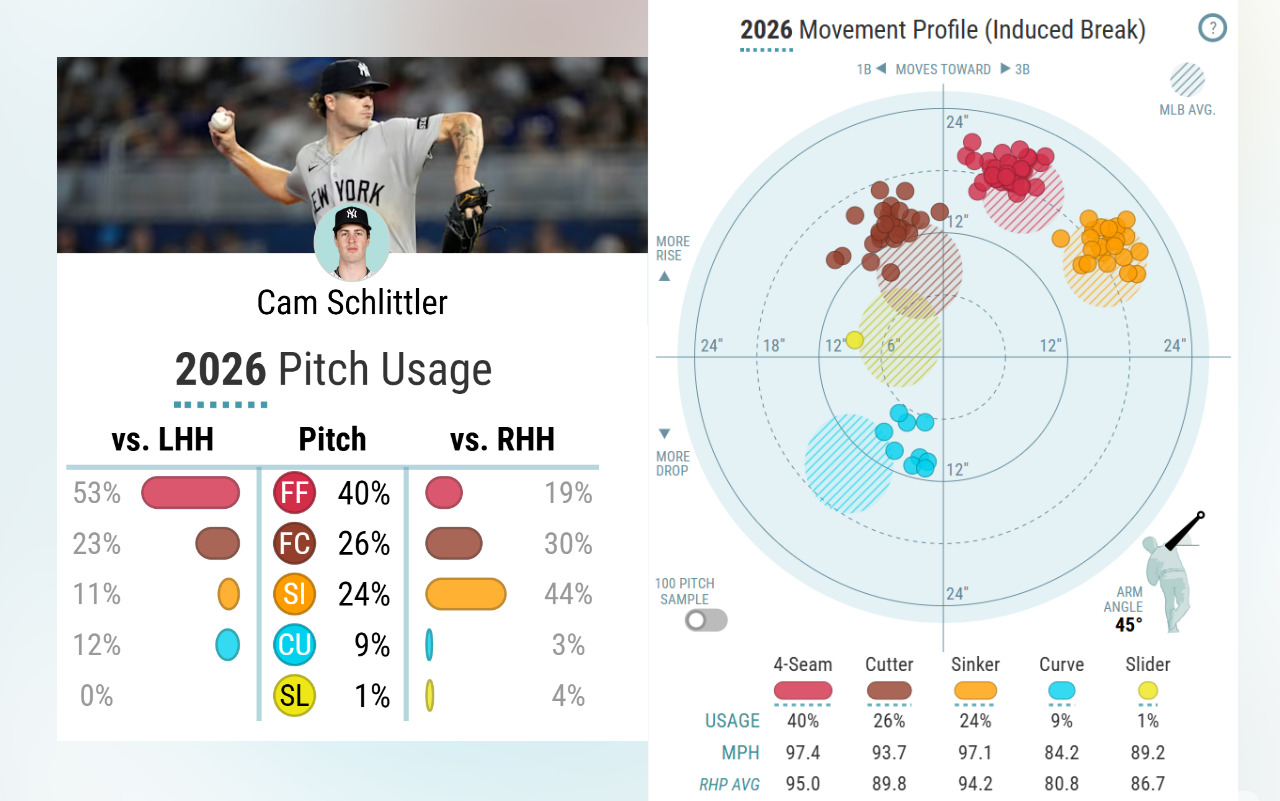
Yes, that is true, it's always been a part of his arsenal. But the pitch has evolved: Just three years ago, he averaged 90.0 mph with his fastball at Single-A. Now, his four-seamer averages 97.5 mph, eighth fastest among qualified starting pitchers.
As a whole, Schlittler is throwing his four-seam fastball 16% less often than he did last season, with the majority of that drop-off coming against right-handed hitters (more on that soon). But he's still peppering lefties with the pitch, and for good reason.
Schlittler has improved the shape of his four-seamer, adding over an inch of induced vertical break (IVB), which helps produce the illusion of rise. He also maximizes that trait by pounding his four-seamer at the top of the strike zone, where that extra carry plays best.
2-seamer
Schlittler did not throw more than 12 two-seamers in any one of his first 12 Major League starts. Then, in his postseason debut, he unleashed 25 two-seamers against the Red Sox.
"Right when I got called up ... I didn't know how I wanted to use it," Schlittler said. "You don't want to mess up too badly, especially when you just got called up.
"But after I succeeded for two months, I got a little wiggle room. I really found out towards the end of the season how to use that pitch. That's why my game plan against Boston and Toronto was so good."
Though the pitch is classified as a sinker, it's really more of a running two-seamer. He's added nearly three inches of arm-side run year over year, creating the sort of horizontal movement that he can use to befuddle right-handed hitters. Same-sided sinkers are back in style, and the two-seam fastball is Schlittler's go-to pitch against righties: They are 3-for-22 with no extra-base hits in at-bats ending on a two-seamer this season.
"I've really learned and incorporated that pitch to both sides of the plate," Schlittler said.
He can pound the two-seamer inside to righties, like he did above with Matt Chapman and Heliot Ramos. Or, he can use it to come back over the outer half of the plate, like he does below against Jacob Wilson.
Oh, and if you haven't gotten the memo by now, Schlittler throws hard. His 97.1 mph average sinker velocity trails only Miami's Sandy Alcantara (97.2) among starting pitchers.
Cutter
Schlittler throws his cutter 26% of the time -- one of the highest rates among qualified pitchers -- and uses it to both sided hitters.
"Honestly, I should probably be throwing it more," he said. "I tell [the Yankees coaching staff] that all the time. I'm really happy with that pitch."
Schlittler refers to his cutter as an outlier pitch, and for good reason. While it's not quite Kenley Jansen's signature cutter, its metrics are comparable.
Comparing Schlittler's cutter shape
- Jansen: 92.8 mph // 17.6 in. induced vertical break // 5.5 in. glove-side movement
- Schlittler: 93.7 mph // 11.7 in. induced vertical break // 5.4 in. glove-side movement
Tyler Wells of the Orioles and Nick Pivetta of the Padres are the only other qualified pitchers who come close to matching that unique combination of velocity, vertical break and horizontal movement (90+ mph, 11+ in. IVB, 5+ in. GLV).
On the surface, it may look as if Schlittler is working with a new cutter shape this season. But that's not actually the case -- his grip is the same, and any changes that he made actually happened late in his rookie season.
"I messed with it a little bit towards the end of the season and took that profile into the playoffs," Schlittler said. "Trying to adjust it a little bit, trying to get more vert. I think my arm angle is slightly higher right now, so I'm able to get that 11 vert with negative-five horizontal, where it's an outlier pitch. But I didn't tweak anything. The pitch just naturally got better."
Schlittler knows what his pitch metrics should be, when things are going well. In his MLB debut on July 9, his cutter averaged 4.9 in. IVB and 8 in. horizontal break. In his second postseason start, those numbers were 10.1 in. IVB and 5 in. horizontal break -- closer to where the pitch stands now.
Location matters here, too. Schlittler is pounding the top of the zone with his cutter, often putting it in the same spot as his four-seamer. The average pitch height of his cutter is nearly half a foot higher than it was last season.
"It gets on hitters quickly," Schlittler said. "I know they have a tough time reading it at the top of the zone."
That goes for all of Schlittler's fastballs, which flourish together. There is still room to grow.
"You work on things and then all these pieces come together and it takes so long to see the end result," Schlittler said. "Man, I'm still making adjustments now. If we were to have this conversation at the end of the year, I'd probably have a different answer for you."
That is a scary proposition for hitters.