

From 1976, when a renovated Yankee Stadium reopened, to its final game in 2008, “Meet me at The Bat” was a common refrain. The Bat was an unmistakable landmark where Yankees fans from near and far could meet up with whomever they’d be sitting alongside, hand them their ticket and head through the turnstiles. Situated just outside the old Stadium’s home plate entrance, The Bat -- which still stands -- was actually a smokestack shaped and painted to resemble one of Babe Ruth’s Louisville Sluggers, allowing steam from the ballpark’s boilers to periodically seep out of the “knob” 138 feet up in the air.
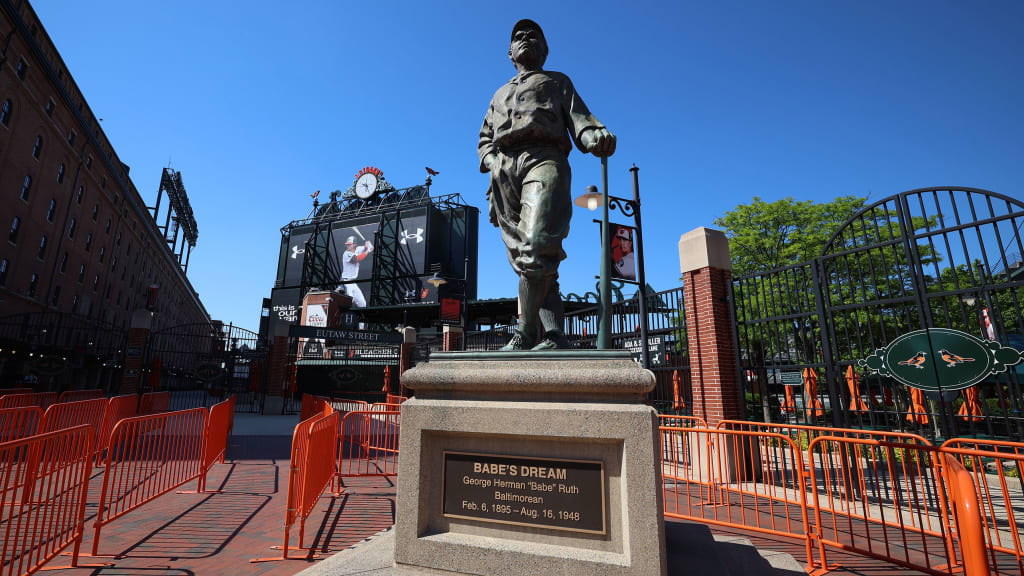
Since 1995, when Baltimore artist Susan Luery unveiled “Babe’s Dream” -- a 16-foot-tall bronze sculpture of a young Ruth outside of Oriole Park at Camden Yards -- to mark what would have been the slugger’s 100th birthday, O’s fans have been saying, “Meet me at The Babe.” Plenty will do so this week, when the Yankees visit Baltimore for a three-game series.
It might seem odd that the Orioles would erect a statue of their division rival’s greatest player on the grounds of their own home. Baltimore’s knowledgeable baseball fans understand, though. There is a long and rich history of the national pastime woven into the fabric of Charm City, and Ruth, the sport’s most legendary figure, sprouted right from the very heart of it.
Around the turn of the 20th century, long before The Babe became a global phenomenon in pinstripes, he was a rough-and-tumble kid from a rough-and-tumble city. As an adult, he rarely spoke about his childhood, letting the imaginations of the obsessed sportswriters run wild with the breadcrumbs he occasionally dropped.
What we know, thanks to the efforts of historians, researchers, curators, biographers, descendants and others who remain infatuated with him, is that Ruth was indelibly shaped by the noisy, bustling, cramped, unsanitary environs in which his similarly chaotic family tried to raise him. And while much has changed over the ensuing 125 years or so, a visit today to Ridgely’s Delight or Pigtown or Gwynns Falls or even Camden Yards reveals that Ruth’s spirit still lingers throughout southwest Baltimore, provided you know where to look.
Every legend has an origin story. This is The Babe’s.
***
During the summer of 2008, when the Hilton Baltimore Inner Harbor -- a gleaming, 757-room hotel connected to the city’s convention center and overlooking Camden Yards -- opened, its first registered guest was Julia Ruth Stevens. It was at this exact location that her famous father developed a taste for beer and tobacco, pilfering both from the bar that his father, George Herman Ruth Sr., kept at the corner of West Camden and South Paca streets.
“Little George” was 7 years old.
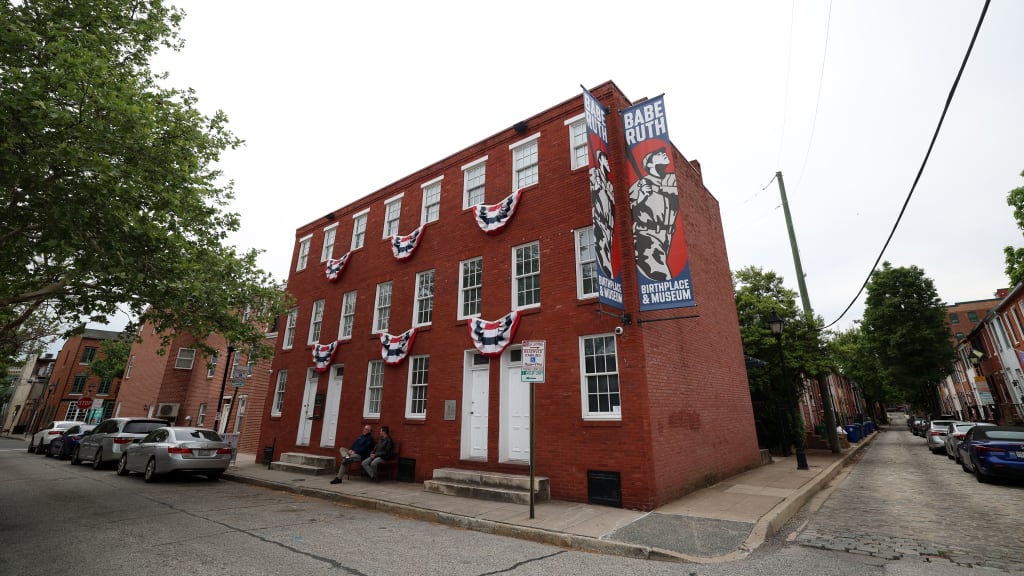
But his story doesn’t begin there. To see where Babe Ruth took his first breaths, follow the 60 baseballs -- one for each of his home runs in 1927 -- stenciled along the sidewalks starting at the “Babe’s Dream” statue for about three blocks west into the Ridgely’s Delight neighborhood. It was there, inside the brick row house at 216 Emory Street where her parents lived, that Catherine “Katie” Schamberger Ruth gave birth to her first child, George Herman Ruth Jr., on Feb. 6, 1895.
Apropos of the time, when the baby was due, Katie and her husband didn’t head to a hospital but rather to her childhood home. The young couple, who had been married less than a year, likely plunked down a nickel each and boarded Baltimore’s No. 8 streetcar outside the house they were renting from George’s father, John Anton Ruth, at 2819 Frederick Avenue in the Gwynns Falls section of Baltimore. The electric trolley would have rumbled two miles east as Frederick became West Pratt, dropping off the expectant parents near the intersection of Emory Street.
After a short, one-block walk, they would step out of the cold and into the home of Pius and Johanna Schamberger. With no sewer system, no electricity and no running water, it wasn’t the most comfortable place to give birth, but it was home for Katie, and with the aid of a German midwife named Minnie Graf, it was where she became a mother.
Whether Little George eventually became a legend because of his parents or in spite of them remains up for interpretation, and that complicated story continues to be told at 216 Emory Street, inside the impeccably restored and thoughtfully curated Babe Ruth Birthplace & Museum.
***
“It’s crazy, the Babe Ruth landmarks, just all right here.”
Seated at a table mere steps from the room in which Ruth was born, Shawn Herne, the museum’s executive director, unfolds a copy of a Sanborn Fire Insurance map of southwest Baltimore circa 1900. He points to spots around the neighborhood, hemmed in on the east by the newly built B&O Warehouse along Eutaw Street and on the west by South Fremont Avenue, where the Ruth family lived and worked in the early part of the 20th century.
The 30 or so blocks on the meticulously detailed map show lot divisions, with pink shapes representing brick buildings and yellow indicating wood structures. Many, such as Ruth’s birthplace on Emory Street, are still standing. Others, such as 406 West Conway Street, were razed to make room for the award-winning ballpark planned and developed by Janet Marie Smith that opened in 1992.
“When they built Oriole Park,” Herne says, “they did not know that those Babe Ruth landmarks surrounded the property.”
The saloon that George Ruth Sr. ran from 1905 to 1912 stood at 406 West Conway, in what is now left-center field at Camden Yards. That was also where his troubled marriage fell apart -- a detail that essentially remained a family secret for decades.
After George Jr. was born, the family returned to the rented home on Frederick Avenue, today the site of Empress Palace Banquet Hall, where local residents occasionally throw birthday parties and baby showers. In 1897, when George was 2, the Ruths moved into a place of their own, a 12-foot-wide, two-story row house located at 339 South Woodyear Street, less than a mile from Katie’s parents’ place at 216 Emory.
Baltimore was booming at this time. According to the 1900 U.S. census, only New York, Chicago, Philadelphia, St. Louis and Boston had larger populations. Its harbor was an essential port for American commerce, and the B&O (Baltimore & Ohio) Railroad, whose sprawling manufacturing complex known as the Mount Clare shops sat across the street from where George Sr. and Katie would be raising their family, was one of the most significant railroads in the country.
When The Babe did tell tales of his youth -- or at least had some hand in the telling of them -- they would begin here. He described himself as “a bad kid,” unaware of “the difference between right and wrong.” But the opening lines of Babe Ruth’s Own Book of Baseball, his 1928 “autobiography” ghostwritten by Ford Frick by arrangement of Ruth’s agent, Christy Walsh, seem to back up the accounts of his sister, Mary Margaret “Mamie” Ruth, who insisted that her older brother wasn’t bad, per se, just mischievous like the rest of the neighborhood boys:
My earliest recollections center about the dirty, traffic-crowded streets of Baltimore’s river front.
Crowded streets they were, too, noisy with the roar of heavy trucks whose drivers cursed and swore and aimed blows with their driving whips at the legs of kids who made the streets their playground.
And the youngsters, running wild, struck back and echoed the curses. Truck drivers were our enemies. So were the coppers patrolling their beats, and so, too, were the shopkeepers who took bruising payment from our skins for the apples and the fruit we “snitched” from their stands and counters.
A rough, tough neighborhood, but I liked it.
From age 2 to 6, Little George lived at 339 South Woodyear, next door to his uncle, John Ruth Jr., and his family. There was no shortage of scruffy kids and cousins with whom to run amok on the streets of this predominantly German enclave. Mostly unsupervised and left to their own devices, they could cross the railroad tracks at the end of their block and head into Carroll Park to play ball or take a dip in the waste-tainted stream that ran through it.
“It was during that early association with boys, good, bad and indifferent, that Ruth acquired his tender feeling for kids in general; his understanding of their emotions and problems,” Bozeman Bulger wrote in a 1931 profile of Ruth for The Saturday Evening Post. “He appreciates thoroughly the cause of rough exterior and awkwardness in little shavers who have been knocked about.”
Despite the unbearable summer stench of his Pigtown neighborhood, where butchers paraded hogs through the streets toward the slaughterhouse and the B&O’s Mount Clare shops belched filth and noise into the air, Little George had no desire to spend any more time inside his family’s home than was necessary. While George Sr. and his brother John scraped out a living producing lightning rods out of the garages at the end of their narrow, adjacent properties, Katie faced her own struggles, alcoholism among them. George Jr. and Mamie were the only two of what is believed to be eight Ruth children who survived infancy, with pneumonia and “marasmus,” a term for severe malnutrition, among the causes named on the death certificates.
The family’s problems only grew in 1901, when George Sr. purchased a liquor license to begin operating his first bar at West Camden and South Paca. Running a saloon closer to the Baltimore waterfront figured to be a more lucrative enterprise than making lightning rods in a city built mostly of brick, so George Sr. sold the house on Woodyear and moved his family into an apartment above the bar. This new enterprise meant working long days and nights, catering to a rugged clientele of railroad workers, longshoremen and city dwellers. In the kitchen, Katie tended to the grill, sneaking drinks with increasing frequency.
Neither had time for Little George, whose escapades grew more daring. He would “help out” at the bar by clearing mugs -- but not before downing any remnants. He caught beatings from his father for stealing money from the till so that he could buy ice cream for him and his friends.
“Bad boy Ruth -- that was me,” he wrote for Guideposts Magazine just days before he died in 1948 at age 53. “Don’t get the idea that I’m proud of my harum-scarum youth. I’m not. I simply had a rotten start in life, and it took me a long time to get my bearings.”
School was never a thought for Little George. But by 1902, when he turned 7 -- not 8, as his mother had led him to believe -- he would soon be complied to attend per a new mandate. Burning the candle at both ends and now legally bound to ensure their wayward son would not be truant, George Sr. and Katie made a decision that not only changed Little George’s life but the entire history of baseball and even America.
They sent their son away.
***
When award-winning author Jane Leavy gave a talk at the Library of Congress in 2018 about her painstakingly researched biography, The Big Fella: Babe Ruth and the World He Created, she imagined what Little George must have thought when his parents sent him to St. Mary’s Industrial School for Boys on Wilkens Avenue, a short walk from the home on Frederick Avenue where he spent his first two years of life.
What did I do to deserve this? You’ve got two children left, and you still don’t want me?
Viewed through a different lens and with the benefit of hindsight, it was the best thing that could have happened to a young hellraiser living above a seedy Baltimore bar. Had he stayed in the dangerous neighborhood where gorgeous Oriole Park now stands, he would have had to move every time his father took over a different saloon, heard the rumor of his mother sleeping with a bartender in exchange for the booze her husband tried to keep away from her, seen his parents divorce in 1906 and his mother die of tuberculosis six years later at age 38. He would have lived a tough life in a tough place, where the odds of making it out were seemingly a million to one.
But that wasn’t Ruth’s destiny.
Charlie Vascellaro is a Long Island-raised baseball writer who came to Baltimore in the late 1990s to do a story on The Babe. Nearly three decades later, Vascellaro hasn’t left. Every Feb. 6, he honors his adopted city’s most famous son by grilling hot dogs and smoking cigars with fellow fans of Ruth outside the museum that bears his name.
Vascellaro also will gladly show curious writers around Baltimore, pointing out the places and landmarks where Ruth came of age. His guided tour winds its way to the grounds of St. Mary’s, where the “inmates,” as they called themselves, received the structure and discipline that all children need, and where George was no longer “Little.”
Tightly run by Brothers of a Catholic religious order that began in Belgium known as the Xaverians, St. Mary’s was part orphanage, part boarding school, with an enrollment of about 800 boys. Not all were deemed “incorrigible” like the unruly Ruth, but even those who were quickly fell in line. A strict schedule included religious and academic studies beginning at 6 a.m., followed by trade works: During his time at St. Mary’s, from 1902 to 1914, Ruth became an expert with a needle and thread, a skill he never put down even as a Major League star, tailoring his own uniforms to fit perfectly.
The carrot at the end of the stick at St. Mary’s, the best way to get the boys to behave, was baseball. Teams and leagues were organized by the Brothers, and no one wanted to lose the privilege of playing in the highly competitive games. Taken under the wing of Brother Gilbert and Brother Matthias, a towering figure who awed the boys by hitting fungoes high into the Maryland sky, Ruth quickly developed the skills and confidence to become big man on a campus that, like the city in which it lies, continues to evolve.
A 1919 fire destroyed much of St. Mary’s, but Ruth -- by then a star in the big leagues -- led fundraising efforts to help restore it. The school shuttered for good in 1950, then reopened in 1962 as Cardinal Gibbons High School, which commissioned a stunning painting of The Babe on one of the buildings’ tiled walls. The school closed in 2010, but the field is still in great shape thanks to a $1.5 million turf installation funded by the Cal Ripken Sr. Foundation in 2014. It might not exist as a diamond for much longer, though: This spring, Coppermine Health and Fitness committed $8 million to build a soccer academy at the site.
Only a couple of the decaying, boarded-up buildings where Ruth lived and learned during the most important years of his youth remain. When Vascellaro visited last year, he was able to gain entry to one of them, ignoring the automated recording that would periodically blare over a speaker system warning trespassers that they would be prosecuted. The scene inside the building was one of hopelessness and despair, the opposite of what Ruth encountered at St. Mary’s. Broken glass, trash and used drug paraphernalia littered the floors. Graffiti covered every wall.
Almost. One wall, the one with the painted tiles of Ruth, had been left untouched, the mural still in pristine condition.
If it’s still there, perhaps it will be preserved and inspire some young soccer player from Baltimore to make a mark on their sport the way Ruth did baseball.
***
Ruth’s exploits at St. Mary’s caught the attention of Jack Dunn, owner of the Minor League Baltimore Orioles, who on Valentine’s Day 1914 offered Ruth a sweetheart deal of $600 -- about $25 per week -- to join his club. Ruth quickly accepted before Dunn could change his mind, then rushed outside to tell the boys the exciting news.
“Well, there goes our team,” one of them lamented.
His career as a professional baseball player was set to begin, but there was one problem. Ruth’s parents had signed custody of him over to the Brothers at St. Mary’s, and he couldn’t leave on his own accord until he turned 21. For Ruth to join the Orioles, Dunn would have to become his legal guardian.
Where do I sign? he thought. When Dunn arrived in North Carolina for Spring Training with his 19-year-old “babe” in tow, a nickname was born that will last as long as the game itself.
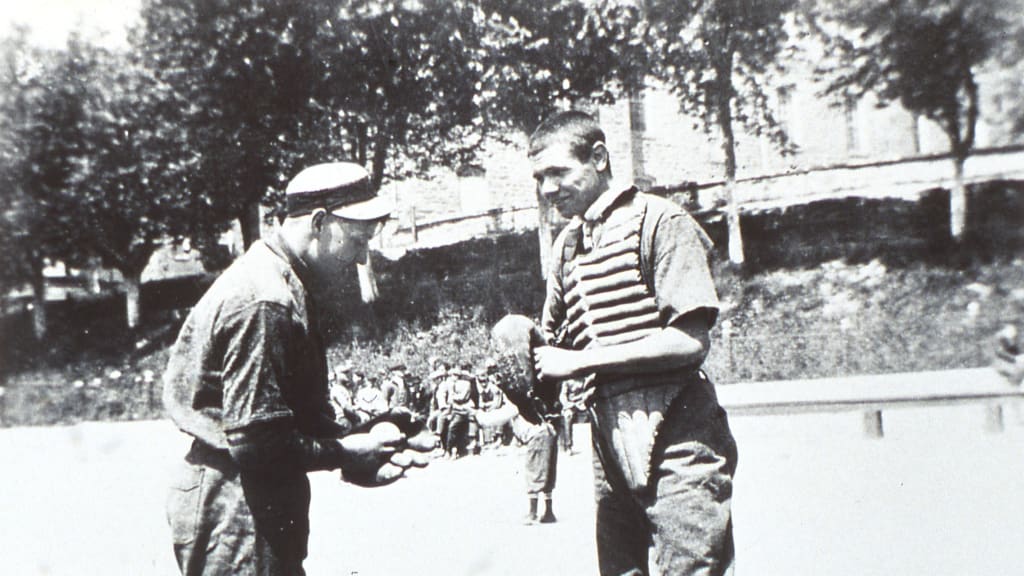
Ruth’s time in the International League was short. By midsummer, Dunn had sold Babe to the Boston Red Sox, for whom he made his Major League debut on July 11, 1914, when he pitched seven innings and went 0-for-2 at the plate in a 4-3 win over Shoeless Joe Jackson’s Cleveland Naps at Fenway Park.
But Baltimore remained his home base. After the season, he returned to the row house he had been staying in with his father and sister at 552 West Conway Street. With him was Helen Woodford, a 16-year-old waitress he met in Boston and married that October at St. Paul Catholic Church in nearby Ellicott City, since no Catholic church within the city limits would perform a wedding ceremony involving a minor.
If Ruth harbored any ill will toward his father for his tough upbringing or the fact that he never visited him at St. Mary’s, he didn’t show it. After his first full big league campaign in 1915, when he went 18-8 and helped Boston capture its first of three championships in four years, Ruth spent his World Series earnings on a new, upscale bar for his dad. Located at 38 South Eutaw Street, Ruth’s Cafe leaned into the publicity being generated by the son’s budding Major League career.
There’s an incredible picture of George Sr. and George Jr. together behind the bar, dressed to the nines as they prepare to ring in the New Year. A blown-up version of the black-and-white photo is on display in the Babe Ruth Museum, allowing visitors to get lost in the details of the time period -- the decorations on the ceiling, the giant bowl of what looks to be eggnog on the bar, the oyster bar in the back, the dog perched on the stool, the trough along the base of the bar. A similar copy hung inside The Goddess, the strip club that now occupies 38 South Eutaw where the photo was taken, but there’s no word as to whether the photo survived the 2024 fire that damaged the establishment.
It was on the sidewalk outside that address where George Ruth Sr. took his final breaths in the early morning hours of Aug. 25, 1918. He had remarried three years earlier, and his new brothers-in-law were causing trouble in the bar, quarreling over domestic issues. Ruth demanded they take it outside. When they did, he followed and joined in the Saturday night fracas. Witnesses said he threw two punches at Benjamin Sipes, who responded with a punch of his own that knocked Ruth to the ground, his head hitting the curb and causing a fatal injury. He was 46.
With the blessing of Red Sox manager Ed Barrow, Ruth left Boston and headed home for his father’s funeral. George Sr. was buried in Loudon Park Cemetery along Wilkens Avenue, less than a mile from the school where his son altered the trajectory of their family’s legacy from the slums to the stars.
“St. Mary’s changed the whole world for him,” Vascellaro says over a pint of Old Oriole Park lager at Peabody Heights Brewery on East 30th Street, near the exact spot where Ruth’s first games as a professional took place. “He was just living on the streets in those neighborhoods that we were running around, smoking cigarette butts, finishing leftover drinks. Something bad would have happened. For a guy who lived such a remarkable and great life, he was also surrounded by a lot of darkness while he was making his way. He was on a path to getting his head cracked on a sidewalk like the old man.
“Brother Gilbert and Brother Matthias, they saw something else in him. And he was eternally grateful.”
Ruth’s parents didn’t live to see their son become a Yankee, save baseball, rewrite its record books or capture the hearts and imaginations of millions of admirers. But all these years later, when fans visiting Oriole Park at Camden Yards pass by the statue of Ruth, they’ll look down at the plaque on its base and see a single word used to describe the boy who rose to become a legend among legends: “Baltimorean.”
Nathan Maciborski is the executive editor of Yankees Magazine. This story appears in the August 2026 edition. Get more articles like this delivered to your doorstep by purchasing a subscription to Yankees Magazine at www.yankees.com/publications.