

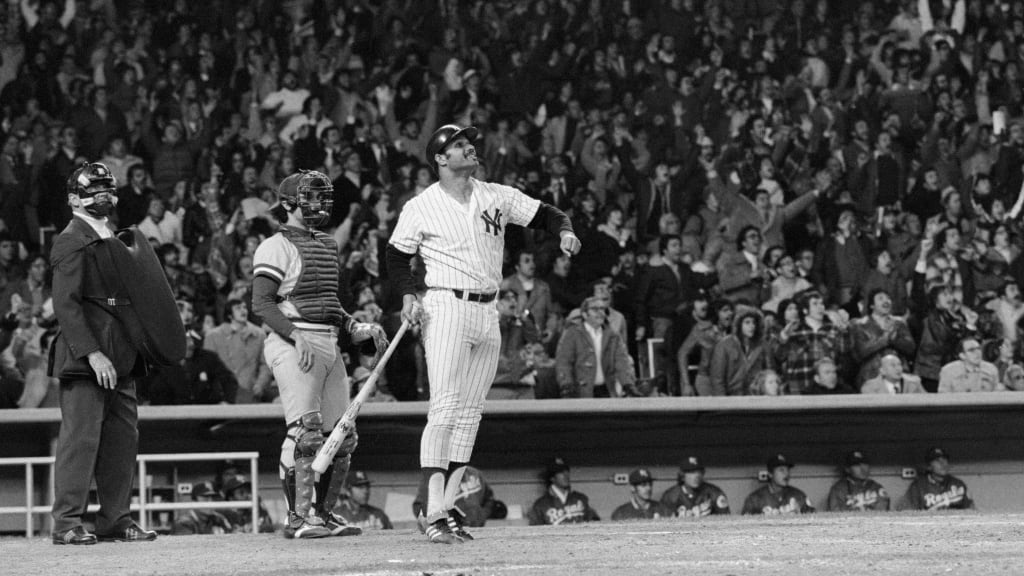
By the time Chris Chambliss stepped to the plate, the pressure of the moment was setting in. Standing in the left-handed batter’s box against Royals right-hander Mark Littell in the fifth and final game of the 1976 American League Championship Series, the Yankees’ cleanup hitter prepared to lead off the bottom of the ninth inning with the score tied, 6-6.
Yankee Stadium had been rocking all night, and the tension of the moment filled the chilly October air. The excitement of a possible return to the World Series for the first time in 12 years spilled over, and the game had to be delayed as overzealous Yankees fans threw debris on the field, giving Chambliss -- and Littell -- more time to think.
It felt like an eternity, and anxiety was starting to take hold.
“It was kind of cold, so I was just standing there waiting to go to bat,” Chambliss recalled recently. “I know Mark Littell was anxious, too, because we just couldn’t get going until the grounds crew picked up everything.”
After all that waiting, Chambliss jumped on the first pitch Littell served up, unleashing a swing born out of preparation rather than impatience. The Yankees’ first baseman got exactly what he was looking for: a high fastball.
Chambliss made solid contact, with the ball traveling over the right-field wall and into Yankees history, as the walk-off home run clinched the franchise’s 30th AL pennant and first since 1964.
With hands raised in the air as he floated toward first base, Chambliss took the most famous home run trot of his career -- one that ended with him sprinting into the home dugout as fans stormed the field in celebration.
With Oct. 14 marking the 50th anniversary of his famous home run, the 77-year-old Chambliss reflected on the moment that would set the table for the Yankees’ return to the top of the baseball world.
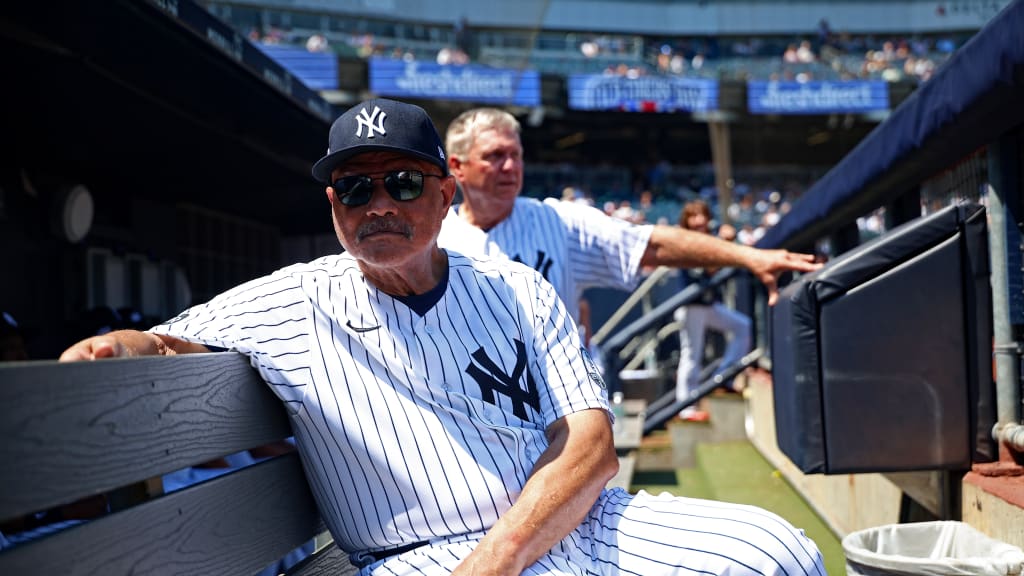
Chambliss was not even sure he would still be a Yankee in 1976. Having arrived in New York via trade from Cleveland in April of 1974, he played 110 games for the Yankees that year, his fourth season as a big leaguer. The Yanks finished 89-73, missing out on postseason play for a 10th straight season, with the team playing home games at Shea Stadium in Queens for the first of two seasons while Yankee Stadium underwent major renovations.
“It was an interesting year for me,” Chambliss says. “As a Yankee, my batting average at the end of ’74 was like .240, but I hit about .250 all year long counting the month that I played with Cleveland. Over the season, the rumors are I’m getting traded. They wanted to get Rod Carew on the club, and it was all in the paper and everything.”
While the future Hall of Fame first baseman Carew did not arrive, and Chambliss remained a Yankee heading into the 1975 season, a diminished role was still a possibility, and Chambliss says the team experimented with the possibility of him splitting time with a pair of right-handed hitters.
“Spring Training, they had Roy White and Lou Piniella playing first base, and they wanted to have a right-handed hitter to play, so they were going to platoon me,” he says. “Roy dove for a ball in Spring Training and jammed his thumb, and then Pinella had this vertigo thing going on.
"All of this happened before the start of the season, so both of them started the season on the disabled list, and they had nobody else to play first base but me.”
Chambliss responded with one of his most productive seasons to that point, hitting .304 and driving in 72 runs, both career bests at the time. He remained entrenched as the starter at first base, even as the Yankees made a change in the dugout.
“The real good news was that, in the middle of the season, Billy Martin became the manager,” Chambliss says. “He never platooned me. So, ’75 for me was kind of like the first year that I really started being a productive hitter driving in runs and stuff.”
While the team missed the postseason again, brighter days were on the horizon as the Yanks returned home to the Bronx. Chambliss produced again in 1976, making his first All-Star Game and finishing fifth in the AL MVP voting after hitting 17 home runs with a career-high 96 RBIs to go along with a .293 batting average.
“Billy hit me fourth in ’76, and that’s something I’m real proud of,” he says. “I had Mickey Rivers, Roy White and Thurman Munson hitting ahead of me. Thurman was the MVP in ’76, Mickey Rivers hit .312 and Roy White was always on base, getting steals with his speed and hitting over .280 himself. All of those guys were on base for me all the time, so I drove in 96 runs, and that was my breakout season.”
It all helped power the Yankees to a 97-62 record in Martin’s first full season in charge. They broke their 11-year postseason drought, winning the American League East and setting up an ALCS matchup with a familiar foe.
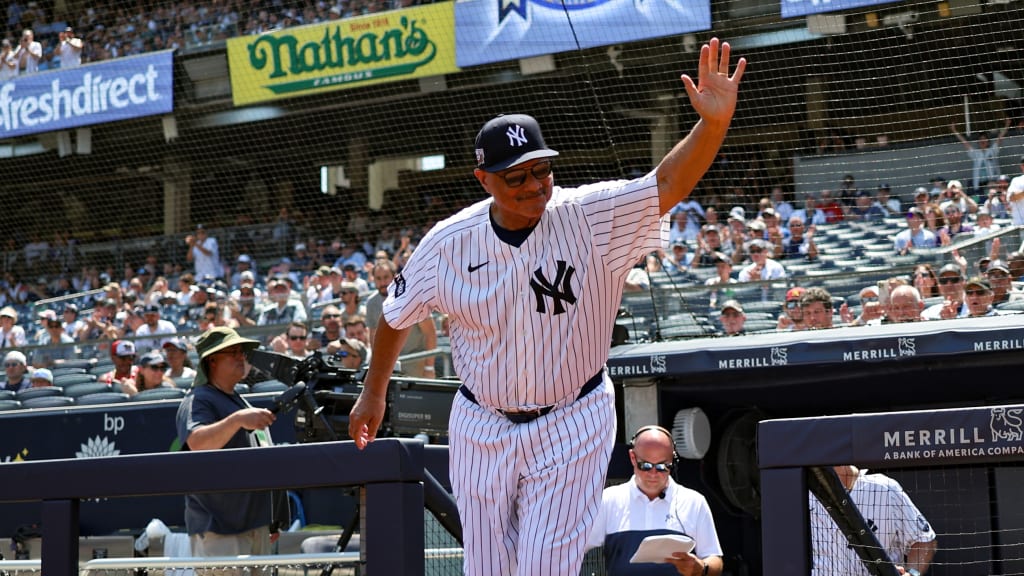
The Yankees and Royals had been on a collision course all season long. By the end of the regular season, New York had spent 174 days atop the AL East, while Kansas City led the West division for 140 days.
Few teams played the Yankees closer that season, with the Royals going 7-5 in their 12 meetings as New York scored a total of 39 runs while Kansas City scored 41.
The ALCS would be no different.
The teams split the first two games in Kansas City, with New York winning the series opener. The Yankees took a 2-games-to-1 series lead with a 5-3 win in the first postseason game at Yankee Stadium in more than a decade, but Kansas City responded with a 7-4 victory to set up a climactic, winner-take-all Game 5.
The Royals jumped out to a 2-0 lead in the opening frame thanks to a two-run homer by John Mayberry. The Yankees responded with two runs of their own in the bottom of the first on an RBI single from White and a sac fly by Chambliss.
The Royals would take the lead back in the second, but Munson and Chambliss would each drive in a run in the bottom of the third to give the Yankees a 4-3 lead. The Yanks tacked on two runs in the sixth thanks to another RBI single from Munson and an error by future Hall of Fame third baseman George Brett that allowed Chambliss to score from second.
Still staked to a 6-3 lead heading into the top of the eighth, Yankees fans could sense that a long-awaited return to the World Series was near, with the crowd of 56,821 on their feet and roaring at every strike thrown by starter Ed Figueroa.
But just as they had all series long, the Royals responded. A leadoff single by Al Cowens chased Figueroa from the game, and after reliever Grant Jackson allowed a single to Jim Wohlford, Brett delivered a three-run shot to deep right field to tie the game at 6-6.
“It wasn’t the first time that we felt like that against them -- we played tough series all season long, and sure enough, that series turned out to be [tough],” Chambliss said. “We had that three-run lead in the eighth, then Brett hit that homer to tie the game. What’s in our mind is, 'Here we go again.'”
With the game still deadlocked entering the bottom of the ninth, Chambliss prepared himself mentally to lead off the inning against Littell. But as public-address announcer Bob Sheppard admonished the raucous crowd and the grounds crew hurried to clean up the debris, the delay gave him added time to assess the situation.
“For it to come down to the ninth and we’re tied, and I’m the first hitter, that was just some kind of moment,” Chambliss says. “And the fans knew it, too.”
Expecting a first-pitch fastball, Chambliss got exactly what he was looking for, delivering a moment most players can only dream about. As the ball fell just over the right-field wall, members of the NYPD opened an outfield gate to get into position to block off the playing field, only to be overrun by jubilant fans.
The celebration was on.
Given the magnitude of the game and the energy of the crowd that night, it’s easy in hindsight to say what happened next was no surprise. Fans flooded the field instantly, all while Chambliss was still trying to round the bases.
“Elston Howard was our first-base coach, and there’s a picture of me throwing my hands up, but right after that I shook Elston’s hand, and I was able to touch first,” Chambliss says. “And there’s a great shot from another angle of a fan right after I touched the base, they ran in there and took the base, first base. I got to second base, and I touched second, and right after that I kind of slipped to a knee and fell, which made me think, What if everybody starts jumping on top of me?
“From that moment, I got up right away and looked up at the third-base area, and it was just nothing but people everywhere.”
One lasting memory for Chambliss is teammate Willie Randolph trying to clear a path, as instincts kicked in for the young Yankee.
“I just remember as a kid, my coaches saying, ‘If you don’t touch all the bases, it doesn’t count,’” Randolph says. “I just lost my mind, because I wasn’t thinking, ‘This is the big leagues, this is unusual.’ I just thought that if he didn’t touch home plate, it wouldn’t count, so I was out there thinking I was a pulling guard, like I was going to run interference for him. I was just trying to make a path for him, as crazy as that sounds with all of these people just going crazy -- and it got scary after a minute because it filled up really quick.”
The plan changed from making it to home plate to simply getting out of the chaos in one piece.
“My first movement was, let’s turn left and get to the first-base dugout -- that was the only thing on my mind,” Chambliss says. “At the time, I didn’t realize it, but when I looked at the film, Willie Randolph was running interference for me, he was knocking people over and getting me into the dugout. That was a great run.”
Randolph says it became clear that it was time to get back to the clubhouse.
“After knocking a couple of people around trying to make way, I finally realized that you better get off the field or you’re going to not be here,” Randolph says with a laugh.
Chambliss ultimately wasn’t able to touch ’em all before heading to the dugout, and Randolph was not the only Yankee who had the same thought.
“I made it to the dugout, we all went into the clubhouse, we’re all celebrating in the clubhouse, and it was probably Graig Nettles -- who was the quickest thinker on the team -- who might have said: ‘Did you touch home plate?’” Chambliss recalls. “And I said, ‘How could I touch it? I didn’t come near home plate.’ So, what I did is, I had a couple cops with me, and I put on a jacket, and we made our way back out to the field, and the three of us walked right through the crowd -- there were people everywhere -- and we walked up to home plate and looked down, and the plate was stolen. It was just completely gone.”
Undeterred, Chambliss did his best to accomplish what he set out to do. “Just the imprint of the plate [was there], so I put my foot on that area and touched it, and we went back into the clubhouse,” he says, laughing. “Some people say the umpires were there, but I doubt it.”
A special moment meant special circumstances. Understanding that Chambliss could not have possibly touched all of the bases, an addition was made to baseball’s constitution for such a situation. Major League Baseball would adopt a new rule, since amended to Rule 5.08 (b), stating: “An exception will be if fans rush onto the field and physically prevent the runner from touching home plate or the batter from touching first base. In such cases, the umpires shall award the runner the base because of the obstruction by the fans.”
It is commonly known as the “Chris Chambliss Rule.”
While the Yankees would get swept in the 1976 World Series by Cincinnati’s “Big Red Machine,” Chambliss’ home run was a preview of things to come. In 1977, the Yankees won their first World Series since 1962, before repeating as champions in 1978.
“I think it was kind of a blessing in disguise when you look back,” Randolph says, reflecting on the defeat in the 1976 Fall Classic. “It really kind of springboarded us to getting back in ’77, and I guess it came true because we went back to back. We knew we were a really good team, and we wanted to show the world that we were much better than getting swept by a great team in the Big Red Machine.”
For Chambliss, the home run easily goes down as the most memorable moment of a 17-year career.
“It’s No. 1, 10 times over,” Chambliss says. “That’s the highlight of my career.”
Robert Hudson is an associate editor with Yankees Magazine. This story appears in the October 2026 edition. Get more articles like this delivered to your doorstep by purchasing a subscription to Yankees Magazine at www.yankees.com/publications.