


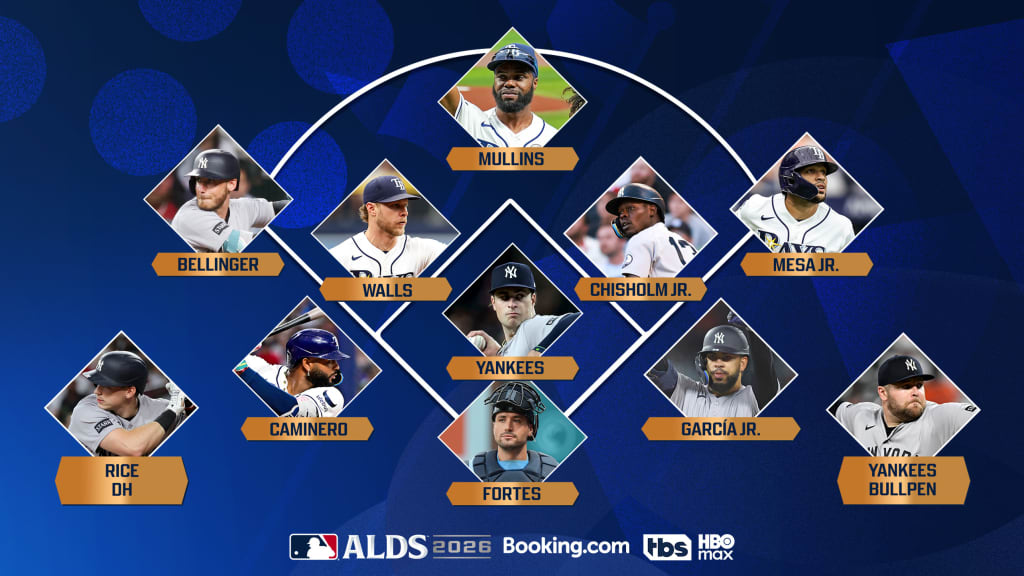
The Yankees and Rays have never met in a postseason series before. OK, that’s not strictly true; in 2020, the Rays did beat the Yankees in the AL Division Series on their way to winning the pennant. But while the wins count, the 2020 of it all should remind you how unusual that was. All five games were played in San Diego’s Petco Park. The official attendance was “zero.”
What we’re going to see this weekend, then, is a first. A fully rocking and renovated Tropicana Field, before a fully rocking and rolling Yankee Stadium. That is postseason baseball, and these two division rivals have never experienced it before.
Here's a position-by-position breakdown of the American League Division Series, which is a lot closer than you might think.
Catcher
Austin Wells, by any objective measure, did not have a good year. When he steps to the plate, the scoreboard will read “.186 average” and perhaps even “74 OPS+” and none of that, really, is any good. Now: We should point out that success in a short series is not so much about who you’ve been all year as it is about who are you right now, and Wells, to his credit, was much better in the second half, to the point that he was 24% better than average as a hitter, and a top-six hitting catcher.
While Wells' second half makes this closer than you would think, the Rays still get the edge because they have both mid-season acquisition Liam Hicks (.801 OPS this season) and Nick Fortes, a competent backstop they’re willing to use. The Yankees, in contrast, don't seem eager to use backup Ali Sánchez if they can avoid it.
Advantage: Rays
First base
With Ben Rice mostly serving as the DH these days, the Yankees roll out a platoon split of Luis García Jr. (vs. righties) and Paul Goldschmidt (vs. lefties), except that with Shane McClanahan injured, it’s possible the Rays will use exclusively right-handed starters in the Division Series.
García (125 OPS+) and Tampa Bay’s Jonathan Aranda (121 OPS+) get to similar production in different ways, with García having a large advantage in slugging while Aranda is superior, by a lot, at simply getting on base. There’s not a lot of daylight between the two, but the Yankees have both a better righty platoon partner (we’ll take Goldschmidt over Ryan Vilade) and stronger defense, so we’ll give them a narrow edge there.
Advantage: Yankees
Second base
The Rays are likely to continue using both Richie Palacios and Ben Williamson, and they have been, for the most part, fine. Palacios, a lefty, hit righties well enough (.748 OPS) and essentially cannot be played against lefties (.158 AVG, .478 OPS). Williamson, a righty, didn’t hit much overall (74 OPS+), and wasn’t actually better against lefty pitching, unusually. Throw in some just-OK defense, and you end up with the 23rd-best second-base situation.
It’s not that Jazz Chisholm Jr. had a great year, but he’s got by far the best hitting track record, to go with good defense, and between José Caballero and Anthony Volpe, the Yankees have multiple platoon options should they need them -- which, again, they may not often, given the righty-heavy Rays rotation.
Advantage: Yankees
Shortstop
Welcome to our first truly tricky decision. Yankees rookie George Lombard Jr. hasn’t hit that much in his first Major League season (92 OPS+), but Rays veteran Taylor Walls hasn’t hit at all, either this year (71 OPS+) or in his six-year career (68 OPS+). He’s actually been the weakest non-catcher hitter in the Majors over the course of his career. Now, for a hitter that ineffective to stick on a good team, you’d expect the defense to be excellent, and maybe it is, but the various metrics are a little split on that. Lombard Jr.’s own reputation for slick fielding took a hit when he committed errors in six consecutive games in August, though it’s been cleaner since.
We don’t feel great about either end here, if we’re being honest -- and given that neither player is a focal point of their respective offense -- we’ll take the shortstop we’re more confident will make the plays given to him. That’s Walls. But not by a lot.
Advantage: Rays
Third base
Junior Caminero hit 42 homers and is likely to end up with a top-five finish in the American League MVP Award balloting. Ryan McMahon is … not.
Advantage: Rays
Left field
We enjoy this one, because you have two valuable players with extremely different styles. Tampa Bay’s Chandler Simpson is maybe the most powerless hitter in the game, but he’s the best contact hitter this side of Luis Arraez, capable of using his elite speed to turn any chance on the bases into absolute chaos, and he’s made tremendous strides on defense, too.
Cody Bellinger is, of course, a far more well-rounded player, if less extremely good at any one thing like Simpson is. Given that Bellinger is a superior defender -- due in no small part to a much better throwing arm -- and has the ability to put one over the fence now and then, he gains the edge, though it would not surprise us at all if Simpson spent the next week driving the Yankees crazy.
Advantage: Yankees
Center field
We’re assuming that Aaron Judge is either not available at all or is coming off the bench, because his presence (or not) will have a lot of repercussions in how Aaron Boone sets his outfield. For the moment, we’ll assume that A) Judge being out and B) the Rays going with so many righties in the rotation means that lefty Trent Grindlinger starts here, as he did against Boston's Sonny Gray on Wednesday. It's been a very weird season for Grisham, who underperformed to start, got very hot in May and June and missed much of September with a hamstring injury. He eventually landed on a very unsatisfying but average-ish hitting season (.211 BA, 95 OPS+), all while his once-excellent defense declined along with his foot speed.
Got all that? Meanwhile, the Rays took a one-year shot on Cedric Mullins, which mostly didn’t work (75 OPS+) outside of a hot June, though his seemingly in-decline defense rebounded to excellent levels. He’s likely to be spotted by righty Jonny DeLuca, who supplied league-average offense and excellent defense of his own; Tampa Bay had baseball’s second-best center-field defense in the game this year. Maybe this all changes if Judge plays and Spencer Jones moves back to center. For now, give us that Rays' defense.
Advantage: Rays
Right field
Again: If Judge is here, throw everything out the window. If the Rays had more lefties, then you’d expect Heliot Ramos to get more chances. Instead, Jones could be the choice here, as he was in Game 2 of the Wild Card Series, and his rookie season has been more or less as expected -- tons of strikeouts, excellent power, OK-ish defense that’s probably a little stretched in center field. If that sounds like faint praise, realize that he was an above-average (105 OPS+) hitter as a rookie, when there were considerable concerns that his strikeout problem would prevent him from sticking at all.
The Rays have their own rookie, though he’s a very different one, as Victor Mesa Jr., acquired from Miami in a completely unnoticed Spring Training deal, has been a revelation, posting a 127 OPS+ in 262 plate appearances and winning a mid-September Player of the Week Award. Like seemingly every other Rays player, his defense has been excellent. Mesa doesn’t really have a strong track record of hitting, and Vilade may spot here at times. Then again, neither does Jones. We can’t overemphasize enough how much this all changes if Judge is here.
Advantage: Rays
Designated hitter
It’s not quite a third-base level of “one guy is in the MVP conversation and the other guy very much is not,” because we’re coming up on nearly a decade now of Yandy Díaz being one of the better hitters in the game. Even at 34 years old this year, he hit 22 homers with a 124 OPS+. He’s a huge part of the Tampa Bay offense. He’s a very good hitter. He’s also not Ben Rice. Not even close.
Advantage: Yankees
Starting Pitchers
The Yankees had the best starting pitching ERA this year -- but the Rays, in third, weren’t far behind. Want to keep it just to the pitchers likely to start in this series? For the Yankees, let's go with their likely top four: Cam Schlittler, Max Fried, Gerrit Cole and Carlos Rodón, in some order. For the Rays, given that it’s not fully clear who starts behind Drew Rasmussen yet, we'll go with five pitchers: Rasmussen, Freddy Peralta, Nick Martinez, Griffin Jax and Ian Seymour. In the second half, that group of Rays pitchers had a Statcast expected ERA (which tries to get past defense and batted-ball luck) that was … almost, to the decimal, identical to what that group of Yankees pitchers produced.
What do you do with that? There’s no wrong answer here. The Yankees have clearly the most dominant overall pitcher here, in Schlittler, but Rasmussen is also likely to be a top-five AL Cy Young Award finisher himself, so he’s not that far behind. While Schlittler won’t start Game 1, he and Rasmussen should both be able to make two starts if the series goes five games. We’re going with the Yankees because we are obligated to pick a side, and in pretty much any time-frame split you can find, it goes “the Rays are truly elite, one of the best in baseball, but the Yankees maybe are the best in baseball.”
If you like starting pitching, you’ve come to the right place.
Advantage: Yankees
Relief pitchers
This, of course, gets tricky. Each team is likely to decide on their primary starters and then deposit the rest here as needed, meaning that it’s difficult to know exactly who will be sitting out in the bullpens, waiting to be called upon. You can use them aggressively, too, given the schedule calls for back-to-back games just one time, that coming between Game 3 and (if necessary) Game 4.
There’s a lot of similarities here. For example: Is there an edge between closers David Bednar and Bryan Baker? Not really; the ERA will say “yes,” but there’s a reason relievers aren’t really judged on ERA, because everything under the hood says “they’re both extremely good and similar.” Both teams have questions about whether or not to roster relievers trying to make it back from injury, those being Tyler Wells and Garrett Cleavinger for Tampa Bay and Ryan Weathers for New York. Neither bullpen, somewhat surprisingly, actually throws all that hard.
There’s lefties galore, for matchups. The Rays will likely have Cam Booser, Cleavinger and Seymour, while the Yankees could have Weathers, Ryan Yarbrough, Brent Headrick and possibly also Tim Hill or Rodón. We are doing our best to describe these bullpens without selecting between them, because really, it’s a strength for both sides. If we’re splitting hairs, let’s really split hairs; in the second half, the New York bullpen added more Win Probability -- which accounts for game context, important for relievers -- than Tampa Bay’s did. It’s not much. It’s what we’ve got.
Advantage: Yankees
Prediction
The Rays won five more games; that mostly holds little predictive value. The Rays got the bye and are better-rested, but the Yankees have plenty of time to reset their rotation, so that mostly doesn’t matter, either. The Rays went 7-6 against the Yankees, and that extremely doesn’t matter, given that it’s basically .500 -- as well as the fact that some of those games came in April when Luis Gil and Steven Matz were the starting pitchers. Nor, really, does it matter that the Yankees won three of four in late September.
We’re going to assume that even if Judge plays, he’s going to be limited in some way. We also expect that there’s going to be one game where the Rays' particular brand of chaos gets them a win they may not have otherwise claimed. In what should be a very tightly-played series, that might be enough.
Prediction: Rays in 5.