



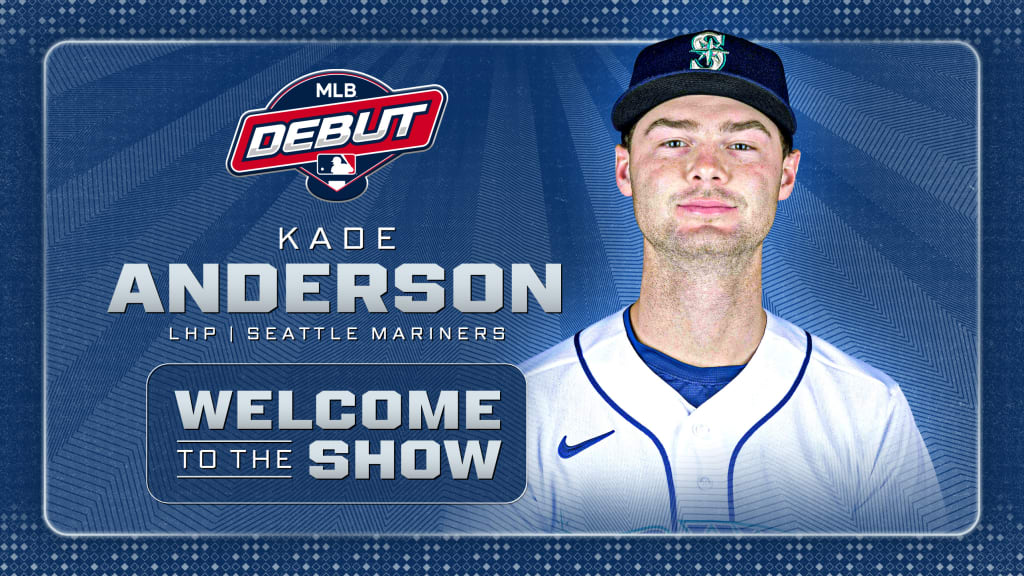
Kade Anderson was the best pitcher in his Draft class after dominating in the top college conference. He went No. 3 overall to the Mariners last year. Yet somehow, he's still managed to exceed expectations.
The 22-year-old made his 18 Minor League starts look absurdly easy, with each one making fans wonder whether he’d get bumped up to Triple-A or straight to the big leagues. And now one of the most highly rated pitching prospects is getting called up to make his big league debut.
MLB Pipeline's No. 5 overall prospect is expected to start for the Mariners on Saturday. In doing so, the 2026 All-Star Futures Game starter for the American League joins a list of top-five prospects like Lucas Giolito, fellow LSU product Paul Skenes and international sensation Roki Sasaki, and he’ll be the first player from the Class of 2025 to reach the highest level.
More from MLB Pipeline:
• Top 100 prospects | Stats | Video | Podcast | Complete coverage
Anderson was coming off 2022 Tommy John surgery that wiped out his senior year of high school when he pitched as a swingman as a freshman at Louisiana State in 2024. He pitched well enough, but certainly didn’t prepare anyone for what he’d do in his sophomore-eligible season. He threw well enough in the fall to land No. 44 on our Draft Top 100 in December ahead of that transcendent season.
By the time Anderson was done dominating the SEC, leading all Division I pitchers with 180 strikeouts in 119 innings, earning Men's College World Series Most Outstanding Player honors as he helped the Tigers win it all, he was the No. 2 Draft prospect in the game. He ended up going third to the Mariners, signing for $8.8 million as the kind of advanced college lefty who would be expected to advance rapidly through a system.
It surprised no one when he was sent straight to Double-A Arkansas to begin his pro career. It was pretty evident right out of the gate that the Texas League was no match for the young southpaw as he allowed just one earned run over four starts in April, striking out 14.5 per nine in 18 2/3 innings. Anyone looking for him to hit a wall of some sort was very disappointed, unless you count his 2.13 ERA and .191 average-against in May -- both his highest monthly marks -- as a stumbling point.
As he prepares to make his big league debut, it’s hard to find a pitching stat he doesn’t lead the Minors in: ERA (1.06), K/9 (13.7), an absurd 10.4 K/BB ratio, K/BB (36.6 percent), BAA (.147), xFIP (2.60). The question of why the Mariners never nudged him up to Triple-A -- it appears they preferred the developmental environment at the level -- is now moot as he’ll try to help the big club cling to playoff hopes, sitting just three games out of a Wild Card spot despite being eight games under .500.
Anderson will attack big league hitters with four at least above-average pitches. If you’re looking for a guy to create a buzz with radar gun readings, look elsewhere. Sure, he can reach back for a 97-mph heater now and again, but he’s comfortable sitting in the 92-94 mph range. The pitch has excellent carry up in the zone, so he still gets 33 percent miss and 33 percent chase on it, according to Synergy.
COMPLETE MARINERS PROSPECT COVERAGE
And that’s not even his best pitch. His mid-80s fading and sinking changeup is virtually unhittable, with a 48 percent miss rate (and 46 percent chase rate) on the plus offspeed offering. He still misses bats with two distinct breaking pitches, a high-spin mid-80s slider he now throws more frequently than his low-80s downer curve. Combined, the breakers have missed bats at a 38 percent clip.
He’s done all that while walking just 1.3 per nine in his debut season, a number that makes his 60 control grade seem light. He enters the big leagues with a 70 percent strike rate. The MLB average this year is around 62 percent. This isn’t just control. His command in the zone has been outstanding with a 4.5 hits-per-nine rate to show for it and Texas League hitters managing just a .166 average on pitches he’s thrown in the zone. That’s a good sign as he faces Major League hitters for the first time; his chase rates are good, but that’s not the only reason he’s put up such gaudy numbers.
Talking to Mariners scouting and player development folks, it’s not the stats or the data that gets them really excited about what Anderson brings to the table. It’s the edge he has when he’s on the mound. He’s been a leader on and off the field from Day 1, and while they knew he could handle top competition after seeing him in the SEC and in Omaha, there’s another level he’s shown they weren’t necessarily aware of. Nice, calm and engaging off the field, there’s a mean streak -- in the best way possible -- when he toes the rubber. The Mariners felt they were getting an advanced, polished arm when they took him. His intensity and desire to win has surprised even those who thought they knew him pretty well and helps elevate those around him.