


Trent Grisham is a free agent, and Yankees managing general partner Hal Steinbrenner recently gushed about his organization's young players. You can read between the lines here: Plenty of opportunity awaits Spencer Jones in 2027.
The hope is that the 25-year-old will build off an encouraging rookie season. A three-week stint at Triple-A in July helped Jones slow the game down. He returned a different player. His 113 wRC+ across the final nine weeks of 2026 was second best among 11 Yankees hitters to take at least 100 plate appearances in that span, trailing only Ben Rice.
- First 31 games: .224/.314/.355 (.669 OPS) and 96 wRC+
- Last 55 games: .254/.312/.459 (.771 OPS) and 113 wRC+
Jones arrived in the Majors as one of baseball's most polarizing prospects. In the Minors, he could slug as well as anyone. At the same time, few hitters struggled to make contact like Jones did.
As it turns out, those same extremes played out during Jones's rookie season, too.
So much of modern hitting is defined by the three true outcomes -- home runs, strikeouts and walks -- and Jones sure fits that bill. More than 48% of his plate appearances ended in one of the three true outcomes, a top-15 rate among all hitters to take at least 200 PA last season.
Very few hitters have an offensive profile like Jones does. It all starts with one of baseball's funkiest swings.
"I know I have a steep barrel, and I know how that plays," Jones told MLB.com on the field at Yankee Stadium in September. "... At the end of the day, your swing is your swing. You've got to go out there and play."
Let's start with the "steep barrel" that Jones mentions. Among hitters to take at least 200 swings last season, only the Tigers' Riley Greene had a steeper swing path than Jones, who had a 44-degree tilt. That sort of uppercut dictates a lot of what Jones can and can't do in the batter's box.
A steep swing path plays exceptionally well against pitches low in the strike zone; the uppercut matches the downwards trajectory of the ball. Sure enough, Jones slugged .674 against pitches in the middle of the strike zone or lower. That was one of the highest slugging percentages against those pitches in all of baseball. For comparison, Aaron Judge -- another hitter with a steep barrel -- slugged .667 against pitches in the middle of the strike zone or lower in 2026.
On the flipside, hitters with steep swing paths tend to be vulnerable against high heat. It's much easier to match the plane of a rising heater with a flat bat path. Jones slugged just .188 against pitches in the upper third of the strike zone. That ranked among the lowest in the Majors. The eight players with a lower slugging percentage against elevated pitches (min. 30 PA) combined for just 30 home runs in 2026.
Jones has plenty of pop. But because of his swing path, that power is largely dependent on where the pitch is thrown.
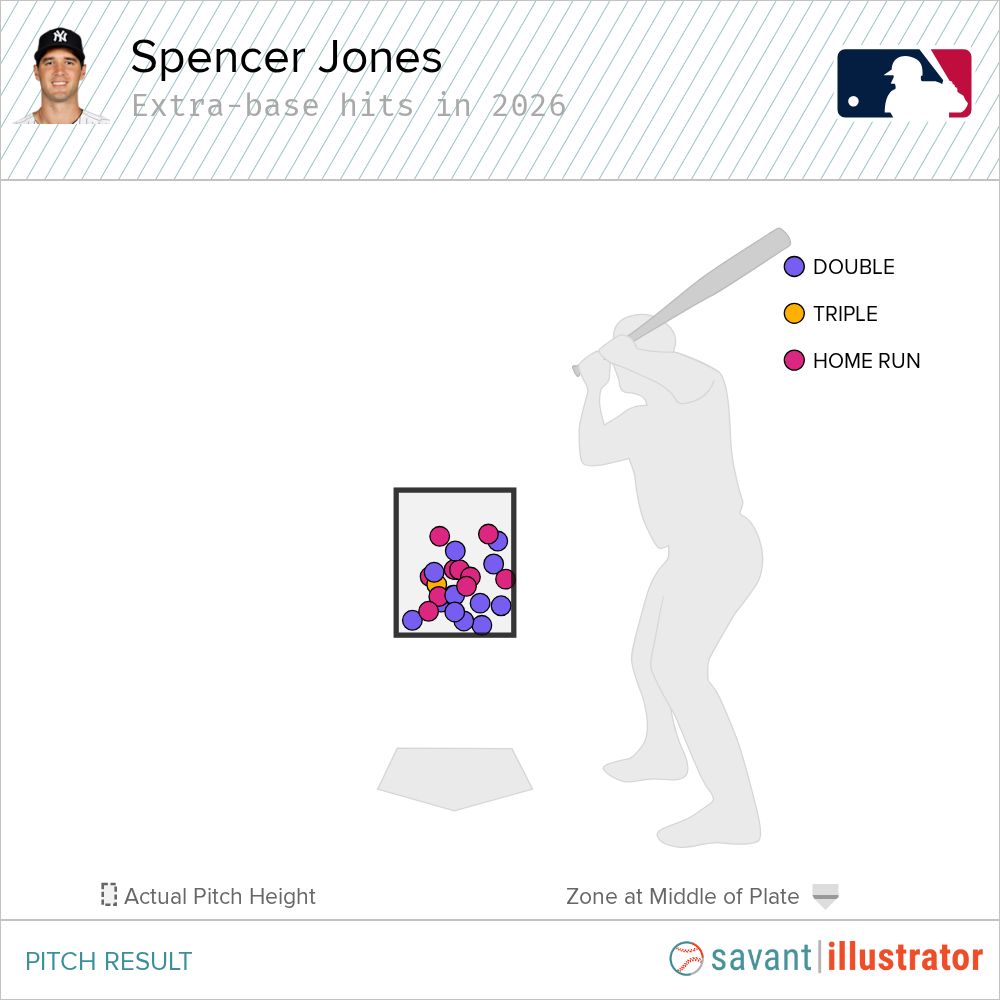
The uppercut also helps Jones lift the ball, allowing him to tap into his power more often. Jones was one of just three qualified hitters to hit more than 73% of his batted balls in the air, along with Rhys Hoskins and Cal Raleigh. But Jones does not think about hitting the ball in the air. Instead, he told me that he thinks about slapping ground balls to the opposite field, a mental cue that actually helps flatten his bat path. Thinking one thing allows him to do something else, which is common in hitting.
There's more to Jones than a steep swing path. Bat speed plays a huge role, too.
Only eight hitters (min. 200 swings) swung a faster bat than Jones last season. His 77.1 mph avg. bat speed was tied with Kyle Schwarber for the ninth fastest swing in MLB. You will not see Jones get cheated. He gets off his 'A' swing far more often than most, with a 71.7% fast-swing rate.
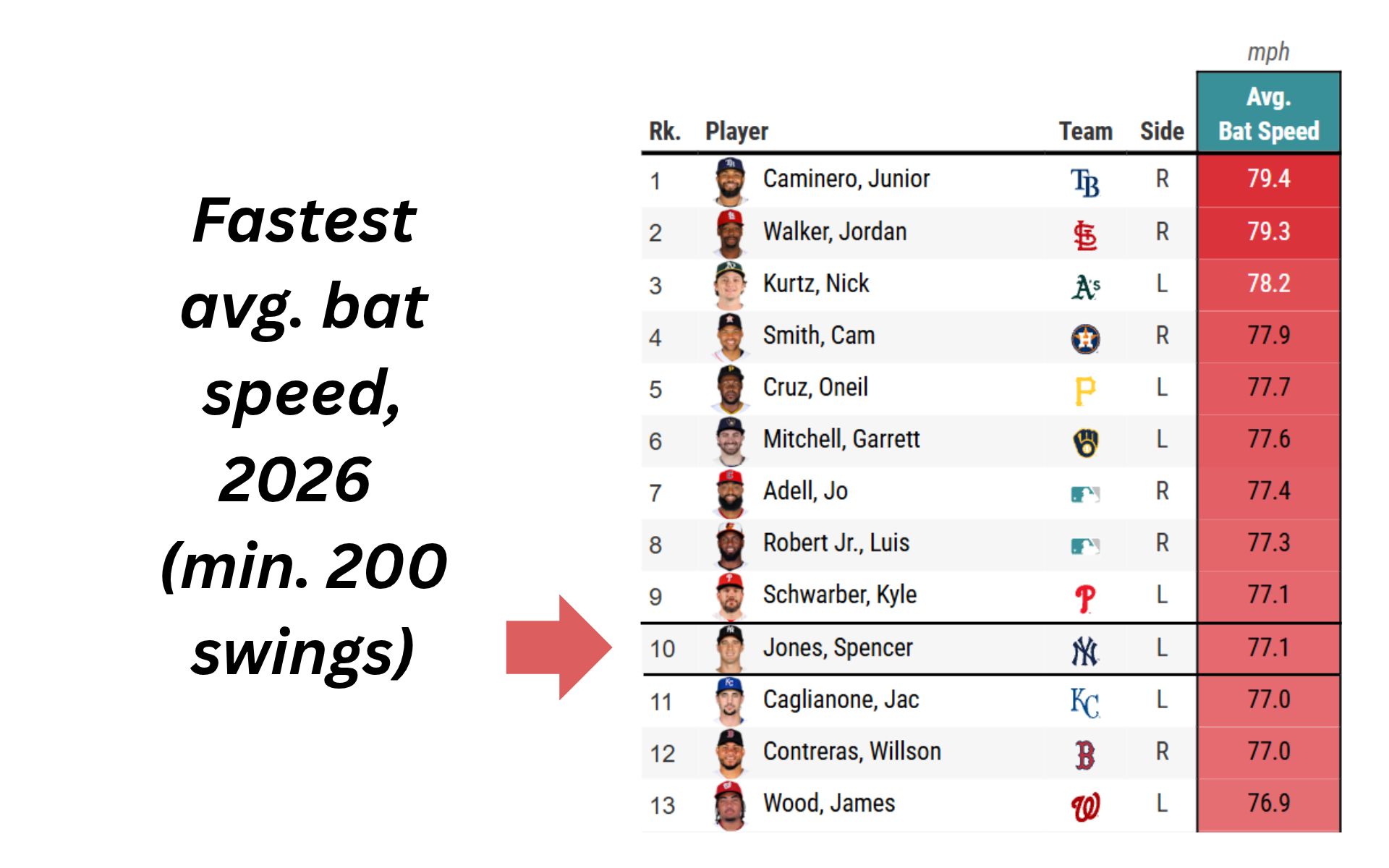
What does elite bat speed help Jones accomplish? Well, for one, it lets him hit the ball extremely hard. Among hitters with at least 150 batted balls, Jones ranked in the top 10 in both hard-hit rate (55.1%) and barrel rate (15.9%).
Jones is 6-foot-7 with plus bat speed, which is to say that he is not built like most hitters. So, he can let the ball travel deep -- seeing it longer before making a swing decision -- and still crush the baseball. He does not have to catch the ball out in front to hit for power, like so many undersized sluggers do. Only Paul Goldschmidt let the ball travel deeper, on average, relative to his center of mass than Jones.
Jones does not need to pull the ball in the air to succeed. He can wait for the pitch and still turn the barrel around, crushing it out to the opposite field. You can see that in the animation below, where Jones makes contact with a four-seam fastball from Cubs left-hander David Peterson behind home plate. And yet, because of plus bat speed, he still sends it out to left field for a home run.
"With some guys, I know that I'll be able to play it deeper," Jones said. "... I'm pretty focused on just hitting balls hard to the other gap and being able to lean on something away. And that's kind of opened up the pull side, so you never know."
We've yet to talk about the other thing here that makes Jones unique, and that would be the swing-and-miss, a staple of his offensive profile. Jones ran a 38.7% whiff rate last season, seventh highest among all players to take at least 200 swings. Those swings and misses came against all different pitch types.
- Jones had the eighth highest whiff rate against non-fastballs
- And the sixth highest whiff rate against fastballs
You may not be surprised to learn that no Yankees hitter has posted a higher swing-and-miss rate in a single season (min. 500 swings) since Joey Gallo in 2022.
For now, this is part of who Jones is.
"I know that's the case in my swing," Jones said. "I know a lot of the loft that I get comes from the uphill hack, so I don't want to run too far away from it. But at the same time, making more contact would help."
It's all a part of what makes Jones one of baseball's most extreme hitters.