



Last winter, we raised a bit of an alarm, noting that the hardest player to find in the offseason was going to be a right-handed bat, specifically outfielders, as it had been decades since we’d had that few regular, righty outfielders with above-average bats. That mostly came to pass; almost every right-handed-hitting outfielder who signed in free agency has failed to make a significant impact thus far.
Now, after what we’ve seen in the first half of the 2026 season, with the Trade Deadline just a few weeks away: You think that was difficult? Good luck trying to find a righty bat this summer – or conversely, enjoy being a rare team with one to offer.
That is, in large part, because there simply aren’t as many right-handed hitters as there used to be. That’s a trend we explored last winter which has really been exacerbated in 2026. Really exacerbated, actually. Reliable data on handedness splits are available dating back to 1974, and for decades, it was something like a 58/42 split, in terms of righties taking more plate appearances.
That ticked down a little in 2024, and a little more in 2025, and it has suddenly absolutely collapsed in 2026, where it’s not quite a 50/50 split, but it’s closer than we’ve ever seen. It’s quite possibly the closest ever, though we can’t say that with certainty.
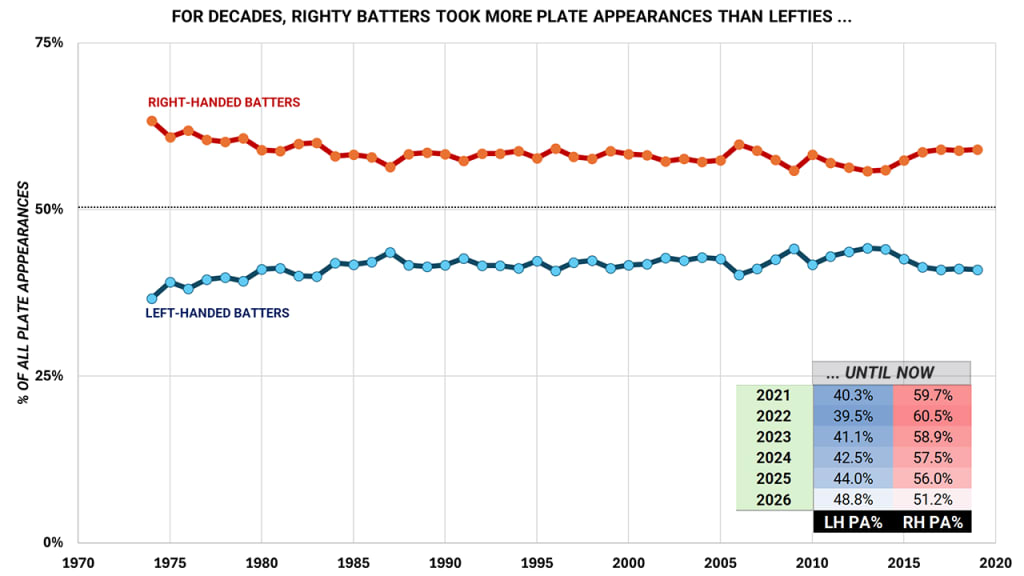
Quite a change from six seasons ago when we got into the decline of the left-handed hitter, isn’t it? The reasons why are more varied than we’ll get into here – keep an eye out for a deeper dive from MLB.com’s Anthony Castrovince on exactly this topic next week – but we have to assume that the 2023 restrictions on defensive shifting had to help a little, though surely not enough to be the entire cause. (Teams weren’t exactly overshifting in 1985, for example.)
There’s a bit of a quality issue, too. While the remaining righties are hitting OK overall, right-handed outfielders are tied with 1997 for the weakest hitting performance in that since-1974 timeframe, continuing a slide that began in 2023.
This, then, is a problem for a team like the Phillies, who have three left-handed All-Stars in Kyle Schwarber, Bryce Harper and Brandon Marsh – and, also, are trending towards the weakest performance by righty batters on record. That’s not hyperbole, either; Philly righties, mainly Alec Bohm, J.T. Realmuto, Trea Turner and Adolis Garcia before he got hurt, have a .271 on-base percentage. That’s a fraction of a point better than the 2014 Mariners (.270) for the weakest of any team’s righties on record.
It’s why the Phillies are so openly talking about needing a righty batter – “they need two,” an anonymous GM told the New York Post – but then again, they’re hardly alone. In a recent roundup of all 30 teams in terms of what they needed most at the Trade Deadline, MLB.com beat writers for the Red Sox, Guardians, Tigers and Marlins each highlighted the need for a righty bat. Elsewhere, we’ve seen rumors that the Mariners would trade a starter for a righty bat, we know the Yankees would prefer a righty-swinging catcher as they look to upgrade their backstop situation, we know that the Braves and Blue Jays each have bottom-six OPS marks from righty batters.
It’s the thing every team seems to want – but how will they all fill that need?
The way things have played out, some of the names we thought might be available probably won’t be.
Mike Trout will now and forever be a popular name, yet he’s shown no indication he’s willing to be traded away from the Angels. The same goes for Byron Buxton, who has repeatedly expressed his fondness for Minnesota, and his Twins are somewhat surprisingly in the playoff race anyway. The Astros have a trio of interesting right-handed names in Christian Walker, Isaac Paredes and Jeremy Peña, but the buzz around them is far more of a buyer than a seller. For a while, maybe you thought the Red Sox could be talked into moving Willson Contreras, yet the way they ended the first half makes that considerably less likely. (And he doesn't want to move, anyways.)
So: Who even is out there? Let’s list a few potential names, and for each, we’ll show their rest-of-season projection from the ZiPS projection system, with wRC+ -- an OPS+ like stat where 100 is "average." That’s right: Even halfway into the season, the projections tell you a little more about what’s to come than first-half performance does. Ordered in terms of best rest-of-season projection to weakest …
C/DH Iván Herrera, Cardinals (rest-of-season projection: 124 wRC+)
Herrera would be the prize of the Deadline hitting crop … if he’s available … which he probably won’t be, given how successful the Cardinals have been, and that he’s an above-average-hitting 26-year-old under contract for three more seasons after this one. But we’re listing him here for a few reasons, none more prominent than the fact that while the Cardinals are indeed in the race, they’re still not viewed as a go-all-in-for-it-right-now roster. It would surprise exactly no one if Chaim Bloom decided he could take advantage of the Deadline's shallow crop of hitters to juice up the pitching help this team needs so badly now and in the future.
Besides: Unlike most teams, St. Louis is deep in catchers. They have three on their roster right now, in fact, with Jimmy Crooks and Pedro Pagés joining Herrera, plus two more on their Top 10 prospects list. Long-term, Herrera might be more of a DH than a catcher anyway, which isn’t as big an issue as it sounds: Catchers are notoriously difficult to trade for in-season due to how hard it is to learn a new pitching staff, but if Herrera is only a part-time backstop or third option as he DH’s for the rest of the year anyway on a new team, that’s not a dealbreaker.
OF Taylor Ward, Orioles (R.O.S. projection: 120 wRC+)
Ward is maybe the most obvious trade candidate here, if only because he’s a free agent following the season. Plus, the Orioles still haven’t managed to get themselves unstuck, though even at 46-51, they’re still just two games out of the final playoff spot. Acquired from the Angels last winter for Grayson Rodriguez, Ward has put together something of a bizarre season, posting mostly the same value (120 wRC+ this year, 117 wRC+ last year) despite completely changing the way he approaches hitting.
We do mean completely. Ward hit 36 homers last year; he has just six now. But his on-base percentage has skyrocketed by 70 points, in part due to his top-five walk rate, itself in part due to having one of the lowest swing rates in the last decade. It all comes out in the wash to “a similarly-valuable hitter,” if one making considerably less noise.
C Ryan Jeffers, Twins (R.O.S projection: 117 wRC+)
Jeffers has been above-average hitter for the last three seasons, then got off to a fantastic start to 2026 (.295/.408/.541) before missing nearly two months after fracturing his left hand on May 18. He’s back now, having appeared twice for the Twins before the All-Star Break, which means there’s time enough for the impending free agent to prove his health for any interested suitors. This, right here, is why we use projections: As great as Jeffers was before he got hurt, six weeks of hitting like Juan Soto does not make a hitter the equivalent of Soto going forward.
Still, Jeffers has a track record of being good, and there’s a very obvious fit for a Yankees team that’s had the weakest hitting performance from behind the plate of, uh, any year in the entire history of the team. They’d hardly be the only suitors, yet the bigger question here is how the next 16 Twins games will inform their Deadline direction -- they enter the second half with a share of the final Wild Card spot.
OF Heliot Ramos, Giants (R.O.S. projection: 110 wRC+)
While it’s teammate Luis Arraez who is most likely to find a new home next month, it’s Ramos who might fit the needs of more teams, given the scarcity of righty hitters. Over the last three years, he’s got a 116 OPS+, which is solidly above average, and that would look even better if his new team primarily used him against lefty pitching, where he’s been excellent (career .857 OPS). He’s not 27 until September, and not a free agent until 2030, so there’s some long-term benefits that come with this, too.
What’s the downside? That youth and contractual control may make the Giants hesitant to move one of their few solid hitters, for one thing; for another, his career mark against righties is much weaker (career .700 OPS); for a third, his defense has generally rated as below-average. As noted: It's not a perfect crop of candidates. Ramos may still help a new team win.
IF Curtis Mead, Nationals (R.O.S. projection: 106 wRC+)
Once best known as being on the wrong side of the trade that sent a pitching prospect named Cristopher Sánchez from Tampa Bay to Philadelphia, Mead is now on his fourth organization, but is still only 25 years old. After three years of generally not hitting for the Rays and White Sox (75 OPS+ in 2023-’25), Mead has had something of a breakout for the Nationals, hitting 17 first-half homers with a 131 OPS+. The argument to keep him is strong; he’s not a free agent until 2031, and perhaps they’ll do just that.
It’s not a fluky improvement, either; hard-hit rate is up, strikeout rate is down. On the other hand, Mead is a below-average defender at both infield corners (he’s one of the weakest defenders overall this year) and the idea of turning a low-level winter trade into both half a season of good production and a possibly decent return – all while knowing the top of the Nationals Top Prospect list is full of infielders – may be too tempting to pass up.
1B Ty France, Padres (R.O.S. projection: 104 wRC+)
We’re now squarely in the realm of “How much do you believe in 2026?” The well-traveled France is on his fifth team in the last two years, and that’s largely because he didn’t hit much in 2024-25, posting a below-average .245/.312/.363 mark, earning him merely a non-roster invite to Padres camp this year. He won a job, and he’s been very good in 2026 (124 wRC+) – which extends to defense as well, where he’s rated as one of the best fielding first basemen for the last two seasons.
So there’s that, the wonder if you’re buying a half-season that didn’t look like previous seasons, and there’s also a whole lot of uncertainty about what the Padres will do at the Deadline. If available, he’s something like an ideal bench bat for a lot of playoff teams.
OF Lane Thomas, Royals (R.O.S. projection: 101 wRC+)
The last two years haven’t gone that great for the 30-year-old Thomas -- already a Deadline mover twice in his career. He never really hit as a Guardian (.189 with a .598 OPS) around a multitude of injuries to his feet and right wrist. Signed to a one-year deal by Kansas City last winter, Thomas has been … fine.
That’s not derogatory so much as the truth; he’s been a league-average hitter and an average fielder, has a valuable throwing arm has helped make up for some below-average range. The sprint speed is again excellent; he’s been one of baseball’s best at not chasing; like Ramos, he’s far better against left-handed pitching. Most importantly, he’s been healthy. If “fine” doesn’t excite you, realize that an average right-handed outfielder is a difficult thing to acquire right now – and that the out-of-the-hunt Royals have no need to keep an impending free agent.
IF/OF Spencer Steer, Reds (R.O.S. projection: 100 wRC+)
You’d think that Steer, 28, and not a free agent until after 2028, would be considered part of the Cincinnati core. On the other hand, this core hasn’t done much winning, with the last-place Reds the only team in the NL Central out of the playoff picture, and so it might be more realistic to think that only Elly De La Cruz and Sal Stewart have solidified their future here. Steer has played five defensive spots this year, and while he hasn't done so to great effect, the versatility is clear and valuable.
Mostly, we think, suitors will appreciate a hitter who is excellent against lefties (career .835 OPS) while still being playable against righties (.721).
OF Jo Adell, Angels (R.O.S. projection: 99 wRC+)
There’s an obvious question here, which is that we don’t really know how the Angels are going to operate, given that they haven’t operated as sellers through most of their decade-long losing streak, and that it’s been less than a month since consultant John Mozeliak took over as interim general manager. Adell, too, is a complicated case. He had one of the best defensive games you’ll ever see, yet routinely rates as a poor outfielder. He’s got truly elite bat speed, yet he’s one of the only top-of-the-scale swingers who’s having a below-average year. He had a breakout 37-homer season year in 2025 and then cut his strikeout rate, but at the cost of 90 points of slugging percentage.
It’s not at all clear what’s to come here: Will the team trade him? What kind of player is he? The questions don't stop there, but it says here that if he were available, some enterprising team would take a chance on a guy with that bat speed, and in the meantime spot him against lefties, against whom he’s clearly stronger.
Bonus, less likely names: 3B Matt Chapman, Giants (has full no-trade clause), RF Seiya Suzuki, Cubs (second-best hitter on a win-now team), C Hunter Goodman, Rockies (All-Star under contract until 2030), DH Miguel Andujar, Padres (no position, having a down hitting year), DH Jorge Soler, Angels (see Andujar), DH/3B Eugenio Suárez, Reds (see Soler).